Will Taiwan's forests disappear in 500 years? Annual use of space bags for mushroom cultivation cuts down 118 forest parks' worth of trees
By Reporter You T-Ru / Special Report
The mobile game "Mushroom Garden" went viral, leading mushroom growers to launch physical space bag mushroom cultivation, sparking an office mushroom-raising craze. But did you know? This method of cultivating shiitake mushrooms using "space bags" made of wood chips could lead to the complete disappearance of Taiwan’s forests in about 500 years.
"In fact, the space bag method of growing shiitake mushrooms isn’t just for enthusiasts—it’s how major mushroom growers in Taiwan cultivate them too," said Yang Junlang, Director of the Mountain Conservation Department at the Citizens of the Earth Foundation. Taiwan, located in a tropical zone, traditionally relied on log cultivation for mushrooms. In recent years, however, growers have shifted to wood chip cultivation in pursuit of profit, making it one of the biggest culprits behind the rapid disappearance of Taiwan’s mountain forests.
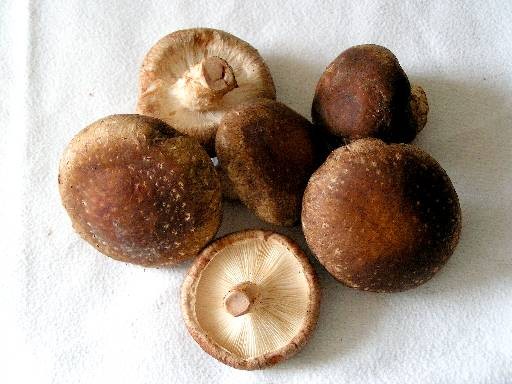
▲Taiwan, being in a tropical zone, actually has very few naturally "edible mushroom" species. (Image / from Wikimedia Commons)
The factory-standardized space bag shiitake mushrooms use a mixture of pulverized wood from various tree species. After extracting a set amount of wood chips, they undergo sterilization to remove bacteria, then have mushroom spawn injected before being sealed in plastic bags to allow "mycelium colonization." Log-grown mushrooms take about six months to a year for colonization, while wood chip mushrooms only need three months, drastically shortening the production time.
"Most growers using wood chips discard the bags after a single use due to extremely low costs," said Yang Junlang. Taiwan’s forest lands lack price regulation, prompting mushroom growers to harvest large amounts of timber to make cultivation materials. It’s reported that the market price for felled timber in Taiwan is only 0.8 NT dollars per kilogram. Calculated the same way, a single space bag weighing an average of 1.7 kilograms costs less than 5 NT dollars to produce when including packaging, spawn injection, and other processes. Yet it sells for around 150 NT dollars in stores, yielding over 20 times the profit.
According to data released by the Citizens of the Earth Foundation in 2008, Taiwan’s mushroom industry logged 2,300 hectares of forest in that year alone for wood chip cultivation—equivalent to 88 Taipei Da’an Forest Parks. Taiwan’s mushroom output value in 2008 was about 7 billion NT dollars. The foundation estimated that from 2008 to the present, the mushroom industry’s output has steadily increased by 500 million NT dollars each year. That means by this year (2013), Taiwan’s mushroom industry output value has exceeded 9 billion NT dollars, with nearly 3,000 hectares of forest felled annually—equivalent to 118 Da’an Forest Parks. If this growth rate continues, Taiwan’s forested mountain areas could completely vanish in another 500 years.
Additionally, the types of mushrooms that Taiwanese can actually "eat" are also quite limited. "When I was young, I only ate black fresh shiitake mushrooms and black fungus—I had never even seen king oyster mushrooms," said Yang Junlang, 43, reflecting on his "mushroom-eating life." He first tried the then-expensive enoki mushrooms at age 25, and only started seeing king oyster mushrooms in the past decade.
"Enoki and king oyster mushrooms are actually cold-climate species—they simply can’t be cultivated in Taiwan’s climate," Yang explained further. Due to Taiwan’s tropical location, the most suitable native mushrooms are the commonly seen fresh shiitake and black fungus. Species like enoki and king oyster, which have become popular in recent years, are actually grown in "air-conditioned environments." There are three major downsides to air-conditioned mushroom farming: first, the high carbon emissions from the air conditioners themselves; second, the dryness of these environments forces growers to water heavily, often using groundwater pumped from wells; and third, these air-conditioned farms are usually built on farmland. Once farmland is paved with cement, it becomes permanently "dead land."
"What we can do now is first choose the right kinds of mushrooms to eat—reduce consumption of king oyster and enoki mushrooms and other 'non-Taiwanese mushrooms.' Second, stop buying space bag mushrooms to prevent further large-scale deforestation," he said. Make the right dietary and consumption choices to vote for your living environment and protect Taiwan’s mountain forests. Otherwise, one day, Taiwan may not only face deforestation, but also the loss of land, farmland, and wildlife.
Editor’s Note:
This article does not aim to attack Taiwan’s mushroom farmers. In fact, Taiwan’s mushroom industry has made the country the world’sIt is hoped that the central government will amend regulations to strengthen the management of "agricultural and pastoral land," and promptly promote certified legal logging while eradicating illegal logging. At the same time, it is also hoped that relevant industry players will develop wood chip alternatives to reduce tree felling. There is a call for changes in government and social policies, production methods, and consumption patterns. Eating mushrooms may not be wrong, nor is growing them, but when the production and consumption processes clearly incur significant environmental costs, should we not reconsider the forms of the industry and consumption to reduce damage to mountain forests?
The reporter of this article conducted an exclusive interview on April 12, 2013, with Yang Jun-lang, Director of the Mountain Conservation Department at the Citizens of the Earth Foundation, obtaining data on the annual increase in Taiwan’s mushroom production value and output from him as the source of information within the text. Below, the reporter refers to and excerpts the "How Much Forest Are We Consuming? — Research Report on Taiwan’s Logging-for-Mushroom Cultivation Issue" published by the Citizens of the Earth Foundation in March 2009, providing the following brief summary response regarding the sources of wood chips.
I. Sources of Wood Chips in Taiwan:
Mushroom farmers tend to use Acacia wood chips as the main material for shiitake mushroom grow bags; native broadleaf tree chips such as tung oil trees and Chinese sumac are used as the main materials for king oyster mushrooms, enoki mushrooms, and other types of mushroom grow bags—referred to in the industry as mixed wood. The sources of wood chips for grow bag manufacturers in Xinshe Township, Taichung County, mainly come from Hsinchu and Miaoli regions; those in Puli Township and Yuchi Township, Nantou County, mainly come from Pingtung and Taitung regions. Andthere are four main ways to obtain timber. The first is through legally approved logging in "forest land," covering an area of about 500–700 hectares; the second is logging in "agricultural and pastoral land," which is not strictly regulated; the third source is trees provided during the site preparation process of "development projects," such as industrial parks, science parks, high-speed railways, and golf courses; the last is "illegal logging."
II. Regarding Agricultural and Pastoral Land:
Agricultural and pastoral land on indigenous reservations covers nearly 72,000 hectares across Taiwan. However, much of this land is not used for agricultural or pastoral purposes and, under natural vegetation succession, has formed excellent forest cover, providing another source of timber for logging.Since logging on agricultural and pastoral land is not regulated under the Forest Law, the Forestry Bureau does not keep statistics on the area of logging in such land, and local governments must be consulted for information. After submitting official documents and calling various county and city governments to request relevant data, only a few local governments have rigorous management over logging on agricultural and pastoral land. It is understood that currently only Pingtung County has implemented controls and has statistical data. According to data from the past five years: the logging area on “agricultural and pastoral land of indigenous reservations” in Pingtung County is approximately 40 hectares per year, averaging 1,400 cubic meters per year; in 2007, Pingtung County approved a logging area of 55.27 hectares, of which 17.62 hectares were forest land and 37.65 hectares were agricultural and pastoral land. Taking Pingtung County as an example, the logging area on agricultural and pastoral land of indigenous reservations is significantly larger than that on forest land, suggesting similar situations may exist in other counties and cities, making it the largest source of wood chips for the mushroom industry.
III. Composition of Grow Bags:
The main ingredient of grow bags is wood chips, accounting for about 75% of the total weight of the bag, while auxiliary materials include rice bran, wheat bran, flour scraps, soybean meal, cornmeal, calcium carbonate, etc., making up about 25% of the total weight. Except for calcium carbonate, which is used to adjust pH levels, the rest serve as nutrient sources. Therefore, for each one-kilogram grow bag, there are approximately 0.75 kilograms of wood chips.
IV. Relationship Between Shiitake Mushroom Grow Bags and Wood Chip Sources:
According to estimates by the Edible Fungi Research Laboratory of the Agricultural Research Institute, Taiwan uses about 473 million mushroom grow bags per year. Calculating with about 0.75 kilograms of wood chips per bag, the total wood chip usage amounts to 354,740 metric tons. Furthermore, based on the experience of wood chipping operators, one hectare of land can produce about 100 to 200 metric tons of wood chips, averaging around 150 metric tons. It is estimated that the forest area logged annually for mushroom cultivation is about 2,367 hectares—equivalent to two Kaohsiung Shoushan areas or 88 Da’an Forest Parks.
However, according to the Forestry Bureau’s annual statistics on logging area, the figure is only between 500–700 hectares (1998–2007). The huge discrepancy in between is very likely due to agricultural and pastoral land. Yet,Whether in forested areas designated for woodland or agricultural and pastoral use, according to forest surveys and interviews with logging operators, the current forest stands used for mushroom cultivation are mostly secondary forests. Loggers admitted that a small portion of these are primary forests. Since logging sites are not located in urban areas, transportation infrastructure is not well-developed, and forest roads must be developed before any logging can take place. If the logging site is steep and far from existing forest roads, newly constructed roads will zigzag across the mountainside for hundreds of meters, causing considerable damage to soil and water conservation.
Share
This article is published by HowToTrip. Sharing and reposting are welcome — please credit the source.
Article URL: https://www.howtotrip.net/views-28866
Related Articles
- Shaoxing's "Grandpa Gourd" hangs the gourds back up: "If there are too many people, we'll interact less — just take a quick look from afar"
- Chinese authorities announce "reciprocal adjustment" to Japan visa fees — single-entry visa jumps from 2,250 to 16,750 yen!
- The "health stones" carried by a traveler were found to have radiation levels exceeding safety limits by a thousand times, potentially endangering fellow passengers on the same flight. Customs issues warning!
- Shenzhen Airport Issues Late-Night Notice: Unidentified Aerial Object Detected, Causing Widespread Flight Delays!
- “They only said it cost money after I opened the box and washed it!” 200g of grapes sold for 60 yuan on a high-speed train—12306 responds!
- Can't buy an airline ticket? Denied exit? Blocked from boarding? A large number of Chinese tourists have mysteriously become "discredited individuals"
- Adverse weather and economic fluctuations impact Colombia's coffee market
- Beach bathing area responds to 2 yuan/30 seconds fee for freshwater foot rinsing: Clearly priced!
- Taking off with an improperly closed cabin door? Wing malfunction? Multiple flights made emergency returns mid-journey!
- Experience the gifts of nature! A countdown of the world’s ten most stunning coastlines