Discover the Lost "Edirne" – Relive the Glory of the Ottoman Empire
Reported by Hong Lingju / Special Feature
How far is it from Asia to Europe? In Turkey, which spans both continents, you can have breakfast in Europe and enjoy a meal in Asia by evening. The Bosphorus Bridge in Istanbul is an important link between the two continents. In this country, known as the "Cradle of Civilization," various eras including Ancient Greece, Rome, Byzantium, and the Ottoman Empire have left their mark. As time passes, the splendid cultures of the past have become today’s world cultural heritage. Aside from visiting Istanbul, Turkey’s top city, the nearby Edirne is also a travel destination not to be missed.
%... (unreadable segment, preserving original characters) ...is still an important city today, especially as it is located in the... "first..." area, attracting many visitors. (#, referring to a link hhh="http://www.tursab.org.tr/en" target="_blank">tursabwebsite)
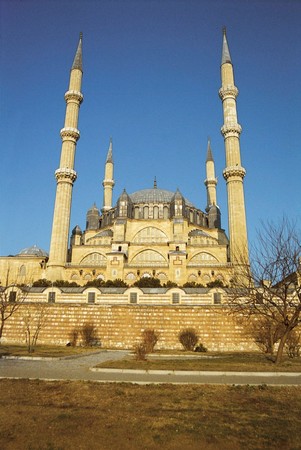
Located about a two-and-a-half-hour drive from Istanbul,Edirne (Edirne) is the westernmost city in Turkey and served as the capital of the Ottoman Empire from 1365 to 1453.This ancient city, centered around the "Selimiye Mosque," may no longer have the bustle of a major metropolis, but strolling through its streets offers a sense of tranquility. Especially in the morning, the serenity helps travelers find inner peace, slow down, and observe the surroundings more closely.
Walking through the streets of Edirne, you might turn a corner and come across a century-old house still lived in, creating a striking contrast with the modern cars passing by. Or, due to unique historical reasons, you might discover a bridge built during the Roman era — an adventure akin to treasure hunting that leaves a deep impression on travelers. If you’re not in a hurry, take a walk to the "Meriç Bridge," located between the city center and the Greek border, sit at a restaurant by the bridge, enjoy a coffee, and take in the view — an experience that is incredibly relaxing.
Visit the Pride of Architectural Master Sinan
Sinan, who is as renowned as Michelangelo, was a master architect of the 16th century. He built countless structures for Muslim sultans throughout his life, but his most cherished masterpiece is the Selimiye Mosque, completed in 1574. At first glance,the Selimiye Mosque may bear some resemblance to the Blue Mosque, but it is not an imitation. In fact, the Blue Mosque was built in 1616, and more accurately speaking, the Selimiye Mosque served as the model for most mosques in Turkey, including the Blue Mosque.。
The Selimiye Mosque, with its minimal decoration, has a simple yet dignified exterior. No matter where you are in the city, you can look up and see its four minarets, each over 85 meters tall. Inside the mosque, Sinan employed geometric design principles to create a symmetrical, distinct, and simple architectural style — featuring arches, arcades, a rectangular courtyard, and tall columns. The white marble-carved walls and pulpit, complemented by stained glass windows, are truly breathtaking. Particularly noteworthy is the massive central dome, one of the greatest features of Turkish mosques. The central dome of the Selimiye Mosque has a diameter of 31 meters, even wider than that of Istanbul’s Hagia Sophia.
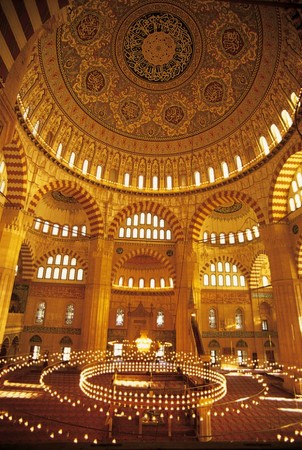
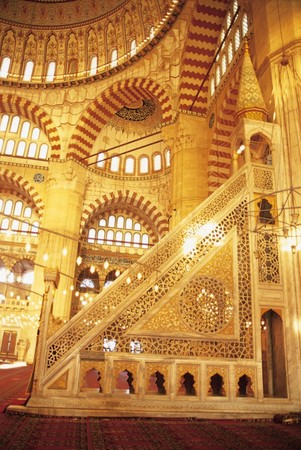
▲ Geometric and symmetrical architectural style is a hallmark of the Selimiye Mosque. (Photo / fromtursabwebsite)
Health Museum – The Enlightenment of Modern Psychiatric Medicine
A "külliye," a distinctive feature of Turkish architecture, centers around a mosque as its core complex. The külliye of the Selimiye Mosque includes an Islamic school, a covered bazaar, a clock tower, an outer courtyard, a library, and also a hospital that has been in operation for 400 years. Today, it serves as the Bayezid II Külliye Health Museum, offering insights into medical developments during the Ottoman Empire.
Interestingly, this hospital specialized in treating mental illnesses, using music, water, and scents to aid in patient healing. When visitors step into the Health Museum, they encounter vivid simulated scenes — with wax figures playing the roles of doctors, musicians, and pharmacists — revealing that psychological therapy was practiced back then. The museum is the second most visited historical site after the Selimiye Mosque.
Related Travel Agency Itineraries
Lion Travel: "Troy, Pamukkale, Underground Cities, World Heritage 10-Day Tour"
Phoenix Travel: "Turkey's Safranbolu 11-Day Tour with Jeep Safari (Includes Flight)"
Golden Expo Travel: "Award-Winning Turkey 11-Day Tour: Istanbul, Cappadocia, and More"
Southeast Travel: "Enchanting Turkey 10-Day Tour – 3 Nights in 5-Star Hotels, Troy, Rock City, Saffron Capital, Belly Dancing"
Turkey Travel Information
● Population: 78 million
● Climate: Mediterranean climate zone, wet winters and dry summers, temperate.
● Flights: Fly with Turkish Airlines (www.turkishairlines.com), via Hong Kong or Bangkok to Istanbul. Turkish Airlines Taiwan branch phone: (02)2756-0849.
● Visa: You can obtain a visa on arrival at the airport for a fee of $15–20 (approximately NT$453–603).
Apply for an e-visawww.evisa.gov.tr
● Time difference: -5 hours from April to October, -6 hours in winter
● Exchange rate: 1 Turkish lira ≈ 16 Taiwanese dollars; euros are also widely accepted locally
Related information
★ Selimiye Mosque – Free entry
★ Bayezid II Külliye Health Museum – Admission 10 lira (approximately NT$160)
Share
This article is published by HowToTrip. Sharing and reposting are welcome — please credit the source.
Article URL: https://www.howtotrip.net/views-28415
Related Articles
- Shaoxing's "Grandpa Gourd" hangs the gourds back up: "If there are too many people, we'll interact less — just take a quick look from afar"
- Chinese authorities announce "reciprocal adjustment" to Japan visa fees — single-entry visa jumps from 2,250 to 16,750 yen!
- The "health stones" carried by a traveler were found to have radiation levels exceeding safety limits by a thousand times, potentially endangering fellow passengers on the same flight. Customs issues warning!
- Shenzhen Airport Issues Late-Night Notice: Unidentified Aerial Object Detected, Causing Widespread Flight Delays!
- “They only said it cost money after I opened the box and washed it!” 200g of grapes sold for 60 yuan on a high-speed train—12306 responds!
- Can't buy an airline ticket? Denied exit? Blocked from boarding? A large number of Chinese tourists have mysteriously become "discredited individuals"
- Adverse weather and economic fluctuations impact Colombia's coffee market
- Beach bathing area responds to 2 yuan/30 seconds fee for freshwater foot rinsing: Clearly priced!
- Taking off with an improperly closed cabin door? Wing malfunction? Multiple flights made emergency returns mid-journey!
- Experience the gifts of nature! A countdown of the world’s ten most stunning coastlines