Taiwan’s One-of-a-Kind Sound: Grandma Sun-Drying Peanuts in Penghu
Text and photos /“Obailai Travel Observation Diary”by Tsai Fa-da
The grandma picks up peanuts with both hands, sorting through them to make sure they dry evenly.
“Peanuts used to play a very important role for us people in Penghu. ‘Luzaimou’ (in the Penghu dialect of Taiwanese, ‘you’ is pronounced something like lu-san?),” she says as she flips over the peanuts.
“Isn’t it just for eating? What can you do with peanuts? Why are they so important?” I asked back, thinking to myself (they’re everywhere on Taiwan proper, even as a side dish with meals, but they give you acne and are so greasy—I don’t like them).”
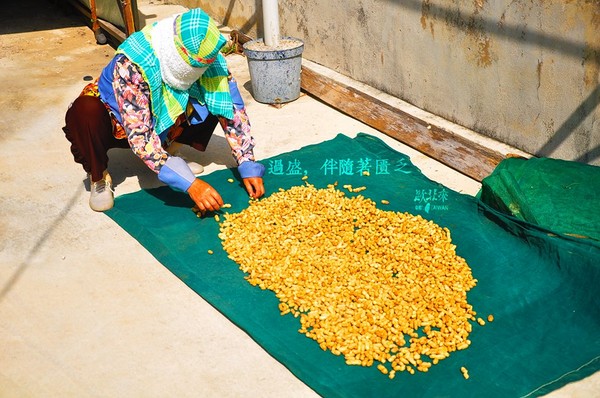
Grandma: “Back then we didn’t have oil. The oil we used for cooking here used to be ‘imported’ from Taiwan—it was expensive. When you stir-fry peanuts, they produce a lot of oil. For us, their value as a source of oil was greater than their function as something to ‘eat.’” Me: “Ah… I never thought about that before…”
Grandma: “Hey now, you city folks, because things here aren’t so convenient. So when you go out to eat, take a look—you’ll notice a lot of dishes have peanuts stir-fried in them. These days oil isn’t as hard to come by as it used to be, but over time everyone’s gotten used to it; without peanuts, it feels like something’s missing.”
Grandma’s talk about cooking with peanuts was immediately reflected in that day’s lunch. As I looked at the dishes on the table, taste became secondary. Instead, I found myself savoring this local Penghu story with genuine appreciation.
When we have abundance, our gratitude for things that are “hard-earned” gradually fades. “Excess often comes with its own kind of scarcity.”
Every place has its own unique way of life. Have you also heard the one-of-a-kind sounds from different places?
Share
This article is published by HowToTrip. Sharing and reposting are welcome — please credit the source.
Article URL: https://www.howtotrip.net/views-26346
Related Articles
- Shaoxing's "Grandpa Gourd" hangs the gourds back up: "If there are too many people, we'll interact less — just take a quick look from afar"
- Chinese authorities announce "reciprocal adjustment" to Japan visa fees — single-entry visa jumps from 2,250 to 16,750 yen!
- The "health stones" carried by a traveler were found to have radiation levels exceeding safety limits by a thousand times, potentially endangering fellow passengers on the same flight. Customs issues warning!
- Shenzhen Airport Issues Late-Night Notice: Unidentified Aerial Object Detected, Causing Widespread Flight Delays!
- “They only said it cost money after I opened the box and washed it!” 200g of grapes sold for 60 yuan on a high-speed train—12306 responds!
- Can't buy an airline ticket? Denied exit? Blocked from boarding? A large number of Chinese tourists have mysteriously become "discredited individuals"
- Adverse weather and economic fluctuations impact Colombia's coffee market
- Beach bathing area responds to 2 yuan/30 seconds fee for freshwater foot rinsing: Clearly priced!
- Taking off with an improperly closed cabin door? Wing malfunction? Multiple flights made emergency returns mid-journey!
- Experience the gifts of nature! A countdown of the world’s ten most stunning coastlines