Cross-Strait Smart Tourism Summit Forum Online Travel Scale in Mainland China Has Grown by 30%

▲(From left)Yeu Chang-Sung, Chairman of the Information Management Society, Gao Xinmin, Vice President of the Internet Society of China, Liu Xilin, Vice President of the Association of Tourism Exchange Across the Taiwan Straits, Chen Jiazhong, Executive Director of Taiwan Internet and E-Commerce Industry Development Association (TIEA), Liu Xiaohui, Deputy Editor-in-Chief of the Cross-Strait Relations Magazine, and Li Jianping, Deputy Director of the Taipei Office of the China National Tourism Administration.
Reported and photographed by Chen Rui-Zhong / Taipei
As the saying goes, "Reading ten thousand books is not as good as traveling ten thousand miles." Personal travel experiences often bring emotional insights that cannot be obtained online. So how do virtual internet technologies such as apps, online auctions, and Facebook relate to travel? With the development of internet technology and smartphones, tasks like booking accommodations or accessing travel information can now be done with just a few clicks. However, the future of smart tourism hopes to utilize the boundless nature of the internet to offer more refined and human-centric technological services for travel.
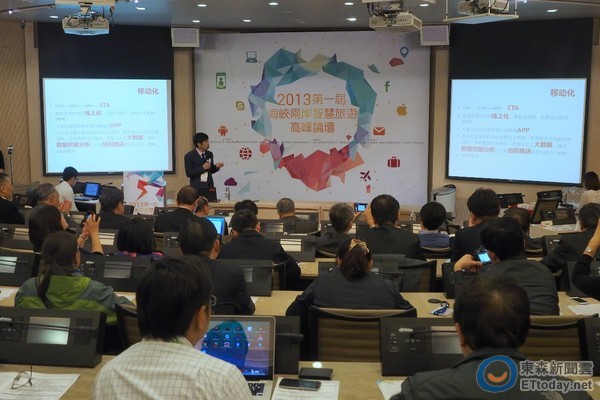
▲The event venue of the First Cross-Strait Smart Tourism Summit Forum.
 %Mubing Dou Pi Da Jiuzi Qian Can Yu Canyuan Canyu Liao Di Yi Jie Huan O Ke Lie Zhuang Meng Lu You Te Sheng Jiao Yi Chang.
The "First Cross-Strait Smart Tourism Summit Forum," organized by the Internet Society of China, Taiwan Network, Information Management Society, and Taiwan Internet and E-Commerce Industry Development Association (TIEA), was held on December 10, 2013, at the Taipei Campus of the College of Continuing Education, Chinese Culture University. It attracted over 150 industry professionals from both sides of the Strait.
The conference focused on discussing the current state and prospects of informatization in Taiwan and Mainland China, the alignment of the cross-strait tourism market in the e-commerce era, the development of the tourism industry in the digital commerce age, online and digital marketing strategies for tourism to Taiwan, and the creation of an information-based and trustworthy tourism market.

%Nai Gong Qian Lian Bangong Shi Zhu Ren Ren Wei, Qiang Meng Lv You Bu Jin Jin Shi Yi Ge Lv You Xiang Mu, Ye Yao Neng Tigong Ren Men Zhi Jian De Hudong.
Taiwan Association of Tourism Exchange Across the Taiwan Straits Vice President Liu Xilinstated that with the high development of the internet today, people can hardly live without their mobile phones. A lot of travel information is no longer obtained through in-person visits to stores or word of mouth but is searched online. Additionally, online marketing and shopping models have also transformed the way people travel.
Liu Xilin also pointed out that smart tourism should not merely involve providing QR codes for querying scenic spot information, but should offer a complete package and service covering the pre-, during, and post-travel phases to deliver the most comprehensive experience. He also hopes that smart tourism can help maintain interpersonal interactions.

%Nà Zhōng Guó Wǎng Lù Xié Huì Gāo Jí Huì Zhǔ Xuān Zhě Gāo Xīn Mín Zhù Zhòng Fā Bìàn.
Gao Xinmin, Vice President of the Internet Society of Chinastated that with the advancement of internet technology, both sides of the Strait now look forward to greater cooperation and exchanges. The tourism industry is one of the five major fields of internet application. According to statistics from the Internet Society, the online travel market transaction scale in Mainland China reached 172.97 billion yuan in 2012, an increase of 31.6% from 131.39 billion yuan in 2011, and this growth is expected to continue.
Additionally, Gao Xinmin noted that smart tourism is about providing better travel services. Therefore, three key components—tourism-related enterprises, tourism administrative bodies, and traveler services—need to be integrated through internet technology, which will be conducive to the development of smart tourism. However, the challenges faced by smart tourism and the solutions required will need ongoing discussion to drive further progress.

%Nà Táo Shāng Lǐ Huì Yǐn Yòng Qí Tài Wān Yè Lǐ Yǒu Xiàng Dòng Zhǔ Rèn Zhāng Píng Zhǎo.
Zhang Pingzhao, Chairman of the General Chamber of Commerce and the Taiwan Service Industry Alliance Associationalso pointed out that tourism is a crucial economic industry for Taiwan. Whether it’s the convenience brought by online travel information witnessed during his time in the United States, or observing the rise and fall of traditional grocery stores in Taiwan years ago, it is evident that changes in lifestyle and technology inevitably influence consumer habits and patterns. E-commerce and smart tourism are trends that must be embraced.
Share
This article is published by HowToTrip. Sharing and reposting are welcome — please credit the source.
Article URL: https://www.howtotrip.net/views-25713
Related Articles
- Shaoxing's "Grandpa Gourd" hangs the gourds back up: "If there are too many people, we'll interact less — just take a quick look from afar"
- Chinese authorities announce "reciprocal adjustment" to Japan visa fees — single-entry visa jumps from 2,250 to 16,750 yen!
- The "health stones" carried by a traveler were found to have radiation levels exceeding safety limits by a thousand times, potentially endangering fellow passengers on the same flight. Customs issues warning!
- Shenzhen Airport Issues Late-Night Notice: Unidentified Aerial Object Detected, Causing Widespread Flight Delays!
- “They only said it cost money after I opened the box and washed it!” 200g of grapes sold for 60 yuan on a high-speed train—12306 responds!
- Can't buy an airline ticket? Denied exit? Blocked from boarding? A large number of Chinese tourists have mysteriously become "discredited individuals"
- Adverse weather and economic fluctuations impact Colombia's coffee market
- Beach bathing area responds to 2 yuan/30 seconds fee for freshwater foot rinsing: Clearly priced!
- Taking off with an improperly closed cabin door? Wing malfunction? Multiple flights made emergency returns mid-journey!
- Experience the gifts of nature! A countdown of the world’s ten most stunning coastlines