Hiking Ancient Trails Amidst Silvergrass & Soaking in Warm Springs in Jinshan
Text %q Yang Peiqi, Photo %q Gao Dajun
The rolling hills are blanketed with silvergrass, swaying like waves in the wind, while winding mountain paths meander through the landscape, dotted with relics such as ancient stoves and irrigation channels. Once an important transportation route between Jinshan and Shilin in Taipei, the Jinkalie Trail has now become a popular hiking destination,especially in autumn when the silvergrass blooms, making a stroll through the mountains an exceptionally pleasant experience; after the hike, you can also unwind nearby in Jinshan’s hot springs to soothe your muscles—an absolute delight.
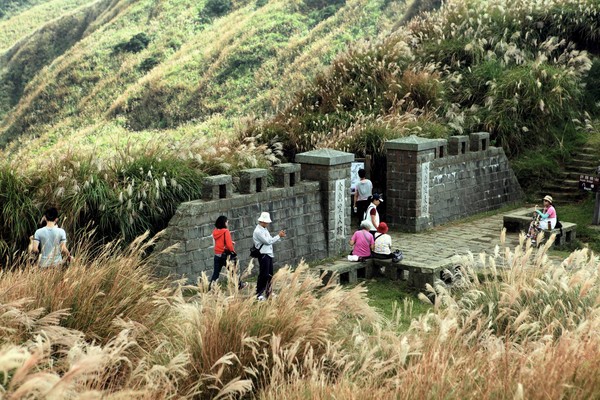
▲Vast fields of silvergrass and mountain mist compose an autumnal poetic grandeur.
The Jinkalie Trail, an ancient path once connecting Jinshan to Shilin, was originally a trail used by indigenous people for hunting and foraging. After Han settlers arrived and began cultivating the land, tea plants and the dye crop qinglun (Persicaria tinctoria) were grown here. During the Japanese colonial period, it became a major thoroughfare for transporting fish catches to Shilin, hence its nickname “Fish Route Ancient Trail.” One can imagine the significance of this “great road” in Northern Taiwan’s history, and it’s easy to see why some say it was the predecessor of today’s Yangjin Highway.
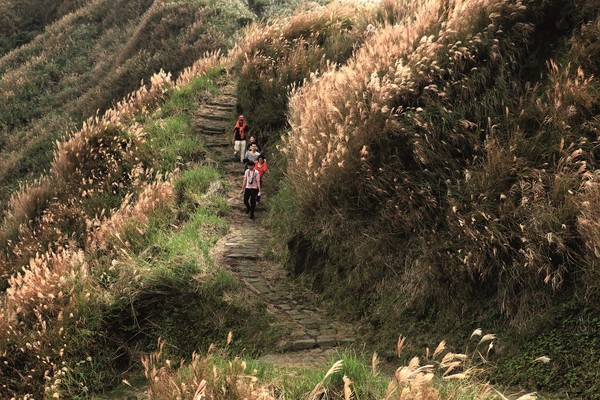
▲In the past, Jinshan’s fish catch was transported to Taipei via the Jinkalie Trail, which is why the path is also called the “Fish Route Ancient Trail.”
During its years as a fish transport route, the trail stretched 35.1 km in total. Due to parts of it being lost to time, the current hiking section runs from Baxian to Shanzihou or Zhonghu, spanning just 7–8 km. However, for a more leisurely walk with scenic views, consider trekking from Qitian Gang to Shanghuangxi.
Fallen leaves carpet the stone-paved path, adding to the autumn ambiance
On clear days, Qitian Gang is naturally expansive and pleasant. In autumn, when the hills are dotted with silvergrass and the wind makes it sway like waves, it adds even more to the autumnal poetic charm. Just at the entrance of the ancient trail, you’re already greeted by silvergrass-lined paths, and after about 0.3 km, you’ll reach the old gate.This was the site of a fortress left behind by anti-Japanese hero Jian Dashī, who gathered resistance forces here during the Japanese occupation to guard the Jinkalie Trail.
Apart from the gate itself, there are no other visible remains within, but the spot offers excellent views of Jinshan and Shanghuangxi. Due to the terrain, mist often forms here—even on clear days, billowing mountain mist can be seen rising continuously, creating a very unique sight. Continuing along the trail, as you cross over the hilltop, you’ll enter a dense forest where the scenery suddenly transforms, and the dirt path turns into a stone-paved road.
Weaving through the woods, the ground is covered with fallen leaves, and a few red leaves hang from the branches, bringing a rich sense of autumn. The forest is humid, fostering lush ferns that add to the vibrant life all around—a stark contrast to the vast feeling of the silvergrass fields.
A Variety of Hot Spring Pools to Relax Your Muscles
Along the way, you can also spot the Xuyan Bridge built by tea merchants, rusted and moss-covered pipes scattered about, and stoves left behind by miners—testaments to the trail’s storied past.As you near the end, you’ll pass through mountain streams and waterfalls, and see irrigation channels hand-carved in the old days. The journey’s ever-changing scenery and historical relics offer a rich visual experience. At the endpoint by Shanghuangxi, you’ll even find golden-hued streams and waterfalls, reminiscent of the Gold Creek Waterfall at Jinguashi.
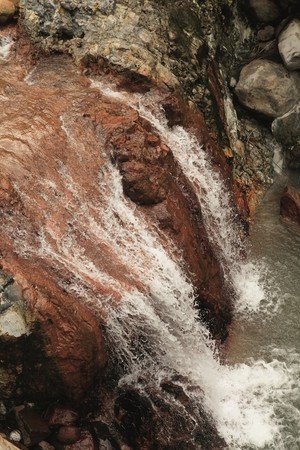
%naxiaqiao?nai?xiqukuanxieshi?zhi?shijiemupianji?
However, the stone path, having endured the passage of time, is covered in moss and can be quite slippery, especially when wet. Extra care is needed to avoid slipping.
Soaking in warm springs after an autumn hike is the ultimate indulgence. Especially recommended is Tianlai Hot Spring Resort in Jinshan, which completed construction in 2012 and boasts Taiwan’s largest open-air bath area, spanning 2,000 ping. To enhance the joy of soaking and offer various therapeutic benefits, the resort has created themed hot spring pools using essential oils, flowers, or traditional Chinese herbal remedies, providing different skin-nourishing experiences. There are also hydro-massage facilities to further relax your muscles.
Thanks to its location nestled among the mountains, you can enjoy a lush green backdrop while soaking. For those who prefer not to wear swimsuits in open-air baths, there are also Japanese-style communal nude hot spring pools. Among all the facilities, the SPA cold spring pool at the highest elevation offers the best views. Its infinity design faces the valley directly, and watching the mountains shift with the light at dusk is particularly breathtaking.
Given the resort’s spacious grounds, if you want to enjoy a more leisurely hot spring experience, you can also choose to stay overnight. Guest rooms come with private hot spring tubs right next to the balcony, allowing you to soak while taking in the scenery.
Fishing Harbor Restaurant: Savor Creative Cuisine
Located at Jinshan’s Shuwei Fishing Harbor, the “88 Water Wharf” restaurant is famed for its creative seafood dishes. Among them, the “Thai King Curry Crab” (NT$380), made with crab meat cooked in Indian curry and homemade Thai sauce, is especially popular.Resembling crab roe in appearance, the curry crab tastes great when spread on bread—slightly spicy with a rich curry aroma that lingers deliciously, leaving you licking your fingers in delight.
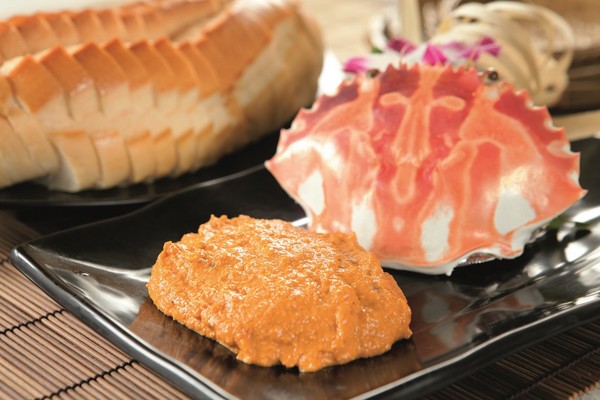
▲Thai King Curry Crab.
%jiasenshanqinxian?hunhedameiwei
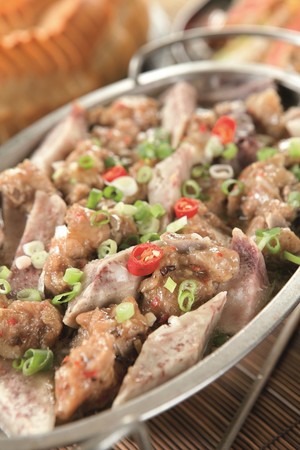
In addition to creative dishes blending Thai and Japanese flavors, the “Taro Pork Ribs Steamed Dish” (NT$240) offers a Hong Kong-style twist. The chef mixes the pork ribs with cornstarch, then rinses them in water for two hours to achieve tenderness before steaming them with taro. The result is a texture that’s both smooth and chewy, and the carefully selected taro is soft and delicious.
Another highlight is the “Sea Urchin Scallion Omelet” (NT$280), which is perfectly cooked to keep the sea urchin moist, offering a rich and sweet flavor upon the first bite.
Excerpted from 《PlayGo Taiwan: 55 Must-Visit Popular Route Spotlights》/Shangzhou Publishing
Travel Information
● By Car
Qingtian Gang and Jinbaoli Road: Take the Zhongshan Expressway to the Taipei Interchange, then connect to Chongqing North Road (Provincial Highway 2B), pass through Bailin Bridge and Zhongzheng Road, turn onto Yangde Boulevard (Provincial Highway 2A), then enter Zhonghu Combat Road and follow the signs to reach the destination.
Tianlai Hot Spring Resort: Continue along Yangde Boulevard onto Yangjin Highway and follow the signs to arrive; or take the Zhongshan Expressway to the Dahua System Interchange, switch to Provincial Highway 62 Freeway, exit at the terminus, connect to Provincial Highway 2, then transfer to Provincial Highway 2A to arrive.
88 Water Wharf: Take Provincial Highway 2 to Jinshan, then turn onto Zhongxing Road, connect to Minsheng Road heading towards Shuiwei Fishing Port to arrive.
● By Public Transport
Qingtian Gang and Jinbaoli Road: From Jiantan MRT Station, take Capital Bus (0800-000-866) Route 小15 to Qingtian Gang Station and get off.
Tianlai Hot Spring Resort and 88 Water Wharf: Take Royal Bus (02-8295-7022) from beside the National Health Insurance Building on Taipei’s Park Road—route from Taipei via Yangmingshan to Jinshan. Get off at Tianlai Hot Spring Resort Station or Jinshan Township Office Station respectively to arrive.
● Related Information
Tianlai Hot Spring Resort: (02) 2408-0000. Open-air hot spring bath (includes SPA water world): weekday adult NT$600, holiday adult NT$800, free for guests. Standard twin room starts at NT$7200.
88 Water Wharf: (02) 2498-1616. Operating hours: 11:00–21:00. Open every day; reservation recommended on holidays.
Share
This article is published by HowToTrip. Sharing and reposting are welcome — please credit the source.
Article URL: https://www.howtotrip.net/views-25605
Related Articles
- Shaoxing's "Grandpa Gourd" hangs the gourds back up: "If there are too many people, we'll interact less — just take a quick look from afar"
- Chinese authorities announce "reciprocal adjustment" to Japan visa fees — single-entry visa jumps from 2,250 to 16,750 yen!
- The "health stones" carried by a traveler were found to have radiation levels exceeding safety limits by a thousand times, potentially endangering fellow passengers on the same flight. Customs issues warning!
- Shenzhen Airport Issues Late-Night Notice: Unidentified Aerial Object Detected, Causing Widespread Flight Delays!
- “They only said it cost money after I opened the box and washed it!” 200g of grapes sold for 60 yuan on a high-speed train—12306 responds!
- Can't buy an airline ticket? Denied exit? Blocked from boarding? A large number of Chinese tourists have mysteriously become "discredited individuals"
- Adverse weather and economic fluctuations impact Colombia's coffee market
- Beach bathing area responds to 2 yuan/30 seconds fee for freshwater foot rinsing: Clearly priced!
- Taking off with an improperly closed cabin door? Wing malfunction? Multiple flights made emergency returns mid-journey!
- Experience the gifts of nature! A countdown of the world’s ten most stunning coastlines