An infringement that can’t be measured in money: On Fan Keqin’s retort to Florentijn Hofman
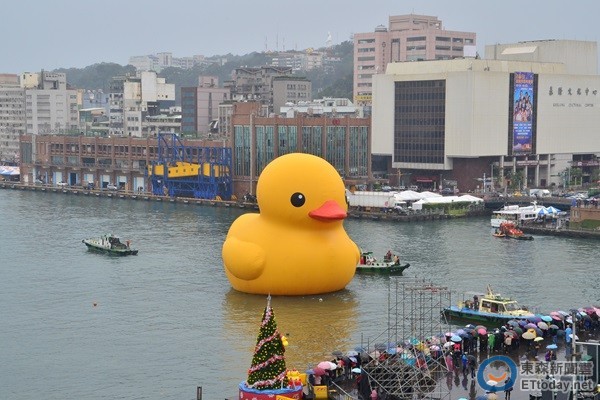
▲Keelung Rubber Duck. (Photo / Reporter Chen Zi-yin)
Text / Tseng Po-wen
Once, I attended an open-air concert featuring Bach’s music. Unexpectedly, recordings of Bach’s compositions, electronic ringtones, and vendors selling music CDs and related toys filled the air. The musician, angered, criticized the vendors for disrespecting the concert. One vendor shot back, “Bach’s music isn’t your patent—aren’t you also selling your own CDs at the entrance?”
Okay, the story is fictional. But it was exactly the image that popped into my mind when I saw Fan Keqin retorting to Florentijn Hofman last night.
Fan Keqin criticized Hofman, pointing out that Taiwan had fifty derivative yellow duck products in the past, none of which were registered under Hofman’s name for intellectual property. Fan emphasized that selling these items didn’t require his authorization.
If sold elsewhere, that might be true.
But I believe the core of this controversy isn’t about the “licensing fee” for yellow duck merchandise, but whether the organizers of the “Giant Rubber Duck in Keelung Harbor” — an event conceived and created by Hofman — had the right to add various “event supplements” without the original creator’s consent, thereby deviating from the artist’s original vision.
This involves a rather blurry boundary: the scope of “artistic creation.”
The responses from Fan Keqin and Speaker Huang clearly interpret Hofman’s “creation” narrowly as just that oversized plastic duck. Their stance seems to be: we only agreed to display your big duck, but we want to sell our little ducks—you have no say in that.
But I imagine that for Hofman, “creation” refers to: inviting people to approach the giant yellow duck, to awaken their inner childlike wonder, and to forget their differences in shared amazement—the “entire process.” Specifically, it at least includes the overall environment of the event.So whether the duck rotates, how other activities are arranged on-site, and even the extent of vendor and derivative product proliferation all matter.
Hofman wrote on his personal website:
"The Rubber Duck knows no frontiers, it doesn't discriminate people and doesn't have a political connotation. The friendly, floating Rubber Duck has healing properties: it can relieve mondial tensions as well as define them."
He emphasized the universal friendliness of the yellow plastic duck, its ability to transcend boundaries and races, and its healing effect in easing various forms of tension. The photos he selected for his website further show that he envisions exhibition sites to be quiet and pure. Perhaps he believes that only by reducing unnecessary distractions can viewers connect more deeply with their inner selves, recalling the joy of seeing a yellow rubber duck in childhood.
Regarding the psychological impact of the yellow duck in Taiwan, Huang Sun-quan also offered profound insights in the October issue of Artco:
“…The yellow duck craze provided Taiwanese with an appropriately eye-catching event… Political and social divisions have made it so that no matter which group Taiwanese align with, they often experience unpleasantness. Only in front of the yellow duck do we all become similar, and everyone can approach it. Ironically, the yellow duck fosters harmony across Taiwanese society, because no opposition in Taiwanese society is as mild as that between lovers and critics of the yellow duck. The yellow duck creates a sense of unified form. We all love or hate the yellow duck together—we just want to dispel shame. We sincerely want to rejoice and share in the joy with our neighbors, hand in hand across party lines, enjoying childlike happiness; we want to seriously debate everything from wages and the Cross-Strait Service Trade Agreement to social injustice, from urban renewal to environmental destruction, but these are almost unattainable in Taiwan’s reality…”
Viewed in this context, the endless stream of “surprises” from the Keelung organizers (the spinning duck, upbeat dance music, numerous vendors, and surrounding merchandise) is undoubtedly a betrayal of the creator’s original intent. We might consider whether these artificially added joys deprive the viewing experience of its psychological space? Do they block audiences from connecting with the mental experience the creator intended to cultivate?
At least for me, they do.
Seeing this farce in Keelung gave me a heavy sense of dissonance—like hearing ringtones during a concert, like seeing garish decorative lights on an elegant architectural carving, like tasting artificial sweeteners in organic restaurant cuisine.It’s not about who earns the licensing fee, but witnessing someone recklessly overdo things with such self-importance, disrupting the original balance of the aesthetic relationship between “creation and appreciation.”
This is an infringement that can’t be measured in money.
Postscript: Actually, I think Hofman himself has some controversial areas in balancing art and commerce. But this short piece can’t cover all angles, so I’ll focus solely on the organizers this time.
The above article is republished fromThinkChina Forum
Original source:Notes: On Public Controversies
Tseng Po-wen
The author currently works at the International Institute for Asian Studies (IIAS) in the Netherlands.
Share
This article is published by HowToTrip. Sharing and reposting are welcome — please credit the source.
Article URL: https://www.howtotrip.net/views-25568
Related Articles
- Shaoxing's "Grandpa Gourd" hangs the gourds back up: "If there are too many people, we'll interact less — just take a quick look from afar"
- Chinese authorities announce "reciprocal adjustment" to Japan visa fees — single-entry visa jumps from 2,250 to 16,750 yen!
- The "health stones" carried by a traveler were found to have radiation levels exceeding safety limits by a thousand times, potentially endangering fellow passengers on the same flight. Customs issues warning!
- Shenzhen Airport Issues Late-Night Notice: Unidentified Aerial Object Detected, Causing Widespread Flight Delays!
- “They only said it cost money after I opened the box and washed it!” 200g of grapes sold for 60 yuan on a high-speed train—12306 responds!
- Can't buy an airline ticket? Denied exit? Blocked from boarding? A large number of Chinese tourists have mysteriously become "discredited individuals"
- Adverse weather and economic fluctuations impact Colombia's coffee market
- Beach bathing area responds to 2 yuan/30 seconds fee for freshwater foot rinsing: Clearly priced!
- Taking off with an improperly closed cabin door? Wing malfunction? Multiple flights made emergency returns mid-journey!
- Experience the gifts of nature! A countdown of the world’s ten most stunning coastlines