Matsu’s Culinary Treasure “Red Yeast Rice” Transformed into Meat Buns and Ice Cream!
Tourism Center / Comprehensive Report
The origins of red yeast rice date back to ancient times, with records of its use existing as early as the Three Kingdoms period. In China, red yeast rice is primarily used in the regions of Zhejiang, Jiangsu, Fujian, and Jiangxi, and spread to Japan, Korea, and Southeast Asia during the Sui and Tang dynasties. The ancestors of Matsu mainly came from Lianjiang and Changle in Fujian, where the tradition of brewing wine with red yeast rice has existed since ancient times. As a result, almost every household in Matsu knew how to make traditional rice wine in the old days.
Matsu’s red yeast rice boasts a unique aroma. Traditionally, it is often used as an ingredient in dishes such as red yeast pork, red yeast eel, and red yeast chicken soup. In recent years, Matsu has actively promoted red yeast rice cuisine, emphasizing its nutritional and health benefits. Through continuous experimentation, new dishes have been introduced, including red yeast fried rice and red yeast finger citron, and red yeast has also been incorporated into baked goods such as “Red Tile Cake” (red yeast cookies) and red yeast Matsu cake.
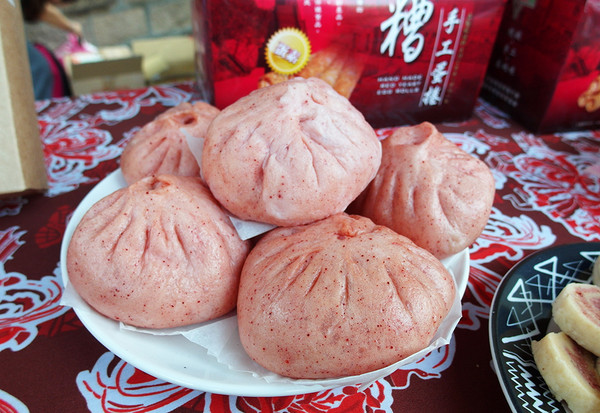
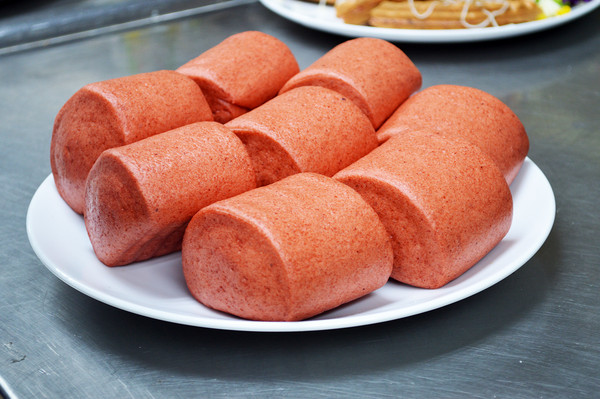
▲Matsu’s culinary treasure “red yeast rice” has been developed into various food and daily-use products locally. (Photo / Provided by the business)
But with the growing trend toward natural, healthy, and wellness-focused lifestyles, studies have found that lees contain health-beneficial components, and natural elements with skin-beautifying properties have been identified in them. As a result, lees face masks have become popular products, and red yeast—the key ingredient used to make red yeast rice—has also been made into health foods. Riding this wave, Matsu’s red yeast rice is now aiming to develop food products or souvenirs with local characteristics. During the R&D process led by a professional team, attempts were made to combine red yeast rice with trendy foods or products, resulting in innovations such as red yeast meat buns, red yeast handmade cookies, red yeast ice cream, red yeast handmade soap, and red yeast peanut candy.
Among them, the red yeast meat bun features a pink appearance and the traditional aroma of red yeast pork. It has already been developed in collaboration with local businesses and will soon be available for mass production and market launch. Leveraging the natural skin-beautifying properties of red yeast, it is also being used as an ingredient in handmade soap, giving the soap not only natural and healthy elements but also beauty and skincare benefits. Meanwhile, the red yeast ice cream offers a subtle wine aroma paired with a rich milk fragrance—it's not only palatable but also delivers a surprisingly delightful texture.
Now, products such as red yeast handmade soap, red yeast ice cream, and red yeast meat buns are ready to hit the shelves in Matsu. In the future, visitors will be able to enjoy these innovative products at tourist spots and even take them home as souvenirs. If you're planning a trip to Matsu, don’t miss out on the local red yeast rice delicacies—and consider picking up some red yeast-themed souvenirs as well.
Share
This article is published by HowToTrip. Sharing and reposting are welcome — please credit the source.
Article URL: https://www.howtotrip.net/views-24588
Related Articles
- Shaoxing's "Grandpa Gourd" hangs the gourds back up: "If there are too many people, we'll interact less — just take a quick look from afar"
- Chinese authorities announce "reciprocal adjustment" to Japan visa fees — single-entry visa jumps from 2,250 to 16,750 yen!
- The "health stones" carried by a traveler were found to have radiation levels exceeding safety limits by a thousand times, potentially endangering fellow passengers on the same flight. Customs issues warning!
- Shenzhen Airport Issues Late-Night Notice: Unidentified Aerial Object Detected, Causing Widespread Flight Delays!
- “They only said it cost money after I opened the box and washed it!” 200g of grapes sold for 60 yuan on a high-speed train—12306 responds!
- Can't buy an airline ticket? Denied exit? Blocked from boarding? A large number of Chinese tourists have mysteriously become "discredited individuals"
- Adverse weather and economic fluctuations impact Colombia's coffee market
- Beach bathing area responds to 2 yuan/30 seconds fee for freshwater foot rinsing: Clearly priced!
- Taking off with an improperly closed cabin door? Wing malfunction? Multiple flights made emergency returns mid-journey!
- Experience the gifts of nature! A countdown of the world’s ten most stunning coastlines