Taiwan’s Provence – The Rinauli Tribe in Pingtung Reborn from Natural Disaster
Text and photos / Excerpted from *Let’s Go Crazy in Taiwan with Roulu: 232 Must-Visit Pocket Spots for Fun and Food*
The reborn Rinauli Tribe is dotted with European-style wooden houses, adorned with indigenous murals, and features a massive pangolin sculpture lying within. There's also an activity center that floats like a leaf in the blue sky. Strolling along, you’ll find a uniquely all-white church tucked away in the streets, cleverly combining stone slab house materials for a distinctive and exotic flair. The sound of hymns wafts through the air, and here, even breathing feels like a blissful luxury.
On August 8, 2009, Typhoon Morakot devastated the mountainous regions of Pingtung. With the help of government and civilian efforts, the current site of the Rinauli Tribe — the Majia Farm — was developed as a residential area for three tribes: Majia Village in Majia Township, Haoca Village in Wutai Township, and Dashe Village in Sandimen Township. The name "Rinauli" originates from the traditional place name Rinari, meaning “a place waiting for grace, filled with blessings and hope.” It cleverly takes one character from each of the three tribe names, forming a playful greeting that means “Hello, everyone,” but truly signifies “the place where we walk together, heading there as one.” One can’t help but admire and applaud the resilience of the indigenous people.
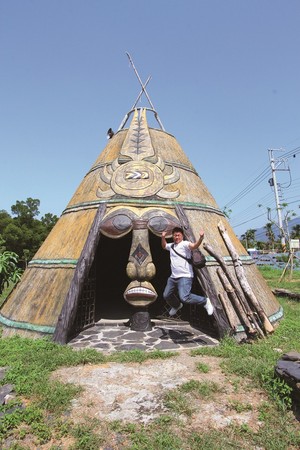
The Rinauli Tribe resembles a lost paradise, home to a 3D conical face sculpture with wide eyes and bared teeth — playful and reminiscent of Star Wars’ Darth Vader. This is the tribal gathering hall. Inside, it stays warm in winter and cool in summer. At the entrance stands an orange glass house building modeled after the traditional barns of Majia Valley. Climb to the second floor, and you’ll get a full view of the Rinauli Tribe, along with the vast expanse of the Pingtung Plain.
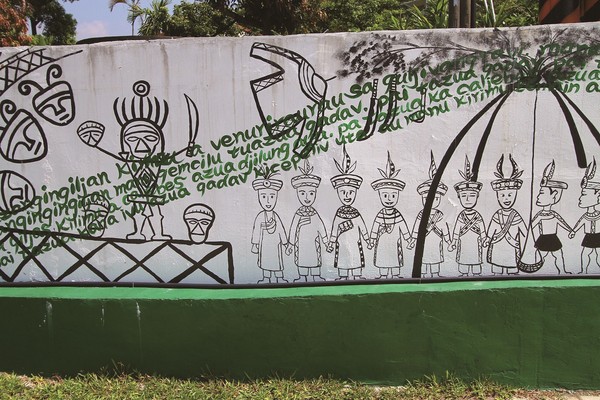
The white walls are painted with vivid images, such as starting fires, clearing land, planting taro, building thatched huts, and herding. Most striking is the warrior wielding a machete and holding up a head trophy, seamlessly integrating indigenous culture into the murals — absolutely cool.
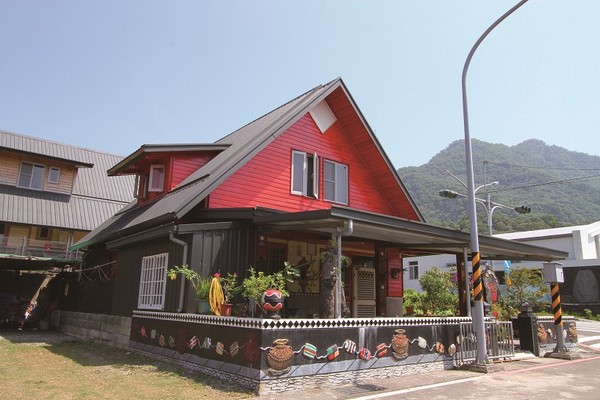
The European-style wooden houses built along the mountain slopes are all homes of the indigenous people. It’s like stepping across the tides of time into a quaint European town. Surprisingly, the density of churches in the Rinauli Tribe rivals the whimsical saying “a temple every five steps, a nunnery every ten.” Now, follow me into the fantastical world of these churches.
Rinauli has a total of nine churches — three in Majia, four in Haoca, and two in Dashe. Since most are hidden on the outskirts of the village wooden houses, finding them is a bit of a treasure hunt. It’s like embarking on a quest with a treasure map, uncovering the mysteries of each church. It brings back childhood memories of collecting points to unlock stages, and there’s even one church that resembles Harry Potter’s hidden room — I searched everywhere but couldn’t find it.
Church Tour 1 – Majia Village
Majia Church, Majia Rose Madonna Church, Majia Gospel Church
The first church you'll encounter is Majia Church, featuring a stone tile façade and dark green marble flooring that exudes a retro indigenous vibe. The cross on the church wall is made of transparent glass, allowing sunlight to cast a faint glow inside. Directly opposite Majia Church is the Majia Rose Madonna Church, with a white base and bright red lettering that radiates a fresh, cozy warmth. Between the two churches lies a giant leaf-shaped shelter, which from afar looks like a menacing insect or a stylish sailboat gliding with the breeze.
The churches in Majia Village are quite easy to find. Walk down the main road, and you’ll come across the Majia Gospel Church at the very bottom. Its raised pentagonal structure with a hollowed-out center has a strong 3D effect. While wandering and taking photos in the village, kids and locals are often curious about visitors and usually nod kindly. I thought to myself: the church transported me to a European town, while the warm hospitality brought me right back to Taiwan — isn’t that wonderful?
Church Tour 2 – Haoca Village
Haoca Church, Haoca Sacred Heart of Mary Catholic Church, Haoca Gospel Church, All-White Church
Haoca Village neighbors Majia Village. From the Majia Gospel Church, you can’t miss a dramatic cross rising abruptly from the ground — that’s the Haoca Sacred Heart of Mary Catholic Church. The front of the church looks like the face of a mischievous child, with its black slate façade inlaid with two carved stone slabs. A three-story-tall white cross stands at the front, beneath which is a small shrine designed with the lily flower motif.
Walking uphill toward the entrance of Haoca Tribe, roadside houses are painted with murals featuring indigenous cultural elements like pottery urns and lilies. Then comes a colorful beaded mural encircling a beige-gray Haoca Church, symbolizing blessings like love, good fortune, and courage. Surprise awaits with a 10-meter-long church mural wall, and winding alleys open up delightfully like “light at the end of the tunnel.” The Haoca Church is quite large, with a wooden cross on the front and a washed-pebble cross on the side. When locals saw me circling around taking pictures, they cheerfully called out, “What’s so interesting about the church?” I replied, “It’s so beautiful!” They smiled proudly in return — I think that’s true confidence.
At the far end of Haoca Tribe, there’s an all-white church under construction, somewhat similar to the Majia Rose Madonna Church. Further down, you’ll find the lush-green Haoca Gospel Church, whose design resembles the Majia Gospel Church, except the pentagonal front isn’t hollowed out but instead features smooth, flowing lines. Nestled next to the natural mountains, the Haoca Gospel Church is extremely comfortable.
Church Tour 3 – Dashe Village
Dashe Gospel Church, Davalan Presbyterian Church
Dashe Village is about a two-minute drive from Majia and Haoca. Along the way, after passing Changrong Lily Elementary School, you’ll see a super-sized pangolin sculpture. Its white cloak resembles the scaly armor of a pangolin, and its streamlined shape is reminiscent of the main stadium of the Kaohsiung Universiade, giving off a mini-domed arena vibe. Inside the pangolin is a basketball court, where cool mountain breezes freely circulate — you won’t break a sweat playing here.
Above the pangolin basketball court is the Davalan Presbyterian Church, marked by a striking and mysterious black cross with a single drop of red blood affixed to it, resembling the staff of a presbyter. Below it is the Dashe Gospel Church, whose side resembles a big truck design, with six transparent floor-to-ceiling windows creating a maze-like effect as you walk through.
The churches in the Rinauli Tribe are exquisitely built, complemented by the unique blue skies of the south, making it feel like strolling through Greek temples — a scenic view at every step, a church every ten. I believe the word “Rinauli” has surpassed Provence, Shangri-La, Utopia, and the Ideal State. Come to southern Pingtung to discover this simple tribal paradise.
Share
This article is published by HowToTrip. Sharing and reposting are welcome — please credit the source.
Article URL: https://www.howtotrip.net/views-24546
Related Articles
- Shaoxing's "Grandpa Gourd" hangs the gourds back up: "If there are too many people, we'll interact less — just take a quick look from afar"
- Chinese authorities announce "reciprocal adjustment" to Japan visa fees — single-entry visa jumps from 2,250 to 16,750 yen!
- The "health stones" carried by a traveler were found to have radiation levels exceeding safety limits by a thousand times, potentially endangering fellow passengers on the same flight. Customs issues warning!
- Shenzhen Airport Issues Late-Night Notice: Unidentified Aerial Object Detected, Causing Widespread Flight Delays!
- “They only said it cost money after I opened the box and washed it!” 200g of grapes sold for 60 yuan on a high-speed train—12306 responds!
- Can't buy an airline ticket? Denied exit? Blocked from boarding? A large number of Chinese tourists have mysteriously become "discredited individuals"
- Adverse weather and economic fluctuations impact Colombia's coffee market
- Beach bathing area responds to 2 yuan/30 seconds fee for freshwater foot rinsing: Clearly priced!
- Taking off with an improperly closed cabin door? Wing malfunction? Multiple flights made emergency returns mid-journey!
- Experience the gifts of nature! A countdown of the world’s ten most stunning coastlines