A Delightful Light Travel in Taipei’s East District – Part 2 of the “Pink Fun Park” Art Treasure Hunt
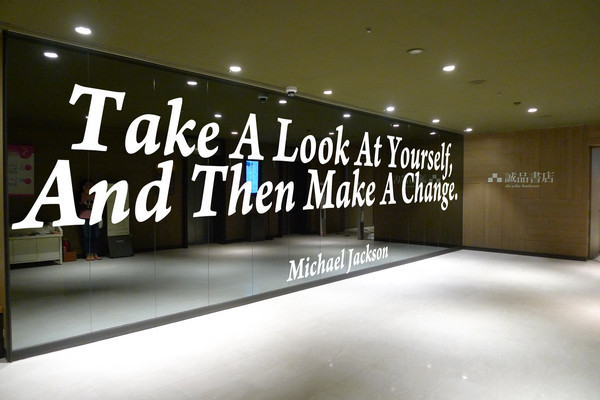
▲ Liu Yaozhong uses text as the starting point of his creative thinking, engaging in humorous dialogue with space through the transformation of slogans into art. (Photo provided by Fubon Art Foundation, the same below)
Travel Center / Comprehensive Report
The “Pink Fun Park – Taipei East District Contemporary Art Exhibition,” organized by the Fubon Art Foundation, is now in its ninth edition this year. It emphasizes the core spirit of an “art gallery without walls.” The word “Pink” is a popular slang term meaning “very,” or “extremely,” “Fun” is the Mandarin pronunciation for “happy,” and “Park” is a Japanese kanji character pronounced similarly to “Ting” (挺), carrying subtle connotations of cultural exchange, meaning a place or corner. In summary, “Pink Fun Park” (Very Fun Park) refers to a very joyful place.
Through the presence of art, Pink Fun Park is situated within the city streets we often stroll through—perhaps at a corner, along a street, or inside a shop. Artworks step out of the exhibition spaces of museums and enter our daily lives. There’s no need to queue or buy tickets; anyone passing by can stop to appreciate them, observing the relationship between the artwork, the environment, and people. And now, it’s right here around us. Look closely, and you’ll encounter art—you’ll also discover how approachable art can be.
Last time, we introduced nine artworks in the Songshan Cultural and Creative Park. Today, let’s step out of the creative park and explore its surrounding areas and the Eslite Songyan Life Store to see what other surprises await.
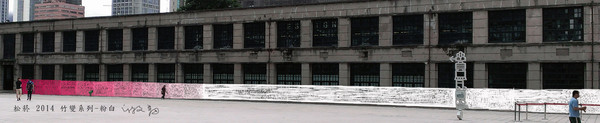
▲ You Wenfu uses bamboo as a medium, conveying ideas through color—pink represents romance and joy, while white embodies purity.
“Bamboo Transformation Series – Pink & White” by creator You Wenfu
Located at the water feature plaza on Yancao Road, the artwork “Bamboo Transformation Series – Pink & White” by environmental artist You Wenfu, who specializes in using bamboo as a creative medium, evokes responses to natural elements such as wind and sound through large-scale bamboo installations, while also presenting a serene atmosphere that returns to nature.
Using bamboo as a material stems from the artist’s close observation of the material properties of bamboo. He takes advantage of its ability to change color with weather shifts to reflect the rhythm of time and the natural environment. This time, using a land art approach, over 60,000 colored bamboo skewers were inserted into the ground, transitioning in color from pink to white. Pink symbolizes romance and joy, while white represents purity. Amid the summer breeze, the bamboo skewers sway, their rustling sounds echoing, immersing viewers in the enchanting ambiance of Songyan.
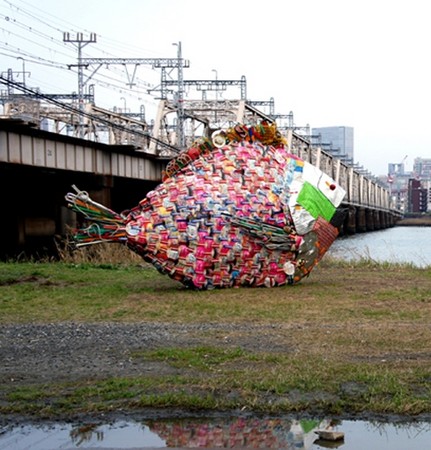
▲ The Yodogawa Technique redefines our notion of “trash,” turning these discarded items into meaningful pieces.
“Black Sea Bream” by the Yodogawa Technique (Shibata Hideaki & Matsunaga Kazuya)
The “Yodogawa Technique,” a collaboration between artists Shibata Hideaki and Matsunaga Kazuya since 2003, transforms collected waste materials into uniquely shaped sculptures, redefining the concept of “trash.”
“Yodogawa” is a major river in Osaka, Japan, flowing through a densely populated metropolis and carrying all sorts of human debris into the sea. The Yodogawa Technique began creating art using discarded items collected from the river and its banks. In recent years, they have expanded their community-based participatory projects across Japan and around the world. Although the sources of their materials have changed, their commitment to environmental care remains constant: rivers are the cradle of human settlements, yet pollution in rivers has intensified alongside civilization. The trash collected from the Yodogawa is not only astonishing in quantity but also incredibly diverse. By combining the artists’ creativity and humor, their works aim to raise environmental awareness among the public—just like a river, every drop of care and effort accumulates.
This time, they have also come specially to Taipei to decorate this black sea bream from Japan with waste collected from the Tamsui River, meeting the public at the Cultural and Creative Green Space.
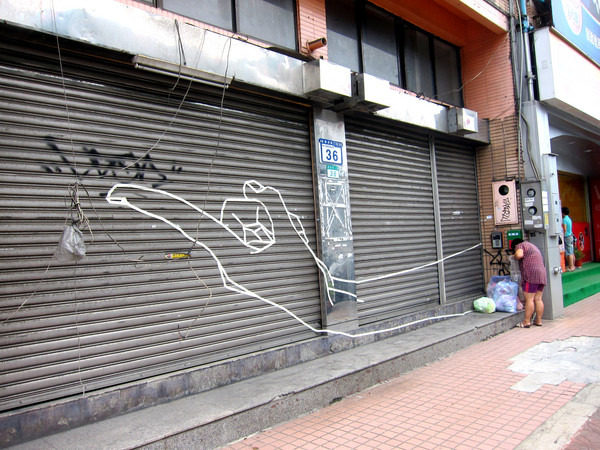
▲ Untrained in formal art, Buff Diss creates street art using tape.
“Eurydice” by Buff Diss
Buff Diss’s artwork “Eurydice” is located in the cultural and creative corridor. Hailing from Melbourne, Australia, Buff Diss leaves a first impression of clean, sharp lines with detailed textures—a hallmark of street artist Buff Diss. But upon closer inspection, you’ll realize these aren’t spray-painted or drawn works—they’re entirely created using tape.
In fact, Buff Diss has no formal training in art or design, but his keen observation allows him to see the intertwined stories of the city’s history, architecture, streets, and the people and vehicles flowing through them. Visually, he skillfully blends the dialogue between the real and the imagined. His tape-based street art does not damage buildings, yet it retains the essence of impact and reflection.
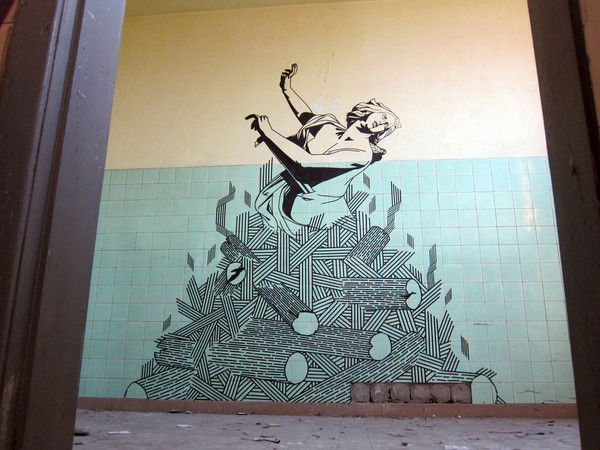
▲ Untrained in formal art, Buff Diss creates street art using tape.
Invited by Pink Fun Park, Buff Diss this time came to the corridor of Taipei’s cultural and creative building, using tape to depict the Greek myth of Orpheus and his wife Eurydice, who died from snake venom. Orpheus’s extraordinary musical talent moved heaven and earth, but he failed to lead his wife’s soul out of the underworld when he couldn’t resist looking back. The artist uses this story as a metaphor for the inspiration and talent of creators—no matter how difficult the situation, one must not doubt oneself and must move forward with determination to achieve ultimate spiritual freedom.
“Heterogeneous Daily Perception, Folded Cloth, Kneaded, Folded” by Gu Shangling
Are all things we see or feel in daily life judged solely based on our own experiences?
Artist Gu Shangling explores the difference between visual and sensory perceptions of ceramics. What initially appears as paper-thin works raises questions about materiality—but the subtle sound produced by the collision of objects reveals that the material is actually ceramic. In this process, understanding the work comes from changes triggered by collision, a shift in perception driven by visual and auditory stimuli. The reality of anything exists not only within the realm of rational thought but also requires understanding through bodily perception.
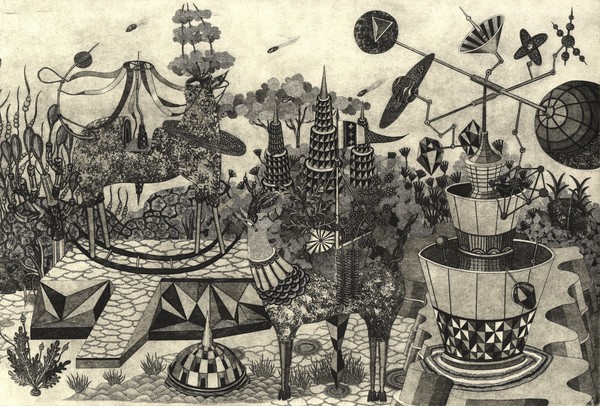
▲ Lin Yilong guides viewers into different spaces through spatial depiction.
“Earth House” by Lin Yilong
The creature resembling a bird with horn-like features, as well as various surreal spatial scenes, reflect artist Lin Yilong’s imagination and observations of daily life and life experiences.
Within the fantastical spaces he creates, filled with beings that are neither fully beast nor human, neither fully person nor otherwise, these figures are the protagonists of his works, as well as imaginative entities from mysterious alternate dimensions. However, the forms of these fantasy creatures are not recreations of any known organisms, but rather new beings reshaped through the imagination of various events or a blend of experiences. Through these mutated beings, Lin Yilong attempts to project emotional memories from everyday life and traces left by once-existing states.
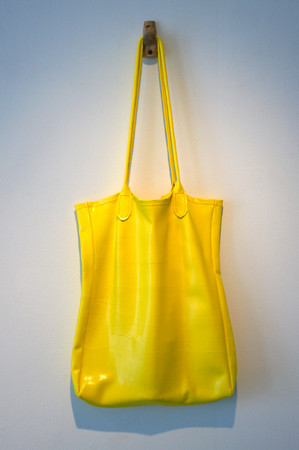
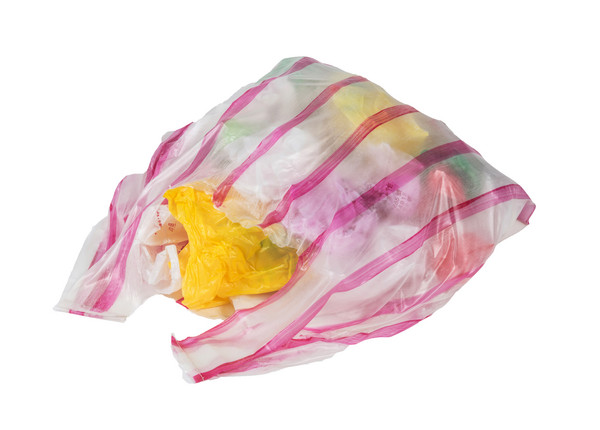
▲ Resembling an ordinary shopping bag, “Shield No. 1, Home, Starry Night.”
“Shield I, Home, Starry Night” – Huang Guanjun
The samples of a series of works by artist Huang Guanjun are drawn from everyday objects. This time, his piece “Shield I, Home, Starry Night” is hidden at the Whiple Lib Eslite Life Songshan Store. Through layers of varnish and acrylic paint, he recreates the colors of familiar objects from our daily lives. Then, using his skilled sewing techniques, he liberates the paintings from canvases and frames, breaking free from traditional single-plane visual effects and engaging more directly in dialogue with the space.
The commonly chosen objects, once re-created, appear usable yet fundamentally altered, attempting to create an interesting contrast between art objects and readymades. At the same time, they transform things that frequently appear around us but are often overlooked into works that compel us to acknowledge their existence, allowing us to rethink our environment and life.
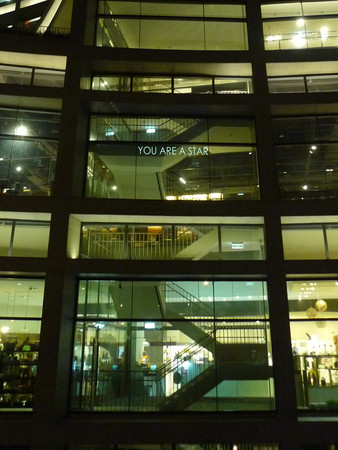
▲ Liu Yaozhong believes that he can start by practicing his ideals himself to make society better.
“YOU ARE A STAR”, “Man in the Mirror” – Liu Yaozhong
Liu Yaozhong’s two works “YOU ARE A STAR” and “Man in the Mirror” are exhibited respectively on the glass staircase at Eslite Life Songshan Store and the west side staircase hall on the 3rd floor of Eslite Life Songshan Store.
Born in the 1980s, Liu Yaozhong uses text as the origin of his creative thinking. In the transformation of slogans, he forms humorous dialogues with space. When the emergency staircase is covered with a long red carpet, it evokes thoughts of an elegant walk of fame. Externally, the neon sign “YOU ARE A STAR” corresponds with the interior of the staircase, while also conveying to passersby that everyone is unique and shines as brightly as a star.
In modern life, people are often constrained and frustrated by various nameless forces, absurdities, and realities. When the artist stood before the long mirror outside the Eslite bookstore on the third floor, the famous Michael Jackson song “Man in the Mirror” came to mind, with one of its lyrics singing: “If you wanna make the world a better place, take a look at yourself, and then make a change.” Moved by the recent social unrest and instability, although facing the system may seem powerless, Liu Yaozhong still believes that one can start by practicing ideals from oneself to make society better.

▲ Stepping into the lobby of Eslite Songshan Life Store, you first enter this illogical fairy-tale world.
“Little Stars” – Hong Yunting
“Little Stars,” a nursery rhyme familiar to all of us, teaches through its lyrics that the scenes before our eyes can be slightly altered simply through imagination. However, before entering the realm of imagination, one must first cross the threshold of absurdity and transcend logic. The “Little Stars” created by artist Hong Yunting consists of about seventy light bulbs, suspended in the lobby of Eslite Songshan Life Store, twinkling like stars.
By focusing on the Little Stars and the animals transformed through imagination within them, marvelous ideas are reflected in the mind. Imagination is like a magnifying glass, leading people into a miniature world, guiding them to dream, creating freely controllable images, and opening up a self-contained new world. And when the dreamed-up images appear, take it as an invitation to continue the daydream that created it, reflecting your own understanding of the natural world amid repeated contemplation of the world.

▲ Even discarded tin cans unwanted by others become beautiful creative elements in the hands of DJ Neff and Paul Ramirez.
“Baptism of Love, When We’re Together” – CANLOVE
Founded by two American artists, DJ Neff and Paul Ramirez, CANLOVE sees boundless possibilities in vibrant discarded spray paint cans.
“Every can holds a surprise. We want to prove to the world that as long as treated with love, everything has a beautiful side.”
In the summer of 2014, the international art organization “POW! WOW!” invited forty domestic and international artists to create murals in Taipei, leaving behind a thousand empty spray paint cans, which naturally became a great opportunity for CANLOVE to showcase their talent. They transformed rigid tin cans into organic elements—flowers, rain, and various beautiful colors—showcasing the artists’ passion for creation and care for nature.
Today we’ve introduced 10 artworks by 9 groups of artists. We’ve explored the area around the Songshan Cultural and Creative Park. What other works are there? To learn more about the Pinkoi Town artworks, stay tuned to “ETtoday Travel Cloud.”
Share
This article is published by HowToTrip. Sharing and reposting are welcome — please credit the source.
Article URL: https://www.howtotrip.net/views-22191
Related Articles
- Shaoxing's "Grandpa Gourd" hangs the gourds back up: "If there are too many people, we'll interact less — just take a quick look from afar"
- Chinese authorities announce "reciprocal adjustment" to Japan visa fees — single-entry visa jumps from 2,250 to 16,750 yen!
- The "health stones" carried by a traveler were found to have radiation levels exceeding safety limits by a thousand times, potentially endangering fellow passengers on the same flight. Customs issues warning!
- Shenzhen Airport Issues Late-Night Notice: Unidentified Aerial Object Detected, Causing Widespread Flight Delays!
- “They only said it cost money after I opened the box and washed it!” 200g of grapes sold for 60 yuan on a high-speed train—12306 responds!
- Can't buy an airline ticket? Denied exit? Blocked from boarding? A large number of Chinese tourists have mysteriously become "discredited individuals"
- Adverse weather and economic fluctuations impact Colombia's coffee market
- Beach bathing area responds to 2 yuan/30 seconds fee for freshwater foot rinsing: Clearly priced!
- Taking off with an improperly closed cabin door? Wing malfunction? Multiple flights made emergency returns mid-journey!
- Experience the gifts of nature! A countdown of the world’s ten most stunning coastlines