Where to eat? What to buy? All the secrets and tips for Wanli Crab seafood restaurants are right here
Text by Liu Beibei, photos from the official Wanli Crab website
● Where can you find restaurants that sell Wanli Crab?
Since Wanli Crab is a wild sea crab that must be kept in a live water tank, I always look for restaurants with live tanks first—especially those guided by New Taipei City government with clearly marked prices, which are my top choice. (Remember, never eat dead crabs!)

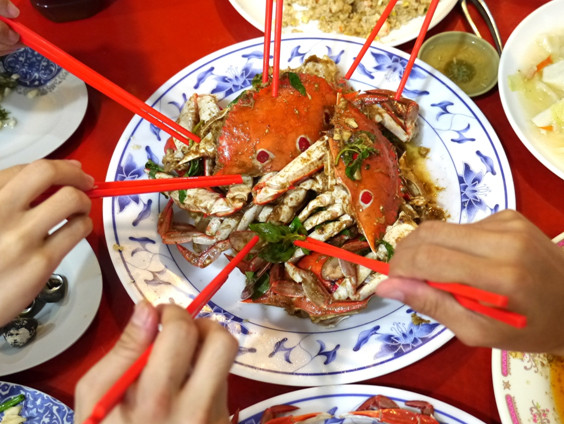
▲ When dining at a seafood restaurant for Wanli Crab, make sure to choose one with a live water tank. (Photo fromthe official Wanli Crab website, the same applies below)
As for location, the seafood restaurants by the fishing ports in New Taipei City—the largest distribution hub of Wanli Crab—are naturally the top pick, as the supply is freshest and most abundant near the source. I’ve tried many seafood restaurants in New Taipei City and have specifically selected affordable, popular stir-fry spots and unique seafood restaurants with great value and distinctive cooking styles for your reference.
Recommended harbor seafood restaurants:http://wanlicrab.tw/index.php/features/crab-restaurants
Recommended seafood restaurants in New Taipei City:http://wanlicrab.tw/index.php/features/crab-restaurants-mrt
However, after unloading, Wanli Crabs are quickly transported by water trucks to urban areas and central-southern Taiwan, even reaching as far as Kaohsiung the next day. So feel free to follow the “Crab Bulletin” Facebook page—I’ll be sharing the latest great Wanli Crab restaurants I’ve tried.
“Crab Bulletin” Facebook fan page https://www.facebook.com/WanliCrab
● At a seafood restaurant, which type of Wanli Crab should you order?
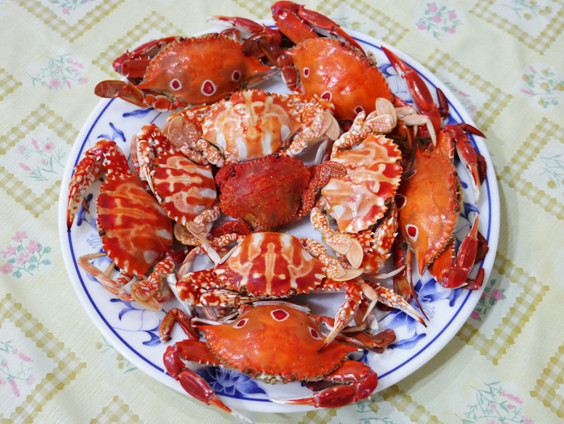
Wanli Crab includes three types: flower crab, three-spot crab, and stone crab. Although autumn and winter are the best seasons for crabs, these three varieties differ slightly in seasonality, texture, and flavor.

Take the flower crab—it’s available year-round, but quality varies, especially around the Dragon Boat Festival in the first half of the year and the Mid-Autumn Festival in the second half, when they’re at their plumpest, sweetest, and most delicious. Flower crabs are the largest in size, and during peak season, it’s not uncommon to see giants nearly two pounds each. At that size, if you ordered one in Hong Kong, it would cost one to two times more than in Taiwan, and Taiwanese flower crabs, grown in cooler waters (the northwest fishing grounds off New Taipei City), have firmer, springier meat with a delicate and subtle sweetness. I’d say they’re like elegant ladies at the dining table—irresistibly charming in color, aroma, and taste.
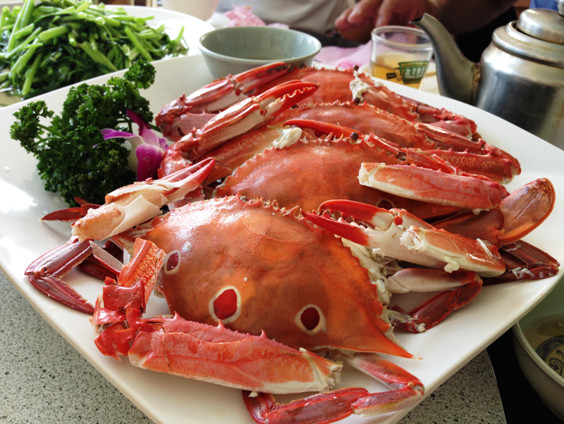
Three-spot crabs are mainly available from late summer to early autumn, with the peak starting after the end of September through November and December. Once the season hits, you can just look at them to see how plump they’ve gotten, each one bigger than a palm. Take a closer look at the shell—dark green with a hint of pink—that’s the sign of maturity. Every harbor resident and crab boat captain I know absolutely loves three-spot crabs. The more I tried them, the more I realized they’re similar to the “Kinmen crabs” beloved by foodies of the past—both are thin-shelled, fine-textured swimming crabs with pointed tips. Especially ripe three-spot crabs, once cracked open, are packed solid with white, tender meat that melts in your mouth, and the little white crab roe tucked in the corners bursts with briny ocean flavor, as if the essence of the sea is concentrated in that single bite of roe. Since then, I’ve never wanted to miss out on a plump three-spot crab whenever I see one.
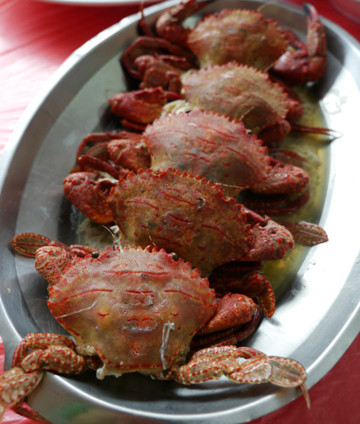
Stone crabs don’t appear until October and are available until just before Lunar New Year. They’re smaller than the other two types and also the cheapest, but their claws are very meaty. In the past, they were often used for night market “butter crab legs,” but now whole stone crabs are a favorite ingredient in seafood restaurants for dishes like “stone crab hotpot” or “crab congee.”
If the flower crab is the dainty lady, and the three-spot crab is the plain yet inner-beautiful village woman, then the stone crab is like a blonde-haired, blue-eyed foreign beauty—its crab flavor is very strong, the meat is denser with distinct fibers, much like Atlantic sea crabs, which is why many of my foreign chef friends love eating stone crabs the most.
● On many restaurant menus, Wanli Crab is listed as “market price”—doesn’t that make you worry about either high costs or being overcharged?
Many restaurants in New Taipei City, under the guidance of the city government, have done away with market pricing and instead clearly display prices for each type of crab on signs. But even at restaurants labeled “market price,” as long as you ask in advance before ordering, you can still ensure you’re getting a good crab that fits your budget.
I usually decide on the number of Wanli Crabs based on the number of diners. If each person gets one, I’d pick crabs weighing about six to eight taels per person, multiplied by the number of diners. If choosing larger crabs (one pound or more per crab), you can share one between two to three people.
For a ten-person gathering, I typically order two crab dishes—one steamed, boiled, or salt-blasted to enjoy the natural flavor, with about two people sharing an eight-tael crab. The other dish would feature the restaurant’s signature preparation, such as stir-fried, grilled, or braised—like in Wanli, where they like stir-frying with satay sauce or sesame oil, while regular stir-fry shops prefer garlic crab, chili crab, or soy-burst crab. These have bolder, appetizing flavors and offer variety, also at about two people per crab. If everyone really loves crab, I’ll also pick some smaller ones and ask the kitchen to make crab congee or miso soup.
Next comes asking for the price—seafood restaurants will usually quote you a unit price.Remember, restaurants price by the tael; only live crab vendors at markets use the per-jin (1 jin = 16 taels) pricing.
Flower crabs vary in price depending on fatness/musculature, sex, ripeness, seasonality, market supply/demand, etc.: from 50–80 NT$ per tael. It’s not always necessary to pick the biggest ones for the best taste. Wild sea crabs, like people, come in all shapes and sizes—as long as the meat is full and the crab is mature, a Wanli Crab around six to eight taels can be incredibly satisfying. That’s why I usually go for reputable restaurants rather than street stalls, because restaurant owners pre-select their crabs and only sell ones that are fat enough. Even if a customer ends up with a less plump crab, I’ve seen restaurants immediately offer a replacement for free—and I give them a mental round of applause for that.
Have the staff pick and weigh the crab(s) you want to estimate the price. For example: a fat flower crab over one jin (16 taels) is rare—even fishing trips might only yield 3–5 of this premium size—so restaurant prices usually range from 60–70 NT$ per tael. If you pick one such crab weighing 18 taels, your cost would be 18 x 70 = 1260 NT$.
If you opt for smaller, leaner three-spot crabs, the price might only be 30 NT$ per tael. For one weighing 8 taels, that’s 30 x 8 = 240 NT$. Stone crabs are usually similarly priced to three-spot crabs but are smaller in size—I highly recommend ordering several to cook in congee, hotpot, or miso soup for amazing cost-performance.
But if all this estimating goes over your budget, be sure to ask the restaurant to select and price the crabs again based on your budget, and proceed to cooking only when both sides are satisfied—so you can dine with peace of mind.
● Any recommended ways to cook crab? Sick of steamed or boiled already?
In early 2012, while having a meal with the crab boat captains, I discovered that they often have unique ways of preparing crabs on their boats—what you might call “fisherman’s cuisine.” One dish in particular completely blew me away: “Pan-Seared Wanli Crabs.” You should know that Wanli crabs are caught using crab traps, so the entire process of setting and retrieving the traps takes a very long time. During the downtime between trap hauls, the captains would go ahead and “pan-fry some crabs.”
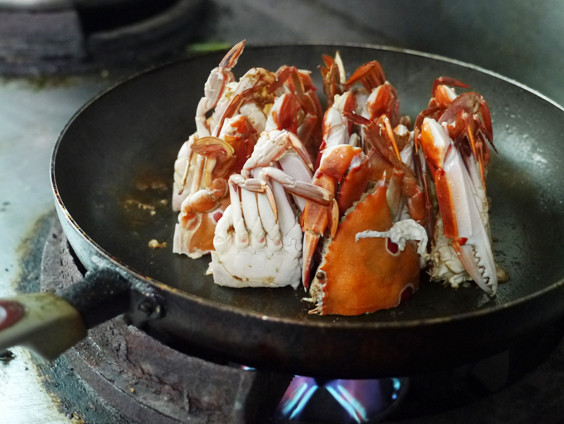
The method is simple: prepare a frying pan, add some oil, heat it up, sprinkle a bit of salt, then cut the crab in half lengthwise. Just like cooking a steak, sear one side for about ten minutes (the captain steps out to supervise the trap retrieval), then flip it over and sear the other side for another ten minutes (he runs back to set the traps again), and finally, stand the crab up and sear it for ten more minutes. That’s it. This method preserves the maximum sweetness of the crab meat and infuses the caramelized flavor of the shell into the flesh. The overall flavor is absolutely captivating. Once you try it, you’ll never forget it!
Here’s the recipe: http://wanlicrab.tw/index.php/crab-talks/2013-08-28-21-47-10/2013-08-18-17-24-27
If you’re at a restaurant, besides listening to the boss or head chef’s recommendations, I also have a few little tips:
Flower Crab: Because its meat is slightly sweet, it usually pairs best with eggs for the most flavorful results. For example, stir-fried osmanthus crab (crab stir-fried with onions and scrambled eggs) or steamed flower crab with egg (the egg mixture varies by shop—some taste like chawanmushi, others are rich like traditional steamed eggs, and some simply use the egg to complement the fresh crab juice). Also, serving flower crab over tofu or other bean products is an unbeatable combo where one plus one equals more than two.
Three-Spot Crab: Due to its thin shell, which easily absorbs flavors, stir-fried dishes are the most popular. For instance, in the Yehliu area, fishermen’s cuisine often features stir-frying with satay sauce. Other delicious options include stir-frying with chili and garlic, fermented black beans, curry sauce, dried shrimp (shuzi), or salt-and-pepper crabs—all incredibly satisfying.
Stone Crab: Excellent for making soup, congee, or hot pot. Cooking it simply with butter and roasting it brings out great flavor, and it’s also delicious when prepared at home.
● I ordered Wanli Crab, but there was no burst of crab roe. Was I scammed?
First, let me clarify: Wanli Crab is a wild sea crab caught in its natural habitat. It’s entirely natural and not raised on feed, so even if a female crab has roe, the amount is usually small, and the texture is thinner with a more delicate flavor.
On average, a Wanli Crab that meets edible standards is over two years old and grows in the vast ocean—much like free-range chickens. Its flavor and texture are quite different from farmed crabs.
Plus, as we promote conservation, we recommend eating male crabs, which have plumper, richer meat and incredibly savory crab cream (roe).
Wanli crab captains also say that real connoisseurs specifically ask for male crabs. Since sea crabs are wild, male crabs are full of “muscle”—their meat is firm, plump, and abundant, and their shells are packed with white crab cream that’s brimming with the briny essence of the sea. That’s what gives you the most authentic, pure seafood flavor. In comparison, female sea crabs have less roe, and while their taste is also rich and sweet (especially the three-spot crabs), the male crab’s flavor is more distinctive!
Remember: For natural sea crabs, the crab cream (from male crabs) is superior to the roe. This is very different from what people are used to with Chinese mitten crabs (freshwater farmed) or red crabs (farmed), whose roe bursts with thick, intense flavor. If you’re expecting that burst of roe, go for farmed crabs—like red crabs, blue crabs, Chinese mitten crabs (freshwater farmed), or seawater-farmed sand crabs. Only crabs raised artificially can have that explosive roe.
● I want to buy live crabs to cook at home, but I don’t know how.
If it’s a farmed crab raised on feed (like red crabs, blue crabs, or Chinese mitten crabs), it can survive out of water for at least a week, so it’s relatively easy to handle at home. But Wanli Crabs are wild crabs that live in seawater. They start to weaken just two hours after being removed from the water and can’t be kept in a tank (you can’t feed them). So unless you can get the live crab home and start cooking within two hours, I’d suggest: just eat it at a restaurant (and definitely don’t buy live crabs to take home and freeze for later—the moment raw crab meat is frozen, its texture and flavor will be ruined).
I’ve observed in Wanli Fishing Village that when locals get live crabs, they take them straight home and either steam or boil them right away. They cook the crab first (if you leave it for hours after it dies, the flavor fades), then let it cool before eating. Some even refrigerate it for a while before digging in (one captain said it tastes even better after a night in the fridge). That’s when I realized: because sea crabs are pure and wild, the cooled crab meat doesn’t have the earthy smell you get with farmed crabs. And like “free-range chicken” sea crabs, thanks to their active lifestyle, once cooled, the meat becomes even firmer and springier, with a sweeter taste. You don’t need ginger-vinegar sauce at all—just peel it apart and enjoy it strand by strand. It’s a hundred times more delicious than any XX fish thread. Absolutely mouthwatering!
So in 2013, we worked with local seafood vendors to introduce a “cooked crab delivery” product. The idea is the same: they quickly cook the live crabs as soon as they’re off the boat, then deliver them to customers in refrigerated delivery boxes. Since the delivery arrives almost the same day, you can open the box and eat right away. No need to kill or cook the crabs or make a mess at home. Isn’t that convenient—and you still get the connoisseur’s flavor!
Check out cooked crab delivery here:http://wanlicrab.tw/index.php/2013-01-29-01-38-10/walnicrab-express
Note: Because the catch of sea crabs depends on weather, tides, and other factors, if you want refrigerated cooked crabs, you’ll need to place a pre-order. Once stock is available, the vendor will process and ship immediately. If you can’t wait, vendors also offer “pre-cooked and frozen Wanli Crabs”—they’re cooked first, then quickly frozen. Once they arrive at your home, just follow the thawing instructions provided, and you can still enjoy delicious sea crabs. You can also thaw them and cook further if you like. Very convenient!
* Want first-hand Wanli Crab info? Join the‘Crab Express’ fan pageor
The above article is sourced fromthe official Wanli Crab website. For more information about Wanli Crabs, please visit the site.
Share
This article is published by HowToTrip. Sharing and reposting are welcome — please credit the source.
Article URL: https://www.howtotrip.net/views-21704
Related Articles
- Shaoxing's "Grandpa Gourd" hangs the gourds back up: "If there are too many people, we'll interact less — just take a quick look from afar"
- Chinese authorities announce "reciprocal adjustment" to Japan visa fees — single-entry visa jumps from 2,250 to 16,750 yen!
- The "health stones" carried by a traveler were found to have radiation levels exceeding safety limits by a thousand times, potentially endangering fellow passengers on the same flight. Customs issues warning!
- Shenzhen Airport Issues Late-Night Notice: Unidentified Aerial Object Detected, Causing Widespread Flight Delays!
- “They only said it cost money after I opened the box and washed it!” 200g of grapes sold for 60 yuan on a high-speed train—12306 responds!
- Can't buy an airline ticket? Denied exit? Blocked from boarding? A large number of Chinese tourists have mysteriously become "discredited individuals"
- Adverse weather and economic fluctuations impact Colombia's coffee market
- Beach bathing area responds to 2 yuan/30 seconds fee for freshwater foot rinsing: Clearly priced!
- Taking off with an improperly closed cabin door? Wing malfunction? Multiple flights made emergency returns mid-journey!
- Experience the gifts of nature! A countdown of the world’s ten most stunning coastlines