A luxury "breakfast" costing over a thousand yuan – Tsukiji’s popular nigiri sushi that you can’t get without queuing

Text and photos byNata
Few people haven’t heard of Tsukiji, but it’s only after seeing it in person that you truly understand what those two characters mean. I thought it was just a market, but after spending several hours exploring, I still didn’t have enough. Funny enough, because of Tsukiji, I even felt a slight urge to become Japanese (though I’ve always loved traveling to Japan). Whether it’s the wholesale produce, fish, or the shopping streets, there wasn’t a trace of unpleasant odor either inside or outside the market, the ground was dry and clean, reminding me of the narrow-street markets in Hakodate, Hokkaido, and Osaka’s Kuromon Market. Although I’d heard about Japanese markets before, walking through Tsukiji left me in awe once again—why is that?

It’s one of the largest in Japan and an extremely popular destination for tourists from around the world. Before seeing it in person, I thought it might be messier than other markets I’ve visited, but it turned out I worried too much. Not only is Tsukiji Market clean, but the wide variety of rich and tempting ingredients make you really want to live nearby and shop there often. I’ll write another post to document our Tsukiji experience in detail. If I visit Tokyo again, I hope to go every time (no exaggeration—I’ve really loved visiting markets these past two years).

We chose to arrive early on a market-opening day, getting there before seven in the morning just to try the top-ranked sushi shops at Tsukiji Outer Market for breakfast. Sushi Dai and Daiwa Sushi are the two most popular spots among tourists, and originally, the plan between me and Wade was to queue at whichever had the shorter line.

We thought Sushi Dai’s line, which only had one row of people, wouldn’t take too long—but it turned out they’d cut off the line to avoid blocking the path and started another queue further back. The photo shows the other line, which stretched way back.

I heard that Sushi Dai serves food at a leisurely pace, so customers feel less pressure and eat more slowly as a result. But since the line was really too long, we gave up on it and opted for the slightly shorter line at Daiwa Sushi instead.

Daiwa Sushi lines up in a tightly folded formation at the shop entrance, with a staff member helping to gather people near the door to avoid blocking the fish and vegetable delivery vehicles.
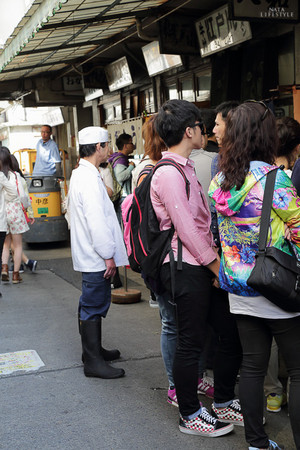
The white-hatted staff member maintaining the queue that day was quite fierce. Even though I couldn’t understand what he was saying, his tone sounded urgent and angry—it was a bit intimidating.

They only accept cash, not credit cards, so please keep that in mind. We started queuing around 6:40 a.m. and finally got in at 7:30 a.m.—phew. But we were faster than Sushi Dai; their service was noticeably slower. If it weren’t for the long wait, I would’ve loved to try both.

The shop is divided into two sections. This is one of them, where customers all sit at the counter waiting for the chef to handcraft the sushi right in front of them.

The space is narrow, with the aisle behind the customers only allowing one person to pass through at a time.

The seat we got was at the entrance counter area, with table settings as shown in the photo.

There were quite a few customers from Europe and America. Among them, this foreigner wearing a white hat was from California—he was super enthusiastic and chatted with us, mentioning he’d been here many times. He even pulled out a business card and said we could visit his home if we had the chance (so friendly!). He finished his set meal first and then ordered several individual nigiri pieces, praising the chef while eating and ending with a look of pure delight—it was obvious he really loves this place.

The chefs were all very approachable and smiling, welcoming customers to take photos. Thankfully, we didn’t encounter the reportedly harsh service attitude. As for how we ate—we went for the set meal (3,500 yen per set + 8% tax), but à la carte is also available. For à la carte, you can just point to whatever you want from the refrigerated display and ask the chef to make it into nigiri sushi.
The first piece in the set—the tuna belly (otoro) nigiri—was incredibly delicious. The freshness goes without saying, with rich, buttery fat melting smoothly in your mouth before transforming into a sweet, mellow richness. The vinegared rice was slightly soft, lightly tangy and sweet with just the right amount of moisture. Fluffy yet firm and distinct, it was exactly my kind of rice texture.

The white squid was super thick, and once it was in my mouth, the texture was firm and juicy, bursting with delicate, smooth freshness—absolutely delicious.

The shrimp nigiri didn’t feel particularly special, but the shrimp meat itself was fresh, plump, and firm.

The sea urchin (uni) gunkan was the most amazing thing of the day.

It had a jelly-like QQ texture with a delicate liver-like smoothness, completely free of any fishy smell. It was extremely fresh and full of ocean flavor. The moment it melted smoothly in my mouth, I was deeply moved. This was incredibly delicious—it was my favorite piece in the set.

The tamago (sweet egg omelet) was sweet, rich, thick, and tender—rivaling the offerings of some famous tamago shops at Tsukiji Outer Market.

The miso soup was just okay—the only thing I appreciated was how finely chopped the scallions were...

The tekka maki (tuna rolls) included tuna-nori rolls and salmon roe rolls. Both had good flavor and texture.
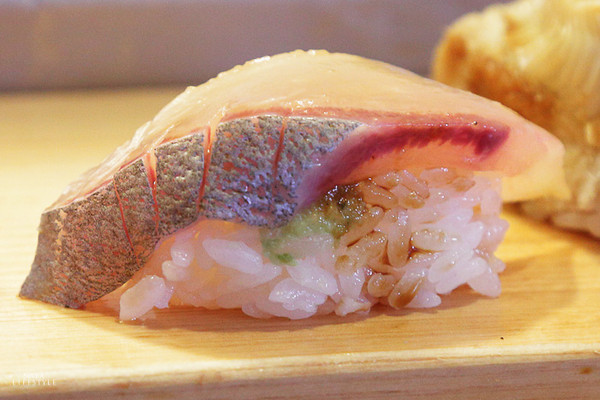
It looked like a tuna (maybe yellowtail) sashimi nigiri—the slice was pretty thick, with unbeatable freshness and bounce.

This piece, which I’m guessing was an ankimo (monkfish liver) or possibly aniseed eel (anago) nigiri, didn’t stand out much, but the texture of the fish was quite delicate.
The famous-shop nigiri sushi met a certain standard—we generally enjoyed it. However, while eating, two tourists from Taiwan kept complaining, saying they’d eaten much better elsewhere. Basically, every shop has its own specialty, and of course, there are many higher-end options. Perhaps the chef didn’t understand Taiwanese, but I think that Daiwa Sushi, located right next to Japan’s largest fish market, at least offers a solid level of seafood quality. If you don’t like it after eating, just don’t come back next time. Could everyone maybe refrain from criticizing the restaurant while eating?

By the way, the cheerful-looking chef in the photo is the owner’s son (in person, he reminded me a bit of the husband of celebrity Ivy Chen). This was probably the most luxurious "breakfast" I’ve ever had. I really liked this style of dining. Next time I come, even though I hate long queues, I’d really love to try Sushi Dai—hopefully, I’ll get the chance. Have you all tried these two famous Tsukiji shops? Or do you have other recommendations? Share them with us.
Info
Daiwa Sushi
Address: Tsukiji Nai 6, 5-2-1 Tsukiji, Chuo-ku, Tokyo
Business hours: 5:30–13:30
Nata Not Sloppy
Enjoys being a stylish lifestyle coffee lover and cooking researcher
Share
This article is published by HowToTrip. Sharing and reposting are welcome — please credit the source.
Article URL: https://www.howtotrip.net/views-18150
Related Articles
- Shaoxing's "Grandpa Gourd" hangs the gourds back up: "If there are too many people, we'll interact less — just take a quick look from afar"
- Chinese authorities announce "reciprocal adjustment" to Japan visa fees — single-entry visa jumps from 2,250 to 16,750 yen!
- The "health stones" carried by a traveler were found to have radiation levels exceeding safety limits by a thousand times, potentially endangering fellow passengers on the same flight. Customs issues warning!
- Shenzhen Airport Issues Late-Night Notice: Unidentified Aerial Object Detected, Causing Widespread Flight Delays!
- “They only said it cost money after I opened the box and washed it!” 200g of grapes sold for 60 yuan on a high-speed train—12306 responds!
- Can't buy an airline ticket? Denied exit? Blocked from boarding? A large number of Chinese tourists have mysteriously become "discredited individuals"
- Adverse weather and economic fluctuations impact Colombia's coffee market
- Beach bathing area responds to 2 yuan/30 seconds fee for freshwater foot rinsing: Clearly priced!
- Taking off with an improperly closed cabin door? Wing malfunction? Multiple flights made emergency returns mid-journey!
- Experience the gifts of nature! A countdown of the world’s ten most stunning coastlines