The unification of China by Qin Shi Huang owes a bit to this flavor — Guilin’s thousand-year-old fragrant and spicy rice noodles

▲ Traditional lucai rice noodles keep the broth and noodles separate, with the bowl containing the noodles and various slices of meat. (Photo / Reporter Chen Ruizhong)
Reporter Chen Ruizhong / Guilin report
Guilin, part of Guangxi, has seen its culture and eating habits influenced by surrounding regions such as Yunnan, Guangdong, and Guizhou. Its flavors tend to be sour, salty, and spicy, and the food variety is incredibly diverse. Among the many dishes found on Guilin’s streets, the most iconic street food is “Guilin rice noodles.”
Unlike Hsinchu rice noodles, which are thin, long, and have a semi-transparent sheen, and unlike Taipei rice noodles, which are thick, short, and served in soup, Guilin rice noodles are about the thickness of a thin chopstick — somewhat like a fusion between ramen and rice vermicelli. They can be eaten dry or with soup, and their clean white color is very refreshing.
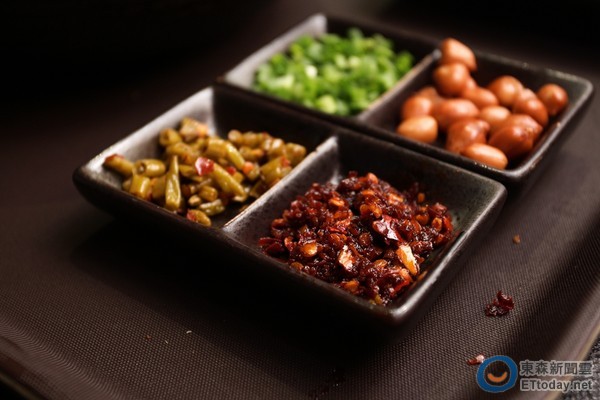
▲ Fried chili peppers, pickled beans, peanuts, and chopped scallions are the most basic toppings for Guilin rice noodles.
Legend has it that Guilin rice noodles were first created during the Qin Dynasty, over a thousand years ago. At that time, Qin Shi Huang, in his quest to unify China, sent 500,000 troops on an expedition to the southern Yue region and stationed soldiers in Guilin. However, the soldiers from the north suffered from digestive issues due to the unfamiliar climate and diet, as they were not accustomed to eating southern-style rice. As a result, the army often went hungry and fell ill. To solve the problem, the army cooks imitated the northern method of making wheat-based noodles by grinding rice into powder, creating a paste, and extruding it into noodle-like strands. They then cooked these in a medicinal broth made from various Chinese herbs to suit the soldiers' taste preferences while also providing health benefits — thus forming the prototype of today’s Guilin rice noodles.
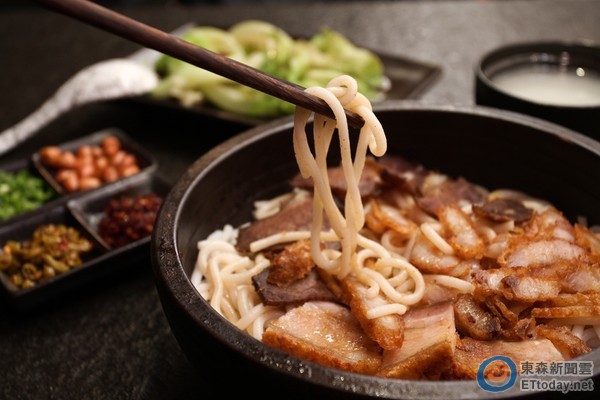
▲ Guilin rice noodles are thicker than Hsinchu noodles but longer than Taipei noodles, resembling a fusion between ramen and rice vermicelli.
After enduring a long history, Guilin rice noodles now come in a wide variety of flavors and ingredients. Among them, the most traditional and authentic version is the type eaten with a savory broth known as“Lucai Rice Noodles”— the most famous variety.
The so-called lucai rice noodles consist of boiled noodles served separately in a bowl, then topped with ingredients such as fried pork (known as "guo sha"), braised beef slices, and char siu. Customers can customize their bowl with chili peppers, peanuts, pickled beans, and scallions according to their taste, and finish it off with a pour of specially prepared savory broth. Everything is mixed together before eating.
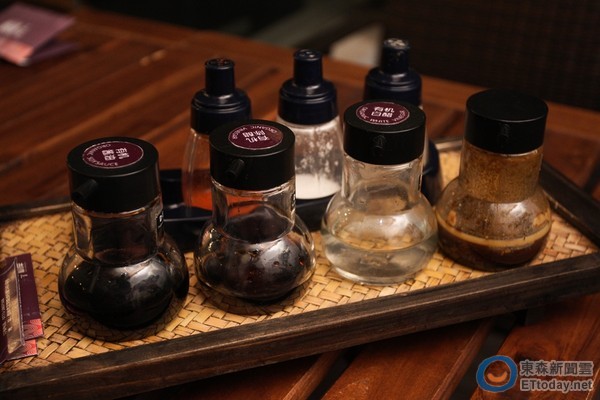
▲ In addition to the special savory broth (right), customers can also adjust the flavor with additional sauces.
Guilin rice noodles emphasize a balance between smoothness and chewiness. They’re refreshing and slippery when you “slurp” them, yet bouncy rather than tough when you “chew” them. The meat toppings, prepared through frying, braising, or roasting, showcase the diversity of Chinese culinary techniques. The generous use of chili peppers, pickled beans, and peanuts gives the dish a comprehensive traditional Guilin flavor profile — tangy, fragrant, salty, and spicy — along with varied textures: soft, hard, and crispy. Every aspect, from texture to taste, is designed to whet the appetite and go down smoothly, often leaving diners unknowingly finishing a whole bowl. No wonder Guilin rice noodles became the standard meal ration for the Qin Dynasty army.
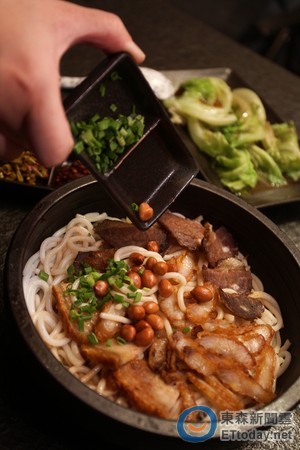
%The rich and aromatic aroma of the broth is very enticing upon first smell.
According to local guide Zhu Datong, high-quality Guilin rice noodles should be made using water from the Li River to achieve a sweet and smooth taste.Beyond the noodles themselves, the savory broth used for seasoning is the soul of Guilin rice noodles. A good broth is made by simmering ingredients such as beef bones, fermented black beans, star anise, and monk fruit — among more than ten different spices — and cannot simply be replaced with ready-made soy sauce. Although rice noodle stalls are everywhere in Guilin, every vendor has their own unique broth recipe, giving each spot a distinct flavor. Add to this the many other combinations such as sour-spicy noodles, beef noodles, and horse meat noodles, and the possibilities become endless.
On the street, Guilin rice noodles are priced by weight, usually around 1–2 liang (a Chinese unit of weight), which is enough to fill an adult. Prices start at around 4–5 RMB (approximately 20–25 TWD). In more upscale restaurants, each bowl may start at around 30 RMB, with prices varying. After taking in the beauty of Guilin’s landscapes, why not enjoy a bowl and experience this millennia-old Guilin flavor.
Share
This article is published by HowToTrip. Sharing and reposting are welcome — please credit the source.
Article URL: https://www.howtotrip.net/views-12307
Related Articles
- Shaoxing's "Grandpa Gourd" hangs the gourds back up: "If there are too many people, we'll interact less — just take a quick look from afar"
- Chinese authorities announce "reciprocal adjustment" to Japan visa fees — single-entry visa jumps from 2,250 to 16,750 yen!
- The "health stones" carried by a traveler were found to have radiation levels exceeding safety limits by a thousand times, potentially endangering fellow passengers on the same flight. Customs issues warning!
- Shenzhen Airport Issues Late-Night Notice: Unidentified Aerial Object Detected, Causing Widespread Flight Delays!
- “They only said it cost money after I opened the box and washed it!” 200g of grapes sold for 60 yuan on a high-speed train—12306 responds!
- Can't buy an airline ticket? Denied exit? Blocked from boarding? A large number of Chinese tourists have mysteriously become "discredited individuals"
- Adverse weather and economic fluctuations impact Colombia's coffee market
- Beach bathing area responds to 2 yuan/30 seconds fee for freshwater foot rinsing: Clearly priced!
- Taking off with an improperly closed cabin door? Wing malfunction? Multiple flights made emergency returns mid-journey!
- Experience the gifts of nature! A countdown of the world’s ten most stunning coastlines