The Last Matriarchal Society on Earth!Step into the Tranquil Embrace of Lugu Lake
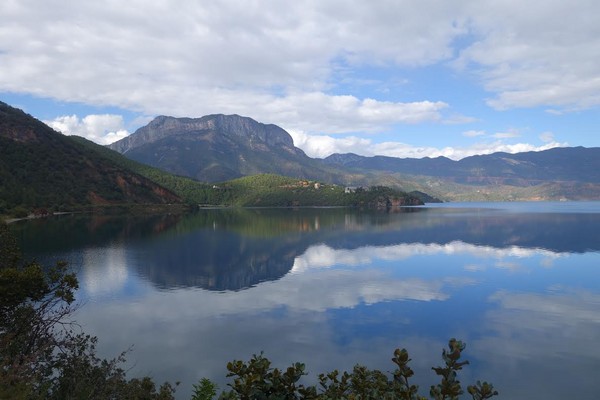
Photos and text / Excerpted from "Bathing My Soul in Tibet", authored by Liu Shiming.
Once you enter Lugu Lake, you won’t want to leave. The days are so gentle, without even a ripple; people are as lazy as the swaying aquatic plants by the lake, and even time seems to stagnate dully.
I got up at seven in the morning to catch a bus, wanting to save the good weather for Jade Dragon Snow Mountain, so I headed to Lugu Lake first. The bus tickets were booked through the inn, sixty yuan round trip per person.
Sitting in front of us was an elderly couple from Beijing. Their tone of conversation was gentle, and they were very considerate toward me and A-Qin, much like the cheerful and contented attitude of the elderly couple in "Backpackers in Their Sixties." We chatted animatedly along the journey and learned a touching story.
It turned out the aunt had throat cancer and was undergoing regular chemotherapy. Her son hoped that traveling would help her relax and shift her mood, so he booked round-trip flights to Yunnan and covered all travel expenses. I could feel the son’s filial piety, as well as the couple’s serene enjoyment of the trip. They appreciated their blessings, treated everyone they met kindly, and I still remember their kind smiles and the sight of them walking hand in hand.
The most important thing in life is not how long you live, but that you have truly loved, lived without regrets, and experienced the romance of having someone accompany you until your hair turns white. That’s enough for a lifetime. I look forward to seeing you both stay healthy and explore mountains and rivers until the end of time.
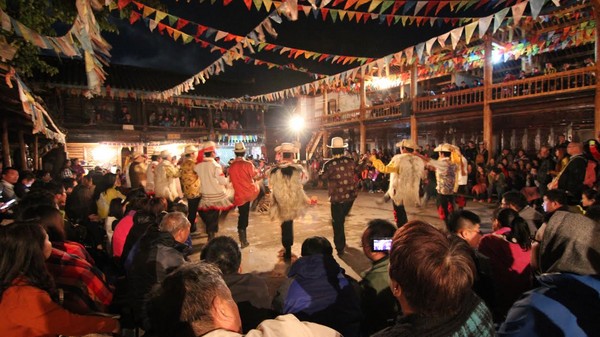
The lively atmosphere of the bonfire party
Upon first arriving at Lugu Lake, it rained slightly, with a fine mist shrouding the area and making visibility poor. The mood was subdued, but every experience felt like an adventure. What mattered most was being present in the moment, not just discussing the weather. If there were no clouds in this world, people might become too complacent and lose their appreciation for beautiful things.
The Last Matriarchal Society on Earth is the enchanting vision that Lugu Lake offers to travelers. The Mosuo people hold women in high esteem within the family. Children reside matrilineally, and only form "Azhu" intimate partnerships, practicing the "walking marriage" custom where "men do not marry and women do not wed."
The Mosuo "walking marriage" custom has a pointed explanation: "The man slips in at night and slips out in the morning." Love here is free from the constraints of marriage, focusing solely on emotion, without regard for economic status, family background, or social standing. If personalities clash or feelings fade, the relationship can be severed at any time. When love enjoys pure freedom, can eternal true love be preserved? Or does it only value the experience of having had it?
Coincidentally, these past two days in Lige were undergoing fire safety inspections, and all guests were not allowed to check in. Previously, Ruiqi had talked excitedly about the beautiful lakeside views we were unable to enjoy. Since we were already here, we decided to make the best of it. The most beautiful part of a trip isn’t uncovering everything, but leaving some things unexplored; only by feeling a sense of incompleteness will you find yourself missing it and falling in love all over again, giving you reason to return.
The driver dropped us off at Daluoshui, and we searched for accommodation along the way. The youth hostel that A-Qin originally liked was full. He stared at the lake view and pool table, his face full of resignation. In the end, we found a standard room for 120 yuan. Although we couldn’t see the lake, the environment and facilities were decent.
The elderly couple from Beijing found a lakeside room near the dock. With the window open, they could watch the sunrise right from their bed, and the price was also 120 yuan. We could only console ourselves: the older, the wiser.
To kick off our visit, we joined an add-on tour recommended by the driver: having dinner with a Mosuo family and attending a bonfire party.
We went to Xiaoluoshui for the evening event, visited ancient wooden cabin houses, and entered the grandmother’s room for welcome snacks. The room retained its classic old-style decor, and on the bed slept the most powerful woman in the entire family.
Besides driving, the driver also acted as the host, hyping up the atmosphere and assigning each table to send someone on stage to perform. The quick-witted A-Qin was naturally chosen by everyone. Unexpectedly, the usually mischievous guy became so nervous on stage that he stammered. I had to go on stage to rescue him and even dragged some fellow Fujian tourists from the neighboring table to sing the Hokkien song "The World's Number One" with us.
After the appetizers, we moved into the dining hall for dinner. The table was filled with fifteen dishes plus two bottles of alcohol — a truly sumptuous meal. Mosuo young men played guitars and sang by the side. I figured that as long as the atmosphere was lively and everyone was happy, money would flow naturally. I bought a photo with one of the young men, though I later found out the ones taken by my camera actually looked better.
Traditional bonfire parties are occasions for Mosuo men and women to subtly observe and express affection for each other. If you fancy someone, you gently scratch their palm three times. If they respond in kind, the suitor may visit the lady’s room under the cover of night.
Nowadays, the bonfire parties, with their performances and songs, resemble the cultural shows of Taiwan’s indigenous peoples and have become an evening entertainment activity for tourists. It’s mainly about soaking in the joyful, lively atmosphere. In the end, tourists join hands to dance around the fire pit, crowding in so tightly you can’t get in, and even lining up to take photos with Mosuo performers is impossible. When traveling in mainland China, it’s important to go with the flow and not be too shy — boldness counts.
On the road, you’ll often come across travel bookstores tailored for visitors. I always spend a bit of time browsing and picking out postcards to soak in the local culture, just like "Heavenly Time" in Lhasa and "Mosuo Time" in Lugu Lake. "Mosuo Time" is dedicated to promoting local culture, producing Mosuo-themed character merchandise, as well as recording Mosuo songs and music videos.
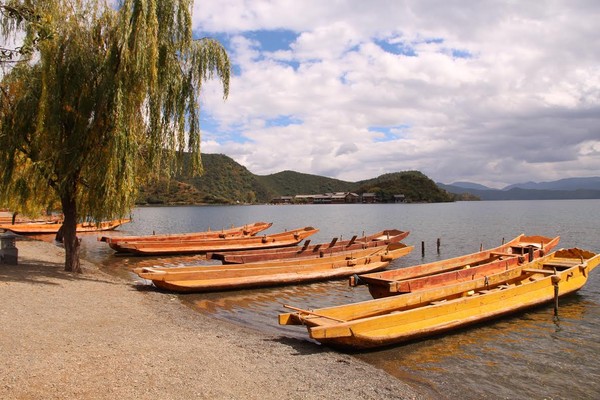
Into the Quietest Part of the Lake
Sometimes you want to go somewhere to revisit a landscape that once resonated in your memories. Xie Wanglin’s "Turning the Mountain" spent some of its most tender moments in Lugu Lake. That piece of writing stirred my heart deeply, leading to a journey of pursuit — a pilgrimage — which later became something I deeply cherished.
Lugu Lake is said to be formed from the tears of the sorrowful goddess Gemu, earning it the name "the lover’s tear." Its maximum visibility can reach twelve meters.
Lugu Lake is located at the border of Sichuan and Yunnan, with one-third in Yunnan and two-thirds in Sichuan. More visitors come from the Yunnan side, but the Sichuan side preserves more natural landscapes and traditional village architecture. Next time, I’d like to experience the authentic Mosuo culture.
Cycling around the lake is the most straightforward way to take in Lugu Lake’s scenery. There are two transportation options: bicycle or electric scooter. To save money, we chose bicycles. If we couldn’t finish the ride, no worries — we’d just cruise along the mountain-and-lake roads at our own pace.
From Daluoshui to Lige Peninsula, we wandered slowly, stopping and starting along the winding lakeshore, surrendering our hearts to the mysterious and intoxicating blue.
Lige Peninsula juts out into Lugu Lake. Surrounded by water on three sides, it offers a unique lakeside view. The island is dotted with inns built right by the water. We arrived at Lige by noon, and the accommodation restrictions had been lifted, but unfortunately, we couldn’t stay there.
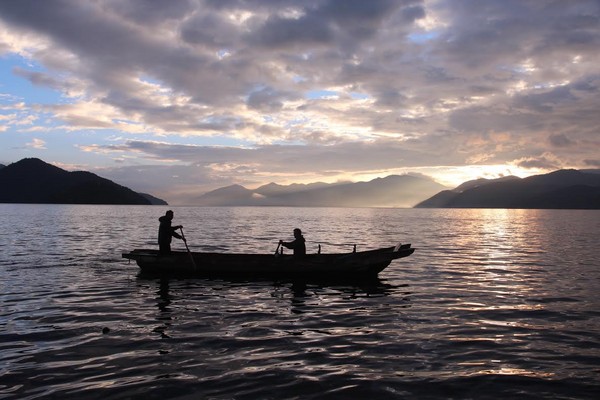
The inn posted a "boating to watch the sunrise" tour that deeply intrigued me. The Lige sunrise is a famous photography spot. Paddling through the lake shrouded in morning mist feels like entering the dwelling of immortals.
We lounged on the dock basking in the sunlight, our hearts swaying freely with the lakeside aquatic plants, delighting in the carefree flight of seagulls, lost in a deep blue, translucent daydream. Traveling — isn’t it just about living somewhere else, and daydreaming somewhere else?
On the way back, the wind suddenly died down, and the lake surface became as still as a mirror. I saw two azure skies, just like the “jellyfish sea” I once saw while serving in the navy on a long voyage. When a ship passes through the equatorial doldrums, if the wind stops, the sea becomes as smooth as glass, and when the ship cuts through, it’s like slicing into a piece of jelly — the Taiwanese navy calls it the “jellyfish sea.”
That day, the wind stopped, and everyone rushed to the deck to witness the spectacle. The sea acted like a refracting mirror, reflecting the dazzling horizon, staging two magnificent sunsets like burning fireballs sinking into the ocean, leaving behind a sky full of embers. Even now, the memory still leaves me in awe.
Someone once asked me, “What’s the most beautiful scenery you’ve ever seen in your life?”
I replied, “The jellyfish sea — that only happens during an ‘absolute moment’ when time, place, and people align perfectly.”
The wind began to stroke the lake again like silky satin. Standing within the vast embrace of the mountains and waters, my inner melancholy found release; I felt an unprecedented sense of calm, and got to know myself a little better. It turns out I’m so unfamiliar with myself, and how strong I am is matched by how fragile I can be.
Four Cantonese friends we’d met on the bus invited us to dinner. After the meal, we strolled along the lake enjoying the moonlight — the entire night seemed illuminated only by the moonlight on the water. We hopped onto a boat by the lakeside and chatted about everything under the sun, reaching out to touch the lake water. We had thought the autumn water would be cool, but it turned out to be warmer than the temperature of our hands.
Everyone lay on the boat like nesting in a soft mattress, gently swaying with the small waves. Swinging and swinging, we drifted off to sleep, quietly merging into the boundless water and moonlight. Lugu Lake was even tender at night, making one’s heart ache with affection.
Everything in Lugu Lake is transparent, even the sunrise feels like a quiet and clear dream. On the morning of our departure, I watched the sunrise alone by the lakeshore. The crisp air was invigorating, with wisps of ethereal mist rising from the lake. Suddenly, spectacular beams of light poured down from the clouds, piercing through the heart of the lake and warming my heart too. Facing the tender light and enchanting hues where water and sky merged, I whispered softly, “Goodbye.”
The gentleness of Lugu Lake is a kind of mystery. Behind the tranquility of its emerald waters, I left behind the serene moments of my twenty-eighth year.
Share
This article is published by HowToTrip. Sharing and reposting are welcome — please credit the source.
Article URL: https://www.howtotrip.net/views-10761
Related Articles
- Shaoxing's "Grandpa Gourd" hangs the gourds back up: "If there are too many people, we'll interact less — just take a quick look from afar"
- Chinese authorities announce "reciprocal adjustment" to Japan visa fees — single-entry visa jumps from 2,250 to 16,750 yen!
- The "health stones" carried by a traveler were found to have radiation levels exceeding safety limits by a thousand times, potentially endangering fellow passengers on the same flight. Customs issues warning!
- Shenzhen Airport Issues Late-Night Notice: Unidentified Aerial Object Detected, Causing Widespread Flight Delays!
- “They only said it cost money after I opened the box and washed it!” 200g of grapes sold for 60 yuan on a high-speed train—12306 responds!
- Can't buy an airline ticket? Denied exit? Blocked from boarding? A large number of Chinese tourists have mysteriously become "discredited individuals"
- Adverse weather and economic fluctuations impact Colombia's coffee market
- Beach bathing area responds to 2 yuan/30 seconds fee for freshwater foot rinsing: Clearly priced!
- Taking off with an improperly closed cabin door? Wing malfunction? Multiple flights made emergency returns mid-journey!
- Experience the gifts of nature! A countdown of the world’s ten most stunning coastlines