The magnificent and dazzling Gothic: St. Vitus Cathedral in Prague
By Li Guangzhen
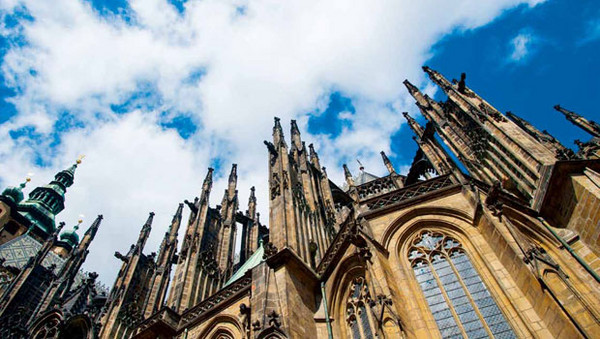
Photo caption: St. Vitus Cathedral (Photographer: Li Mingyi)
Known as a "treasure of architecture," St. Vitus Cathedral took seven centuries to build and stands as a splendid example of Gothic design. Its beauty lies in its spires, net-like vaults, and flying buttresses, which leave visitors awestruck. The vast stained-glass windows create a mysterious brilliance, and the artwork on them vividly expresses people's reverence for the heavens and longing for paradise.
Those familiar with architectural history know that Barcelona’s Sagrada Família in Spain has been under construction since 1882, when the eccentric genius Antoni Gaudí first conceived it—and it still isn’t finished after 133 years. But the most “excruciatingly slow” project in the world might be Prague’s St. Vitus Cathedral, which began in 1344 and was completed in 1929—spanning a full seven centuries.
In the 9th century, the Czech dynasty built a royal palace atop this strategic high point. Over the centuries, it passed through the Holy Roman Empire, the Habsburg Monarchy, and the Austro-Hungarian Empire, and now serves as the seat of the Czech President.
Upon entering the castle and just beyond the spacious central courtyard, less than 20 meters from the presidential office building, you’ll unexpectedly come face-to-face with St. Vitus Cathedral. Its twin towers, soaring 82 meters high, rise from the ground, flanking what is hailed as the “most beautiful rose window in Europe.”
Around the cathedral, you’ll also find one of the most distinctive features of Gothic architecture—flying buttresses. Though Gaudí jokingly referred to these intricate structures as “tall people using crutches,” they are actually quite beautiful. Why so many “crutches”? Because Gothic cathedrals emphasize “loftiness,” using the vertical lines of the spires to draw the worshippers’ gaze upward toward the heavens and the Almighty overlooking all creation, inspiring awe and reverence.
Mucha’s Window: Painting the Realm of the Divine
Inside the cathedral, in addition to the magnificent, towering net-like vaults, the long stained-glass windows in red and blue around the church are dazzlingly vibrant, and they carry symbolic meaning: red represents the blood of Jesus Christ, while blue symbolizes the kingdom of heaven.
Stained glass is a crucial element of religious art, visible in Islamic mosques and Catholic churches alike. But Gothic cathedrals took this art form to its peak, minimizing solid walls and filling the space with translucent glass.
Ironically, most of these stained-glass windows are 20th-century creations, some even added after the cathedral’s completion in 1929. The window panes even bear the names of donors—insurance companies, banks, the Ministry of Education, and the like—which seem somewhat out of place in this ancient setting.
Fortunately, there’s one famously remarkable piece that compensates for this—an acclaimed work known as the “Mucha Window,” painted by Art Nouveau master Alphonse Mucha.
A Century-Long Architectural Relay
The story begins in 1344, when Charles, the Bohemian crown prince with both Luxembourg dynasty German and Bohemian royal Slavic heritage, ordered the expansion of the Romanesque church within Prague Castle into a Gothic cathedral—the most popular style of the time. He brought in renowned architect Matthias of Arras from Avignon, France.
Eight years later, when Matthias died, only a small portion of St. Vitus Cathedral had been built. By then, Charles had already ascended to the Bohemian throne. He then hired Peter Parler, a talented young architect from a famed German family, who later created the famous “Parler-style vaults” seen in the cathedral today.
In 1355, Charles “leveled up” from King of Bohemia to Holy Roman Emperor, taking the name Charles IV, and established Prague as the imperial capital. A man of great vision, he not only aimed to build a grand cathedral but also bridges, universities, and various other structures. Parler worked tirelessly, but by the time of his death, only half of the cathedral had been completed—his two sons took over the project.
Then came the infamous Hussite Wars. Afterward, the focus of the Holy Roman Empire shifted to Vienna, and Prague became a playground for nobles, rendering the grand cathedral seem superfluous. As a result, construction dragged on year after year. It wasn’t until the mid-19th century, spurred by the completion of Cologne Cathedral in Germany, that efforts were intensified to finally realize the great vision of Emperor Charles IV for his homeland.
[ More Reports ]
※ For the full story, see Business Weekly.
※ This article is authorized by Business Weekly. Reproduction without permission is prohibited.
Share
This article is published by HowToTrip. Sharing and reposting are welcome — please credit the source.
Article URL: https://www.howtotrip.net/views-10744
Related Articles
- Shaoxing's "Grandpa Gourd" hangs the gourds back up: "If there are too many people, we'll interact less — just take a quick look from afar"
- Chinese authorities announce "reciprocal adjustment" to Japan visa fees — single-entry visa jumps from 2,250 to 16,750 yen!
- The "health stones" carried by a traveler were found to have radiation levels exceeding safety limits by a thousand times, potentially endangering fellow passengers on the same flight. Customs issues warning!
- Shenzhen Airport Issues Late-Night Notice: Unidentified Aerial Object Detected, Causing Widespread Flight Delays!
- “They only said it cost money after I opened the box and washed it!” 200g of grapes sold for 60 yuan on a high-speed train—12306 responds!
- Can't buy an airline ticket? Denied exit? Blocked from boarding? A large number of Chinese tourists have mysteriously become "discredited individuals"
- Adverse weather and economic fluctuations impact Colombia's coffee market
- Beach bathing area responds to 2 yuan/30 seconds fee for freshwater foot rinsing: Clearly priced!
- Taking off with an improperly closed cabin door? Wing malfunction? Multiple flights made emergency returns mid-journey!
- Experience the gifts of nature! A countdown of the world’s ten most stunning coastlines