Even Eason Chan loves it!Hong Kong’s best dim sum spot — must-try signature egg custard buns
Text & Photos /Xiao Hu’s Dream Food Blog
Having visited Hong Kong four times, I was constantly on the hunt for authentic Cantonese dim sum, curious to see how it differed from what we have in Taiwan. In the end, while hotel dim sum generally maintained a higher standard than in Taiwan, it somehow lacked that “freshness” — a freshness that speaks of uniqueness, both visually and in taste.

Each time I go to Hong Kong, I rely on our go-to guide from the Tiger Head Gang. He always finds unique little spots for us to try. For instance, this place — I’m told even he hadn’t eaten there before. Located in Kennedy Town at the westernmost tip of Hong Kong Island, Sun Hing Restaurant is in an area where development has been relatively slow. Even the MTR (the western terminus of the Hong Kong Island Line) only opened at the end of 2014.

It’s just a five-minute walk from the MTR station, making it quite convenient even for travelers relying mostly on public transport. A sign hanging at the entrance, awarded by CNNGO as one of the best dim sum spots, gives it more fame than many well-known old establishments.

This place is also apparently one of Eason Chan’s favorite dim sum joints. PS: Out of those 13 shops mentioned earlier, I wonder how many you’ve tried? According to Ah Kang, No. 13, Lung King Heen, is the only dim sum restaurant in Hong Kong that’s earned a Michelin three-star rating.

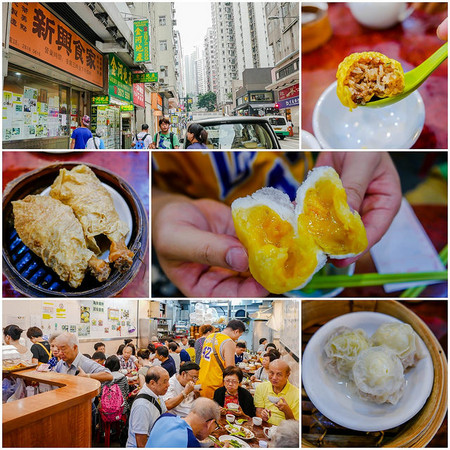
From the outside, you’d never guess the place is this bustling once inside, and it’s mostly filled with slightly older locals — very few tourists. Of course, sharing tables here is totally the norm; if you’re not cool with that, don’t come at all.

But rather than making me uncomfortable, the atmosphere of scrambling for seats, fighting over food, and messy tables actually filled me with joy — “This is the vibe I came for.”

The main dishes they offer are roughly these. For other dim sum, you either ask or grab what you can. If you don’t speak Cantonese, Mandarin works okay; if communication is truly impossible, just point to what the locals around you are eating — guaranteed hit.

Other than that, the posters on the walls show the shop’s signatures. You can just point at those too, but the staff are super busy, so don’t expect them to come check on you — XD.

At traditional dim sum joints like this, sitting down often means missing out on the best stuff unless you really know your way around. I recommend standing near the steamer baskets and grabbing whatever catches your eye. If a place is busy, chances are most of their dim sum is pretty good.

Want tea? Sure, you can ask the auntie to pour some, but the fastest way is to just help yourself. Unless you’re at a fancy hotel in Hong Kong, don’t expect Taiwan-style service.

Funny enough, about twenty years ago, such scenes were common in Taiwanese restaurants too. I know a lot of Taiwanese would be shocked seeing this, but it’s actually part of Hong Kong’s drink culture.

When you take dim sum, the auntie will mark your bill next to your table. I stared at it for ages and still have no idea what she’s writing, but when it comes time to pay, that’s the slip you use.

But since there might be three to five groups sharing one table, make sure she doesn’t mark the wrong bill. Paying for someone else’s meal is like treating them, but if your order ends up on someone else’s tab, that’s just awkward. When traveling, let’s keep Taiwan’s reputation intact.

Signature Egg Custard Bun (HK$17). Ah Kang says this is Sun Hing’s most impressive and iconic dim sum — the main reason he brought us here. At first glance, I thought it was a pork bun... but the answer was “egg custard bun.” Honestly, it didn’t look like one at all...

When you cut it open, the filling bursts out — super eye-catching. First off, the balance between the creamy eggy flavor and salted egg yolk aroma is just right (slightly creamier), and the luscious, gooey texture is amazing. Flavor-wise, it’s definitely the best egg custard bun I’ve ever had. BUT, if I’m being picky, it’s slightly over-steamed — the bottom is a bit mushy. Still, I bet a freshly steamed one would be even better. Regardless, the custard filling is outrageously delicious.

Curry Beef Tripe (HK$17). The tripe slices are super thick but surprisingly tender without being too soft. Aside from a milder-than-expected curry fragrance (with a bit of juice bursting), the tripe itself brings out a subtle sweetness — now that’s skill.

Black Pepper Pork Tripe (HK$17). Taiwanese folks know pork tripe, but adding black pepper? That’s probably a Hong Kong thing. It’s steamed, not stir-fried, so the black pepper aroma isn’t as harsh as in the Taiwanese style — not too pungent or overpowering. With pickled vegetables underneath, it offers a whole different tripe flavor. Texture-wise, it’s between crispy and soft, quite tasty. But I’d suggest picking either this or the beef tripe above unless you’re in a big group.

This dim sum looks kind of like a siu mai but also a bit like a steamed dumpling. I stared at the DM board forever and still couldn’t figure out the name. Later, I asked Ah Kang (maybe it’s No. 63, the Mushroom Siu Mai?). Either way, it looked pretty unique.

When I bit into it, I realized some high-end Taiwanese hotels serve something similar. It’s mainly a siu mai filling with a pigeon egg on top. The base filling is somewhat like Taiwanese siu mai, but the texture and taste are even better. The pigeon egg adds uniqueness, though I wouldn’t say it added any major “wow” factor. But honestly, the base filling alone was enough to delight me.

Crab Roe Siu Mai (HK$20). To be honest, this siu mai doesn’t look particularly stunning, but after half a bite, I almost jumped. The filling is springy and delightful, and the moment you bite in, it bursts with juice. The flavor is incredibly sweet and rich... When I asked Ah Kang, he said it’s just a regular yet delicious Hong Kong siu mai. At that moment, I finally understood why many Hongkongers find dim sum in Taiwan unpalatable — it all comes down to this solid, no-frills siu mai.

Retro Glutinous Rice Wrap (HK$15). Besides the egg custard bun, this is another highly popular dim sum at Sun Hing. But you can’t really tell what’s inside from the outside — XD.

The outer layer looks like ultra-thin bean curd skin, which doesn’t have much flavor, but the glutinous rice filling inside is phenomenal. It’s not salty or greasy in appearance, but as you chew, you get the pure sweetness of the rice, plus a faint aroma similar to Taiwanese fried rice (but without sesame oil or dried shrimp). Even better, the rice grains are separate and not sticky at all — I love the texture and flavor. Even if it’s not super bold, aside from the egg custard bun, this is my personal top recommendation — a must-order.

Crispy Fried Milk (HK$15). This isn’t hard to find in Taiwan either, but the pieces here are generally bigger. It arrives cold, which slightly affects the crispiness. The milk flavor is smooth and natural. It’s not mind-blowingly good, but there are no weird surprises either.

To be fair, the texture doesn’t get mushy — it melts decently in your mouth.

This is the final bonus dish (because we had breakfast at three places that day...). Taro Duck Feet Roll (HK$20). I’d never seen, let alone eaten, anything like this in Taiwan, so when Ah Kang mentioned it, I insisted we had to try it.

Simply put, it’s made by wrapping duck feet, taro, and a bit of pork filling in bean curd skin — the presentation is super unique.

The flavor is actually lighter than I expected, with a subtle oyster sauce taste. The duck feet are pre-marinated, so they’re quite flavorful even on their own. However, taking big bites of this dish is genuinely inconvenient, mainly due to the duck bones. As a result, I ended up eating the taro and meat filling while nibbling on the duck feet, which was still a rather unique experience.
Xinxing Food House
Address: G/F, Mei Fai Building, 8 Smithfield Road, Sai Wan, Hong Kong
Phone: 852 2816 0616
Business Hours: 03:00–16:00
"Xiaohu’s Dream-Eating Web
If “eating” is just about filling your stomach, then “food” would be far too boring~~~"
Share
This article is published by HowToTrip. Sharing and reposting are welcome — please credit the source.
Article URL: https://www.howtotrip.net/views-10261
Related Articles
- Shaoxing's "Grandpa Gourd" hangs the gourds back up: "If there are too many people, we'll interact less — just take a quick look from afar"
- Chinese authorities announce "reciprocal adjustment" to Japan visa fees — single-entry visa jumps from 2,250 to 16,750 yen!
- The "health stones" carried by a traveler were found to have radiation levels exceeding safety limits by a thousand times, potentially endangering fellow passengers on the same flight. Customs issues warning!
- Shenzhen Airport Issues Late-Night Notice: Unidentified Aerial Object Detected, Causing Widespread Flight Delays!
- “They only said it cost money after I opened the box and washed it!” 200g of grapes sold for 60 yuan on a high-speed train—12306 responds!
- Can't buy an airline ticket? Denied exit? Blocked from boarding? A large number of Chinese tourists have mysteriously become "discredited individuals"
- Adverse weather and economic fluctuations impact Colombia's coffee market
- Beach bathing area responds to 2 yuan/30 seconds fee for freshwater foot rinsing: Clearly priced!
- Taking off with an improperly closed cabin door? Wing malfunction? Multiple flights made emergency returns mid-journey!
- Experience the gifts of nature! A countdown of the world’s ten most stunning coastlines