Shennong Altar
Shennong Altar

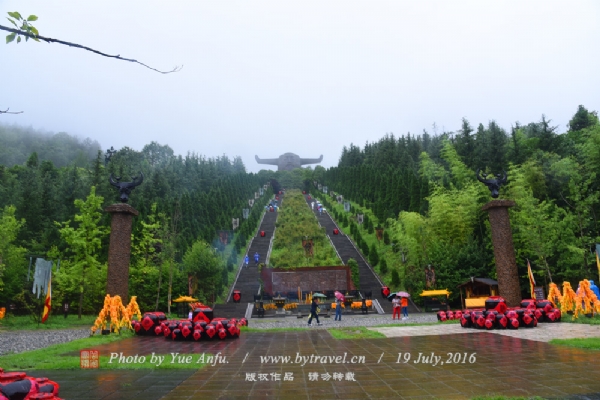
The Shennong Altar consists of two sections: the Heaven Altar and the Earth Altar, both built against the mountain. At the center of the Heaven Altar stands a massive statue of Emperor Yan (Shennong) with the head of an ox and a human body. Below the Heaven Altar lies the Earth Altar, which features a spacious square that can accommodate thousands of people. The large circular pattern on the square represents Heaven, while the square at its center symbolizes Earth. Within the square pattern, five-colored stones are arranged to represent the Five Elements: Wood, Fire, Earth, Metal, and Water.
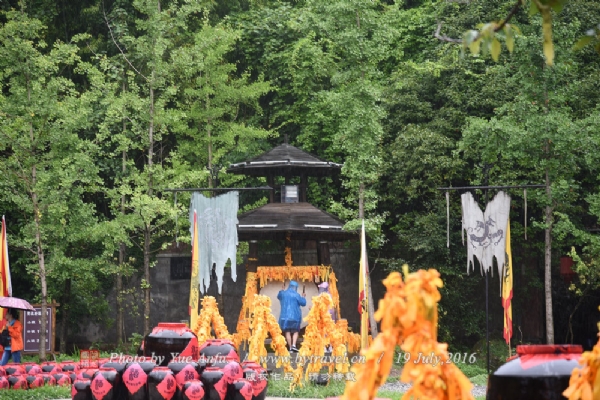
At the front of the Earth Altar Square, there are two 10-meter-tall totem poles resembling Huabiao (ornamental columns), standing on either side, with ox-headed sculptures on them. Behind the totem poles are two large-scale reliefs depicting the great achievements of Emperor Shennong’s life. Between the totem poles and the reliefs is the sacrificial altar. The altar is designed entirely according to the specifications of ancient imperial sacrificial altars, with nine ding tripods and eight gui food vessels cast in bronze placed centrally. Incense burners, offering tables, golden bells, and ritual drums are arranged in front of the altar, presenting a solemn and majestic scene.
To ascend from the Earth Altar to the Heaven Altar, one must climb 243 steps, divided into five levels. Starting from the bottom, the first level has 9 steps, known as “ming jiu” (explicit nine); the next four levels have 72, 63, 54, and 45 steps respectively—all multiples of nine, known as “an jiu” (implicit nine). This “supreme nine-five” design subtly reflects the exalted status of Shennong.
After climbing the 243 steps, you will reach the viewing platform in front of the Shennong statue on the Heaven Altar. Gazing up at the statue of Shennong—depicted with the head of an ox and a human body, eyes slightly closed, majestic and ancient, as if silently contemplating the universe—you’ll notice the statue has no pedestal, rising directly from the ground with its head touching the blue sky and its body draped in colorful clouds. The Shennong statue is 21 meters tall and 35 meters wide, adding up to 56 meters, symbolizing the flourishing and prosperous unity of China’s 56 ethnic groups.
A highlight of the Shennong Altar experience is the local bonfire barbecue evening, featuring performances such as ancient hunting scenes, traditional weddings, and double-flower stick dances. Local youths also sing love songs to each other and exchange shoes as tokens of affection. Of course, you can also enjoy barbecued game, and during the meal, local mountain girls will offer you Shennong yellow rice wine, teach you folk mountain songs, and create a joyful, festive atmosphere.
Nestled among emerald-green mountains, the Shennong Altar has now become a sacred site where Chinese people from home and abroad come to pay homage and worship their ancestors.
Xie Chun (?~1129) Xie Chun (?~1129), styled Jingxiang, was a native of Liuyang in the Song Dynasty. He was renowned for his talent and bravery. In the third year of the Jianyan era of the Southern Song Dynasty (1129), a mutiny broke out in Tanzhou (modern-day Changsha), marked by arson and looting. The regional military commander Xiang Ziyin ordered Meng Yanqing, the prefectural administrator, to pacify the rebels. Soon after, mutinous soldiers led by Du Yan invaded Liuyang, where Meng was defeated and killed. Xiang then ordered Zhao Minyan, another prefectural administrator, to lead troops against the rebels, but they were unsuccessful. At the time, Xie Chun led a militia as the vanguard to assist Zhao in battle. He personally slew dozens of enemies but was eventually overpowered, captured, and killed by the rebels. Upon hearing of his death, the imperial court posthumously awarded him the title of Chengzhong Lang and granted an official position to his son, Xigu... Details+

Share
This article is published by HowToTrip. Sharing and reposting are welcome — please credit the source.
Article URL: https://www.howtotrip.net/travel-9616
Related Articles
- Shaoxing's "Grandpa Gourd" hangs the gourds back up: "If there are too many people, we'll interact less — just take a quick look from afar"
- Chinese authorities announce "reciprocal adjustment" to Japan visa fees — single-entry visa jumps from 2,250 to 16,750 yen!
- The "health stones" carried by a traveler were found to have radiation levels exceeding safety limits by a thousand times, potentially endangering fellow passengers on the same flight. Customs issues warning!
- Shenzhen Airport Issues Late-Night Notice: Unidentified Aerial Object Detected, Causing Widespread Flight Delays!
- “They only said it cost money after I opened the box and washed it!” 200g of grapes sold for 60 yuan on a high-speed train—12306 responds!
- Can't buy an airline ticket? Denied exit? Blocked from boarding? A large number of Chinese tourists have mysteriously become "discredited individuals"
- Adverse weather and economic fluctuations impact Colombia's coffee market
- Beach bathing area responds to 2 yuan/30 seconds fee for freshwater foot rinsing: Clearly priced!
- Taking off with an improperly closed cabin door? Wing malfunction? Multiple flights made emergency returns mid-journey!
- Experience the gifts of nature! A countdown of the world’s ten most stunning coastlines