Tengger Desert
Tengger Desert
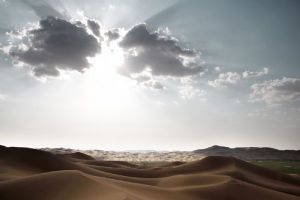
Within the desert, dunes, lake basins, mountains, and flatlands are intermingled. Dunes account for 71%, lake basins for 7%, and residual mountains and flatlands for 22%. Among the dunes, 93% are mobile, with the rest being fixed or semi-fixed. The dunes generally range from 10 to 20 meters in height, mainly consisting of grid-like dunes and dune chains, while crescent-shaped dunes are found in the peripheral areas. Tall, compound dune chains appear in the northeastern part of the desert, reaching heights of about 50 to 100 meters. Fixed and semi-fixed dunes are primarily located on the outskirts of the desert and around the edges of lake basins, where vegetation such as sand sagebrush and Nitraria tangutorum is common. Mobile dunes host plants like sand sagebrush, sand bamboo, reeds, Calligonum mongolicum, Hedysarum scoparium, tamarisk, and Cynanchum komarovii, which grow better than those in the Badain Jaran Desert. In the Mahuang area of the northwestern and southwestern desert, there are vast stands of Ephedra, while natural secondary populus euphratica forests grow among the dunes around Wutongshu Lake. Areas such as Toutao Lake and Tonghu also feature artificially planted forests established after 1949.
A 31-kilometer (19-mile) stretch of the Baotou–Lanzhou Railway passes through the southeastern edge of the Tengger Desert. Within a 200–300-meter (656–984-foot) corridor along the railway, measures have been taken to stabilize what were originally mobile dunes, ensuring the safety of railway transport.
In Mongolian, “Tengger” means sky, symbolizing the endless expanse of flowing sand resembling the boundless heavens—hence the name. Inside the desert, dunes, lake basins, salt marshes, grasslands, mountains, and plains are interspersed. Dunes make up 71% of the terrain, 7% of which are fixed or semi-fixed. Most of the southwestern part of the desert is vegetated, mainly with Ephedra and Artemisia ordosica; the central, southern, and northern lowlands support better plant growth, predominantly from the Artemisia genus. Mobile dunes are primarily grid-like and grid-like dune chains, usually 10–20 meters high, though some compound chains reach 10–100 meters and tend to shift southeastward. There are 422 lake basins of varying sizes, 251 of which contain water, mainly fed by springs and temporary runoff. Most are remnants from the Tertiary period and serve as key residential areas for local inhabitants. Sand control efforts began in 1958, with the establishment of hundreds of shelterbelts, sand-fixing, and grass-cultivating initiatives, enabling the uninterrupted operation of the Baotou–Lanzhou Railway through the desert—an outstanding achievement in China’s desertification science.
The Tengger Desert also hosts hundreds of pristine lakes that have existed for tens of millions of years. Beneath the azure sky, the vast desert is desolate, majestic, and imposing. Rolling dunes stretching for thousands of kilometers resemble frozen waves, undulating in gentle contours that reveal its extraordinary charm. From the heights of Tenggerdala, you may be amazed to discover a unique, naturally formed lake that strikingly resembles the map of China, with reeds delineating the various provinces and regions—this is Tenggerdala · Moon Lake. Testing reveals that Moon Lake is half freshwater and half saltwater, containing over ten mineral trace elements including selenium and iron oxide. It has remarkable purifying properties, remaining crystal-clear for millions of years despite an annual precipitation of only 220 millimeters. Rather than shrinking, the lake’s water volume has actually increased. Moon Lake is the only one of Tengger Desert’s many lakes with a natural shoreline. Along its 3-kilometer-long and 2-kilometer-wide coast, digging just beneath the thin surface layer exposes ancient black sandy mud. Analysis shows that Moon Lake’s unique black mud is rich in a dozen trace elements, closely resembling the formulations recommended by international wellness institutions for therapeutic baths—its quality even surpasses that of the Dead Sea’s black mud, making it a truly one-of-a-kind ecological resource in Tenggerdala.
Tourism authorities offer visitors a variety of special activities, such as desert picnics, overnight camping, stargazing, desert water-seeking expeditions, visits to nomadic desert tribes, tours of the desert’s “Bird Lake” and “Fish Lake,” and viewing ancient rock paintings—all standout experiences when exploring the Tengger Desert. Additionally, the authorities provide vehicles, food, camel handlers, guides, camping equipment, and, most importantly, camels.
These tourism camels come equipped not only with well-crafted saddles, stirrups, and footrests but also with saddlebags for carrying fruits and food. Guests’ cameras, binoculars, and other belongings can be stored in the cloth saddlebags draped across the camels’ backs. Each camel caravan includes not only the camels ridden by tourists but also lead camels, guide camels, and rear camels. The caravans are outfitted with jingling camel bells that can be heard from miles away at night, offering a sense of security and stability while also helping regulate the camels’ pace.
Share
This article is published by HowToTrip. Sharing and reposting are welcome — please credit the source.
Article URL: https://www.howtotrip.net/travel-9596
Related Articles
- Shaoxing's "Grandpa Gourd" hangs the gourds back up: "If there are too many people, we'll interact less — just take a quick look from afar"
- Chinese authorities announce "reciprocal adjustment" to Japan visa fees — single-entry visa jumps from 2,250 to 16,750 yen!
- The "health stones" carried by a traveler were found to have radiation levels exceeding safety limits by a thousand times, potentially endangering fellow passengers on the same flight. Customs issues warning!
- Shenzhen Airport Issues Late-Night Notice: Unidentified Aerial Object Detected, Causing Widespread Flight Delays!
- “They only said it cost money after I opened the box and washed it!” 200g of grapes sold for 60 yuan on a high-speed train—12306 responds!
- Can't buy an airline ticket? Denied exit? Blocked from boarding? A large number of Chinese tourists have mysteriously become "discredited individuals"
- Adverse weather and economic fluctuations impact Colombia's coffee market
- Beach bathing area responds to 2 yuan/30 seconds fee for freshwater foot rinsing: Clearly priced!
- Taking off with an improperly closed cabin door? Wing malfunction? Multiple flights made emergency returns mid-journey!
- Experience the gifts of nature! A countdown of the world’s ten most stunning coastlines