Smoky Mountain
Smoky Mountain
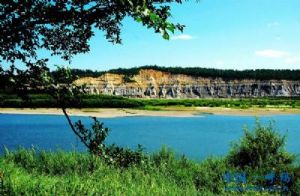
Chahayan is the name of a village — a small, naturally formed settlement with fewer than 100 households along the Heilongjiang River. Its geographical coordinates are 52°16' north latitude and 126°23' east longitude, and it is administratively under the jurisdiction of Jinshan Township, Huma County. Chahayan is also the name of a mountain — a peak by the Heilongjiang River shrouded in mystery. The village of Chahayan is named after the mountain and is also famous because of it.
The Chahayan Scenic Area covers the Chahayan Peninsula, starting from Yingmen Lazi, the first treacherous pass of the Heilongjiang River, stretching 5 kilometers along the undulating Chahayan Mountain, and ending at the Liudaowan area of Yangcaogou. This river section features winding waterways, strikingly rugged peaks, and numerous legends. The river alternates between roaring fiercely and lying calmly like a mirror. The natural scenery here is both mystical and grand, with ecological attractions densely concentrated, making it a place that captivates visitors and leaves a lifelong impression. On June 8, 1857, Collins, the American commercial representative sent to the Amur River, exclaimed while passing by Smoky Mountain on a Russian ship: “This is the most beautiful scenery we have seen so far... The peculiar landscape of these yellow sand cliffs fascinated me. I saw chalcedony, carnelian, and agate on the beach... It is a very enchanting place with extraordinarily beautiful scenery. The Amur River winds along both banks, flanked by lush larches and pines, set against ochre cliffs, all forming a moving picture.”
In the Ming Dynasty, Chahayan was called Wanshan Wei, and in the Qing Dynasty, it was known as Chahan Feng or Chahayan Hada, meaning “white cliff” in Mongolian. Its location can be found on the map from the 25th year of the Jiaqing reign (1820). During the Qing Dynasty, it belonged to the vice-commandery jurisdiction of Heilongjiang City (Aihui), and the Draft History of Qing recorded that there was one post officer and thirty soldiers stationed there. On August 31, 1929, Soviet warships bombarded Chahayan, and the outpost was burned down.
Chahayan Mountain is located on the Russian side of the Heilongjiang River, 4 kilometers upstream from the village of Chahayan. Judging by sight across the river, its height is only about 50 meters (The 1861 book The Russians on the Amur, published in London, UK, by Raventstein referred to “Tsagayan (Chahayan)” as being “250 feet high,” which converts to approximately 76.2 meters). Though it is neither particularly tall nor steep, what is astonishing is the 5-kilometer-long, arc-shaped cross-section of the mountain that is fully exposed to view, standing like a massive mural on the opposite bank. Its varied colors and marvelous composition echo with the river, creating a spectacular sight. This feat of mountain-splitting and river-carving was likely caused by tectonic movements, further shaped by years of rain erosion and landslides, resulting in the current form of Chahayan Mountain.
Chahayan Mountain is a mystical mountain, and its mystique lies in the fact that it smokes. Hence, it is also known as Smoky Mountain. Historical records show that the smoking phenomenon of the mountain dates back to the 17th century. In the mid-17th century, the skies around Smoky Mountain were filled with smoke during the day and blazing fires at night. Today, when viewed from across the river, the exposed rock face of the mountain resembles a compressed thousand-layer cake, with the upper part mostly yellow-brown, the lower part mostly lead-white, and two to three layers of gray-black in between — these are coal seams. The smoke from the mountain originates from the coal seams within the mountain, which ignite spontaneously upon exposure to oxygen and sunlight. The coal seams are not very thick, only about a foot wide, and appear intermittently, but the wispy smoke shrouds Chahayan Mountain in an air of mystery.
Chahayan Mountain is also a mountain that gave birth to heroes, and its heroic legacy lies in the legendary deeds of the hero Chaha, passed down through generations. It is said that long ago, in the region of Chahayan Mountain, while other peaks experienced brief, hot summers and long, harsh winters, Chahayan Mountain alone enjoyed warm seasons full of birdsong and blossoms all year round. Diligent and kind-hearted Ewenki people lived on this mountain, leading happy lives: men farmed the fields and could harvest crops four times a year; women could start cooking by simply digging a hole in the ground, where lively flames would joyfully erupt, and the food cooked over them was especially fragrant. Later, when the Cossacks heard of this, they came by boat to seize this treasure mountain. The hardworking and kind Ewenki people were no match for these fierce invaders and were forced to flee, beginning a life of hardship. However, Chaha, the chieftain of the Ewenki, refused to accept defeat. He captured the Cossack chieftain and fought him fiercely for three days and three nights, eventually forcing the Cossack leader into the mountain of Chahayan and pinning him down with his own body. Both chieftains died in battle. From then on, Chahayan Mountain began emitting wisps of blue smoke, accompanied by flickering flames, and the climate was no longer so warm and pleasant. The Ewenki people say it was the brave Chaha chieftain, angered to the point of fury by the invaders, who caused the mountain to smoke and blaze. Ever since, travelers passing by would kneel in reverence to this legendary brave Ewenki chieftain, Chaha.
Chahayan Mountain is a mountain with a long history, and its historical significance is reflected in its early documentation in Chinese historical texts. At the end of the Kangxi reign in the Qing Dynasty, Fang Shiji described it in detail in his work Longsha Jilue. According to the Heilongjiang Waiji, in the early Qing Dynasty, smoke and fire emitted from the peak of Chahayan Mountain with great intensity — visible for miles away with smoke rising and flames flickering. From these two historical accounts, we can imagine how intense and spectacular the scenes of smoke and fire from Smoky Mountain must have been.
Liu Qi, a former educated youth from Shanghai, came to Chahayan Production Brigade, Jinshan Commune, Huma County, in April 1970. He was admitted to East China Normal University in Shanghai in September 1978. In 2002 and 2004, he revisited Chahayan twice. He wrote in his memoirs: “On the other side of the river is Smoky Mountain. During the day, you can often see wisps of white smoke coming out from the mountain cliffs, and when the smoke is heavy, it drifts into the village. Sometimes at night, you can even see balls of fire. In the summer evenings, we even saw what looked like glowing lava flows rolling into the river.” “In the past, you could often see wisps of white smoke coming from the mountain cliffs during the day, and sometimes balls of fire at night. Now the smoke isn’t as thick.” (Liu Qi, out of deep love and attachment to Chahayan, made many meaningful contributions to the promotion and development of the area. His website, The Story of Liu Qi, the Educated Youth, contains many beautiful photos and touching stories about Chahayan. Friends who are interested can visit the site to learn more and gain a comprehensive understanding of Chahayan. The website is: www.geyanqi.com/liuqi.)
It is quite possible that the coal seams here are not thick or abundant enough, and once spontaneous combustion reached a certain level, there was no more coal to burn. Today, along the ten-mile stretch of Smoky Mountain, on the day I visited, there was only one spot where thin smoke curled gently — a faint wisp of white smoke drifting among the yellow-brown mountainside, adding an elegant and solemn atmosphere to the vast, tranquil river bay. Chahayan Mountain is a smoking mountain, but it is not a volcano, because the vents of volcanoes are at the mountaintop, whereas the smoke from Smoky Mountain comes from the mountainside, and its body is not composed of any rocky material — there are no volcanic pebbles, pumice, or fragmentary rocks. However, since some people did not conduct on-site investigations, the term “Chahayan Volcano” began to emerge by the late Qing Dynasty and early Republican period, and even maps of the Heilongjiang River published in the 1980s marked the location of Chahayan as a volcano.
On our side of the river, opposite Smoky Mountain, there is a large river beach for visitors to enjoy: you can admire the magical and magnificent Smoky Mountain from across the river, pick up beautiful and interesting pebbles, sit on the ground and chat freely, or have a picnic in the wild — it’s truly a place where “wine doesn’t intoxicate people, but the beauty of the mountain does, and one becomes immortal beneath the mountain of the immortals.”
After visiting Smoky Mountain, you can also take a motorboat operated by local villagers to continue your journey to Yingmen Lazi.
Traveling upstream by boat, a few hundred meters past Smoky Mountain is the still-beautiful Siheyany. Siheyany is a small triangular island on the Russian side. At its northern end, there are four massive square stones standing by the river. The stones are primarily lead-white in color, with blackish-brown in the middle and upper parts, all being exposed bedrock with almost no vegetation. The four stones are connected, alike yet distinct in shape, and solemn and dignified in presence. People call these four square stones the “Four Great Guardians.”
In Buddhism, there are four deities known as the “Four Heavenly Kings”: the Eastern Dhritarashtra (Vaisravana), who is white, wears armor, holds a sword in the left hand and a sheath in the right; the Southern Virupaksha (Virudhaka), who is blue, wears armor, and holds a sword; the Western Virupaksha (Virupaksha), who is red, wears armor, holds a sheath in the left hand and a red cord in the right; the Northern Kubera (Vaisravana), who is golden, wears golden armor, holds a pagoda in the left hand and a trident in the right, and tramples on three yakshas. The Four Heavenly Kings each protect the world. These four deities, after being sinicized, became the “Four Great Guardians” in Chinese Buddhist halls, symbolizing “favorable weather, abundant harvests, peace, and prosperity.” According to the Qing dynasty’s Huo Hao’s Popular Essays, “The Four Great Guardians in temples each hold an object, commonly referred to as representing ‘favorable wind, harmonious music, timely rain, and peaceful governance’; the one holding a sword represents wind; the one holding a lute represents harmony; the one holding an umbrella represents rain; and the one holding a dragon represents smooth governance.” It’s fortunate that Siheyany has these four deities protecting it, blessing the area with bountiful harvests and national peace. No wonder the scenery here is so beautiful.
After visiting Smoky Mountain, travelers can also take a local villager’s motorboat downstream to Liudaowan to continue their journey. This river section has calm waters and gentle winds, allowing visitors to fully enjoy the uniquely fresh air of the Heilongjiang River, admire the continuous green mountains and trees along both banks, and appreciate the unique charm of this major border river. When the boat reaches Liudaowan, you will see the Heilongjiang River obediently making a large bend here — a delightful sight. If you come to Liudaowan from Smoky Mountain by car, you will need to get off at Yangcaogou, then climb to the top of the ridge to look out at the Heilongjiang River, where the bend of Liudaowan will come fully into view, making the curve appear even more vivid.
To the north of Chahayan Village, there is a natural spring that gushes from underground, flowing continuously all year round, forming a lake called “Zhuanshui Lake.” The lake is quite expansive and is suitable for fishing or boating, and it is also a great spot for shooting scenic films. In the early morning, Zhuanshui Lake is veiled in a mist as light as gauze, resembling a shy and beautiful village maiden; in the evening, the lake reflects the dreamy sunset, much like a mellow and profound fine wine. The lake is surrounded by green trees and is a paradise for ducks and red-crowned cranes. Zhuanshui Lake is a precious mirror in the mountains and a beloved place for the villagers of Chahayan, well worth a visit by travelers.
While visiting Chahayan, you can also bring back some local specialties. Among the specialties of Chahayan Village, the top recommendation is the wild black fungus picked by villagers in the deep forests. In summer and autumn, the young men of the village trek deep into the mountains to gather wild black fungus. They have to walk long distances, live in the mountains, endure the summer heat, bear the cold autumn nights, put up with mosquito bites, and withstand the loneliness of the deep mountains — it’s very hard work. The women stay home to care for the children, and whenever guests come from outside the mountains, they sell the dried wild fungus they’ve prepared. The villagers in the mountains are incredibly hardworking, resilient, kind, and simple. Their fungus is purely natural, green, and plentiful, and naturally, the price is much cheaper than similar fungus sold in urban markets.
Wild black fungus is a saprophytic fungus that grows in forests. It has a crisp and tender texture, a delicious taste, and absorbs the flavors of other seasonings. It is often stir-fried with meat or poultry. Black fungus is extremely high in iron content — per 100 grams of dry product, it contains more than 20 times the iron of celery, which has the highest iron content among vegetables, and seven times that of pig liver, which has the highest iron content among animal foods, making it the food with the highest iron content overall. Black fungus has always been a highly nutritious mountain delicacy. Especially in recent years, research has found that polysaccharides in black fungus have anti-aging, anti-diabetic, anti-hepatitis, anti-cancer properties, and enhance human physiological activity, giving it even greater health benefits and making it even more popular.
Source: Huma County Party Committee and County Government
Share
This article is published by HowToTrip. Sharing and reposting are welcome — please credit the source.
Article URL: https://www.howtotrip.net/travel-9276
Related Articles
- Shaoxing's "Grandpa Gourd" hangs the gourds back up: "If there are too many people, we'll interact less — just take a quick look from afar"
- Chinese authorities announce "reciprocal adjustment" to Japan visa fees — single-entry visa jumps from 2,250 to 16,750 yen!
- The "health stones" carried by a traveler were found to have radiation levels exceeding safety limits by a thousand times, potentially endangering fellow passengers on the same flight. Customs issues warning!
- Shenzhen Airport Issues Late-Night Notice: Unidentified Aerial Object Detected, Causing Widespread Flight Delays!
- “They only said it cost money after I opened the box and washed it!” 200g of grapes sold for 60 yuan on a high-speed train—12306 responds!
- Can't buy an airline ticket? Denied exit? Blocked from boarding? A large number of Chinese tourists have mysteriously become "discredited individuals"
- Adverse weather and economic fluctuations impact Colombia's coffee market
- Beach bathing area responds to 2 yuan/30 seconds fee for freshwater foot rinsing: Clearly priced!
- Taking off with an improperly closed cabin door? Wing malfunction? Multiple flights made emergency returns mid-journey!
- Experience the gifts of nature! A countdown of the world’s ten most stunning coastlines