Wu Balao Island
Wu Balao Island
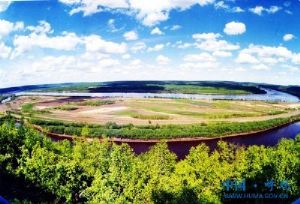
Wu Balao Island is located 100 meters upstream from Sanhe Village. It consists of three separate sandbars: the second island is the largest, oval in shape; the first island is figure-eight shaped; and the third is the smallest and round. During the dry season, the three small islands merge into one, covering a total area of 1.62 square kilometers. The island formed during the Qing Dynasty when the Wu Xianglian family from Sanhe Village lived there. The family of nine ran a tavern on the island and cultivated the land. Since Wu Xianglian was the eighth child in his family, the island was named Wu Balao Island. In 1969, it was the main battleground of the Sino-Soviet territorial dispute, leaving behind many heroic and moving stories. It was named by the State Council and the Central Military Commission as the "Sanhe Battle Village, a Strong Fortress, Heroic People, a Village of Battle."
The surging Heilongjiang River flows mightily, winding its way over 480 kilometers from its source at Luoguhe to reach Sanhe Village, the fifth natural settlement within Huma County.
The beautiful Sanhe Village is nestled between mountains and water. It is surrounded by hills to the north, west, and south, while the Heilongjiang River flows gently from north to south just east of the village, only about 10 meters away at its closest point. From a distance, the small village is tucked among lush green trees and fields of crops. The sky overhead is a deep blue, the clouds at the horizon are pure white, the breeze is gentle, and the moist air carries the rich scent of the Heilongjiang River, refreshing the soul. Here, everything is so simple and natural—the tranquil beauty reaches its peak and is truly breathtaking.
Sanhe Village currently has 78 households. According to historical records: Sanhe Village is located on the banks of the Heilongjiang River southwest of Oupu Township. Around the third year of the Republic of China (1914), a shop named "Sanhe Inn" was established here, and by the fourth to fifth years of the Republic of China (1915–1916), it developed into a village—the name derived from the "Sanhe Inn." In the early days, the people of Sanhe Village lived off farming, fishing, and hunting. They fished and farmed in spring and summer, and hunted during the long winter. Nowadays, the villagers mainly engage in agriculture, planting and harvesting soybeans and wheat, working from sunrise to sunset.
Sanhe Village is indeed somewhat famous, not only for its simplicity, natural beauty, and tranquility but also because it neighbors Wu Balao Island. Wu Balao Island is also quite well-known, not only for its small size, charm, and allure but also because of the world-shaking Sino-Soviet military conflict—the Wu Balao Island Incident—that occurred here during the tense Sino-Soviet relations of the last century.
Wu Balao Island is located 100 meters upstream from Sanhe Village in Oupu Township, on the Chinese side of the main channel of the Heilongjiang River, and has always been Chinese territory. It consists of three separate sandbars: the second island is the largest and oval-shaped; the first island is slightly smaller and figure-eight shaped; the third is the smallest and round. During the dry season, the three small islands merge into one, covering a total area of 1.62 square kilometers. In the wet season, the first and third islands are submerged, leaving only the second island standing alone in the river. The island formed in the early Qing Dynasty when the Wu Xianglian family from Sanhe Village lived there. The family of five ran a tavern on the island and cultivated the land. Because Wu Xianglian was the eighth child in his family, the island was named Wu Balao Island. In 1931, another villager, Luan Yingzhou, also moved to the island and farmed with Wu Xianglian. In 1934, Wu Xianglian passed away and was buried on the island. In 1936, to counter Soviet influence, Japanese troops forced police to drive Wu Xianglian’s nephew, Wu Dingyi, and Luan Yingzhou off the island, relocating them to Sanhe Village. They were only allowed to work on the island but not live there. After the liberation in 1945, residents of Sanhe Village continued to go to the island to cut grass, fish, and gather timber. In winter, river traffic traditionally passed outside Wu Balao Island. In the winter of 1965, Soviet troops placed a row of log blocks outside the island, covered with snow, to block our vehicles.
On July 29, 1967, we organized 14 people to go to the island for production. On July 30, the Soviets dispatched over 30 soldiers to interfere. The next day, the number increased to over 70, along with more than ten military boats including gunboats, landing craft, patrol boats, and self-propelled barges. A Soviet lieutenant colonel and major arrived by helicopter to oversee the scene, displaying military force and threatening our workers. Our personnel engaged them in reasoned argument. The Soviets then used their numbers to surround our workers, restricting their activities. Despite these tactics, we persisted in going to the island daily, and the Soviet pressure escalated: confiscating tools, blocking access with wooden poles, pushing our people into the river... Later, they deployed trained special forces armed with belts, clubs, slingshots, and specially made meteor hammers, severely injuring several of our workers. When pushed beyond endurance, our side fought back in self-defense.
In 1968, the Soviets twice sent armed troops to land on Wu Balao Island. Our unarmed personnel were forced to fight back until the Soviets withdrew. That year, we reclaimed 255 acres of wasteland, built one house, and harvested 120,000 pounds of fodder. From March to May 11, 1969, the Soviets deployed aircraft and gunboats to repeatedly violate our airspace and waters around Wu Balao Island, conducting reconnaissance and provocations, setting up loudspeakers for reactionary propaganda, and launching vicious attacks against the Chinese government. On the morning of May 15, 1969, four freshly uniformed PLA border guards strode onto Wu Balao Island to conduct routine patrols. Suddenly, shots rang out from hidden Soviet positions across the river. At first, they fired warning shots into the air, but when our guards continued patrolling normally, they opened fire with heavy machine guns from multiple directions, creating a crossfire that rained bullets onto the open area where our guards had to pass. The dense fire grew heavier, blocking our path entirely. Around 2 PM, the four guards spread out and dashed across the open zone under fire, safely reaching our hiding spot on the island. Soon after, they resumed patrol. The deputy station chief led the way, followed by Ren Jiulin, a new soldier born in 1949 from Liaoning who had been in the army for less than three months. Before setting off, he shook hands with the local militia and said, “Let’s welcome victory once again.”
The Soviet machine guns opened fire wildly again. The patrol team was pinned down under heavy fire. Minutes later, our shore-based forces saw the patrol crawling forward through the gunfire. Soon, the first member crossed the second line of fire into cover, but as the second rose to move forward, he staggered and fell—forever still. This was Comrade Ren Jiulin, shot through the left chest. As he cried out “Squad Leader!” he was martyred at 3:38 PM. Though the Soviets had killed our soldier, they did not stop. Machine guns continued firing at all access points, and helicopters circled overhead for reconnaissance. Later, the Huma County Revolutionary Committee (now the Huma County People’s Government) built a martyr’s cemetery for Ren Jiulin, who died heroically defending our territory. Nestled in the evergreen pines along the Shibei Highway, the cemetery bears an inscription: “Eternal Glory to Martyr Ren Jiulin, Who Heroically Fell in the Anti-Revisionist Struggle.” Passersby can see the cemetery and remember the hero’s courage. Ren Jiulin, who gave his life for the nation, will live forever in our hearts. From May 12 to September 6, 1969, the Soviets fired 2,160 bursts and 1,363 single shots—totaling 8,191 rounds—with the deepest penetration over 1,000 meters. In the Wu Balao Island conflict, our side exercised great restraint to prevent escalation. But our patience has limits. Our sovereignty and dignity are sacred and inviolable. We are ready to give everything for our motherland.
Wu Balao Island is an ordinary island—and a heroic one. Its soil is stained with the blood of our martyrs, its fields nourished by the sweat of our people. It will always belong to China, forever cradled in the embrace of the motherland.
In 1971, British journalist and renowned international commentator Neville Maxwell personally visited Wu Balao Island to report objectively and fairly on the Sino-Soviet border conflict. Later, Maxwell Pavilion was built on the mountain near our border outpost in his honor. An inscription there reads: “Maxwell was a British journalist. During the 1969 Wu Balao Island dispute between China and the Soviet Union, as a peace advocate, he personally investigated our outpost and later publicly reported in international media that the island belongs to China. To honor him, this pavilion was built.”
Over forty years have passed through seasons and storms. Today, China and Russia are friendly neighbors, and confirmed border surveys recognize Wu Balao Island as Chinese territory. The small, charming island thrives in peaceful serenity, with over ten farming households cultivating wheat and soybeans on 600+ acres.
The border observation post on the mountain north of Sanhe Village is the famed Northern First Outpost—one of the best spots to view Wu Balao Island and Sanhe Village. Climbing the 84-meter-high summit, you’ll see our island below: peaceful as a sleeping infant, lush as a bride on her wedding day. Crops await harvest, the mighty Heilongjiang River surges toward the sea, river gulls soar in peace, and high-powered binoculars reveal life across the river in Russian villages. At sunset, the cooking smoke of Sanhe Village drifts into view—everything is natural, everything is beautiful.
Visitors to Sanhe Village can hike to the outpost to see Wu Balao Island and the village, take boat tours (with yachts, motorboats, or sampans), visit the tomb of martyr Yin Zhengqi (first CPC secretary of Huma County, killed fighting bandits in 1945 at age 27), admire the rural scenery (golden wheat fields, fragrant bean blossoms), dine on fresh river fish at waterside restaurants, or relax on the 300-meter riverside beach with fishing gear when water levels allow.
To reach Sanhe Village and Wu Balao Island, take a train to Tahe Station, transfer to a bus to the scenic Baiyinna Ewenki Ethnic Township, then drive 20 km along the “Sanhe Road” through the majestic Greater Khingan Mountains. Towering birch, pine, poplar, and larch trees line the route, with crystal skies, white clouds, and emerald landscapes. Alternatively, take a 113 km bus from Huma to Baiyinna, passing the Jinshan Forest Farm, anti-Japanese training sites, and the planned Sanjianfang Hydropower Station. For a scenic boat ride (155 km), cruise past the stunning Huashan Scenic Area (disembark for close views or admire the peninsula from afar), the mysterious “Smoking Mountain” (5 km of misty peaks, best seen from the water), and the thrilling Yingmen Lazi Gorge (feel the rush of navigating rapids while spotting legendary rock formations).
Source: Huma County Party Committee & County Government
Share
This article is published by HowToTrip. Sharing and reposting are welcome — please credit the source.
Article URL: https://www.howtotrip.net/travel-9262
Related Articles
- Shaoxing's "Grandpa Gourd" hangs the gourds back up: "If there are too many people, we'll interact less — just take a quick look from afar"
- Chinese authorities announce "reciprocal adjustment" to Japan visa fees — single-entry visa jumps from 2,250 to 16,750 yen!
- The "health stones" carried by a traveler were found to have radiation levels exceeding safety limits by a thousand times, potentially endangering fellow passengers on the same flight. Customs issues warning!
- Shenzhen Airport Issues Late-Night Notice: Unidentified Aerial Object Detected, Causing Widespread Flight Delays!
- “They only said it cost money after I opened the box and washed it!” 200g of grapes sold for 60 yuan on a high-speed train—12306 responds!
- Can't buy an airline ticket? Denied exit? Blocked from boarding? A large number of Chinese tourists have mysteriously become "discredited individuals"
- Adverse weather and economic fluctuations impact Colombia's coffee market
- Beach bathing area responds to 2 yuan/30 seconds fee for freshwater foot rinsing: Clearly priced!
- Taking off with an improperly closed cabin door? Wing malfunction? Multiple flights made emergency returns mid-journey!
- Experience the gifts of nature! A countdown of the world’s ten most stunning coastlines