Fengtai Dawang Temple
Fengtai Dawang Temple
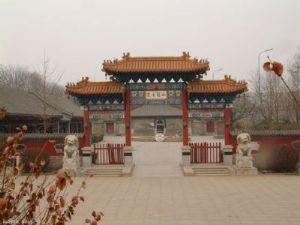
To commemorate the successful emergency repair of the Yongding River dike breach, the officials involved in the water control project used surplus funds and materials the following year (1891) to build a Dragon King Temple at the foot of the dike. This structure served the dual purpose of housing flood prevention personnel and praying for safety. Empress Dowager Cixi inscribed a plaque for the temple reading “Eternal Protection for Calm Waves,” and Emperor Guangxu also inscribed one that read “Golden Dike Forever Firm.”
The temple enshrines the “Water Official Emperor” and the “River-Controlling Dragon King,” who are believed to ward off disasters. Locally, it is commonly referred to as “Dawang Temple” (Great King Temple) by nearby farmers. To this day, these inscribed stelae and plaques are still preserved in the temple, with their texts clearly visible.
The temple complex covers a total area of 1,322 square meters, with a built-up area of 582 square meters, including the gate hall (mountain gate), east and west side halls, east and west wing halls, and east and west side rooms. Upon entering the first courtyard through the gate hall, the east and west side halls are the Wenchang Hall and Guan Yu Hall, while the main hall is the Dawang Hall, which enshrines a deity dressed as a warrior. Legend has it that it was thanks to this “Great King’s” protection that the breached dam was successfully sealed after the flooding. Thus, it was only natural to enshrine him in the temple. Above the Great King hangs a plaque inscribed with “Golden Dike Forever Firm,” written by Emperor Guangxu. It is said that in 1890 (the 16th year of Guangxu), the Yongding River flooded, not only submerging dozens of counties including Daxing, Liangxiang, and Zhuozhou under water, but even reaching the area near Guang’anmen. At the time, Qing officials worked tirelessly day and night to successfully control the flood. The following year, the officials decided to use the remaining funds from the dike reinforcement project to build a water control temple as a commemoration, for which Emperor Guangxu personally inscribed the plaque. Passing through the Dawang Hall into the second courtyard, the side halls are the Cihang Hall and Sanxing Hall, and the main hall is the Dragon King Hall, which enshrines the Dragon King who governs water. Above the Dragon King’s head also hangs a plaque inscribed with “Eternal Protection for Calm Waves,” written by Empress Dowager Cixi.
In the more than 200 years of Qing Dynasty history, it is said that the Yongding River breached its banks seventy-eight times. Therefore, unlike other temples that enshrine deities, Dawang Temple would, during each flood season, find a turtle or snake from the Yongding River to enshrine in the main hall. Operas were also performed on the stage in its honor, conducting rituals to pray for exemption from floods.
Like many ancient sites, Dawang Temple went through various phases — from serving as barracks for river soldiers, to being used as a township government office, elementary school, brigade headquarters, and even a dormitory for educated youths… and inevitably fell into decline and disrepair. Because it was constructed with leftover funds from the water control project, the temple was built very simply, earning it the nickname “Poor Man’s Dawang Temple.” In 2003, Fengtai District in Beijing initiated a restoration project for Dawang Temple. Since then, on the second day of the second lunar month each year, the temple has held a grand blessing ceremony.
Share
This article is published by HowToTrip. Sharing and reposting are welcome — please credit the source.
Article URL: https://www.howtotrip.net/travel-9133
Related Articles
- Shaoxing's "Grandpa Gourd" hangs the gourds back up: "If there are too many people, we'll interact less — just take a quick look from afar"
- Chinese authorities announce "reciprocal adjustment" to Japan visa fees — single-entry visa jumps from 2,250 to 16,750 yen!
- The "health stones" carried by a traveler were found to have radiation levels exceeding safety limits by a thousand times, potentially endangering fellow passengers on the same flight. Customs issues warning!
- Shenzhen Airport Issues Late-Night Notice: Unidentified Aerial Object Detected, Causing Widespread Flight Delays!
- “They only said it cost money after I opened the box and washed it!” 200g of grapes sold for 60 yuan on a high-speed train—12306 responds!
- Can't buy an airline ticket? Denied exit? Blocked from boarding? A large number of Chinese tourists have mysteriously become "discredited individuals"
- Adverse weather and economic fluctuations impact Colombia's coffee market
- Beach bathing area responds to 2 yuan/30 seconds fee for freshwater foot rinsing: Clearly priced!
- Taking off with an improperly closed cabin door? Wing malfunction? Multiple flights made emergency returns mid-journey!
- Experience the gifts of nature! A countdown of the world’s ten most stunning coastlines