Yanghou Chan Temple
Yanghou Chan Temple

The temple integrates religion, culture, art, historical relics, gardens, and tourism. Leveraging its unique features and advantages, it organizes and hosts various activities such as calligraphy and painting exhibitions, Buddhist summer camps, Buddhist academic seminars, Buddhist music concerts, exchanges on Buddhist culture and folk art, New Year tea gatherings, Dharma lectures, and diverse Buddhist ceremonies. Through these events, the temple embodies the relevance and modernity of Buddhism, allowing visitors to experience its cultural richness and serene atmosphere, and to be spiritually uplifted. It has avoided the pitfalls of commercialization, secularization, and superstition, earning widespread acclaim from all sectors of society and establishing a reputable image. Its recognition in society continues to grow.
The temple features numerous stupas, most of which are white. Inside and outside the temple, even within shrine rooms and in front of Buddha statues, one can find exquisitely crafted stupas of various shapes and styles. Seven stupas stand outside the temple gate, resembling seven white jade gourds with pointed tops, hanging straight down from the green mountain shadows and lush pines and cypresses. They are known as the "Seven Buddha Stupas."
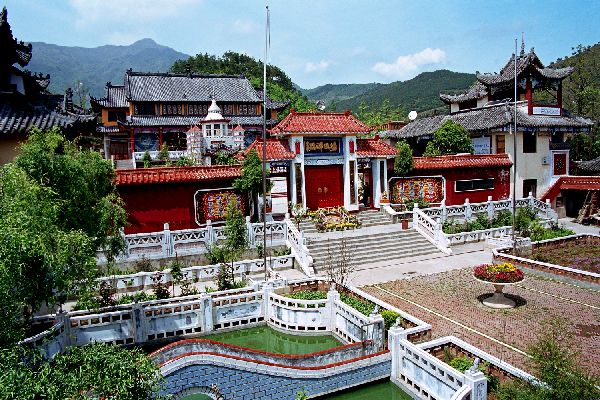
Passing through the temple’s mountain gate adorned with colorful painted flying dragons, the temple has a front and rear courtyard. The front courtyard features pavilions, water pavilions, and dense flowers and trees, creating a serene and picturesque scene. The rear courtyard is the heart of the Buddhist halls—Yanggong Shrine, the Bodhisattva Temple, the Buddha Hall, the Arhat Hall, and other major Buddhist structures are concentrated here. It is solemn and majestic, with flourishing incense offerings. Though the courtyard is not large, it embodies the concept of “piling up soil for platforms, gathering rocks for hills, and encircling water for ponds.” The waterside rocks are rugged, the winding corridors resemble ribbons, and the space is adorned with ancient cypresses, a cluster of banana plants, a few bamboo stalks, a row of snow willows, osmanthus fragrance throughout the garden, and elegantly blooming white chrysanthemums. Together, they create a winding, endless, and profoundly serene atmosphere. The lattice windows in the corridors blend the inner and outer landscapes seamlessly. The curved railings and ancient trees, along with stacked lake rocks and a small red pavilion with soaring eaves, seem ready to take flight into the clouds.
Passing through the grand arched red-painted gate at the center of the corridor opposite, you enter the inner courtyard. Right in front stands a cluster of three tall white stupas embracing an elegant and simple ancient tower gate, elevated on the central platform of the inner courtyard. This is Yanggong Shrine. Its green-tiled double eaves, red-columned corridors, and the towering white marble stupas with dense eaves on both sides complement each other beautifully. The top of the gate is carved with blue beast ridges, above which sits a delicate lotus pavilion tower, blooming in the clouds. Beautiful yet simple, grand yet unpretentious, the structure is magnificent and refined. Inside the shrine sits a jade-faced general holding swords and spears—General Yang Congyi.
A closer look at the information reveals: “The deity is the fourth son of Yang Ye, who died in service to the country and became a water god.” The *Continued Comprehensive Mirror to Aid in Government* states: “Yangtian Weir is located fifteen li northeast of Chenggu and fifty li west of Yang County, damming the river with stones in the middle. Yang Congyi, the founding marquis of Yangzhou, greatly renovated and dredged it, bringing benefits to the people.” “He eradicated the flooding of the Han River, ensured consecutive years of abundant harvests through land reclamation, and brought peace and prosperity to the people.” Suddenly, everything becomes clear. The reverence for General Four is inseparable from his contributions to water conservancy and the welfare of the people.
Behind Yanggong Shrine lies the Mahavira Hall, where the Jade Emperor, Tathagata, and eight directional immortals are orderly arranged. To the right is the Guanyin Hall. Although these halls are all two-story palaces, their structures and scales far surpass those of Yanggong Shrine. They are connected by suspended walkways and intricately linked to the corridors of the front courtyard, featuring exquisite craftsmanship and grand momentum...
Yang Congyi (1092~1169) Yang Congyi (1092–1169) A Southern Song Dynasty general who resisted the Jin. His courtesy name was Zihuo, and he was from Tianxing (now Baoji County). Initially appointed as a military officer in Fengxiang and temporarily governing Tianxing County. In 1130, under orders from Wu, he led troops to resist the Jin in the Fengxiang area and was promoted to Bingyi Lang for his achievements, later becoming a deputy general. In 1142, he repelled Jin forces at Xianren Pass. The following year, he advanced to Aishan Mountain, reached Dachi Plain, and cut off the Jin army’s supply route. In 1162, he captured Dasha Pass and occupied Heshangyuan. He eventually rose to the rank of founding marquis of Ankang Commandery. ... More Details +
Share
This article is published by HowToTrip. Sharing and reposting are welcome — please credit the source.
Article URL: https://www.howtotrip.net/travel-8461
Related Articles
- Shaoxing's "Grandpa Gourd" hangs the gourds back up: "If there are too many people, we'll interact less — just take a quick look from afar"
- Chinese authorities announce "reciprocal adjustment" to Japan visa fees — single-entry visa jumps from 2,250 to 16,750 yen!
- The "health stones" carried by a traveler were found to have radiation levels exceeding safety limits by a thousand times, potentially endangering fellow passengers on the same flight. Customs issues warning!
- Shenzhen Airport Issues Late-Night Notice: Unidentified Aerial Object Detected, Causing Widespread Flight Delays!
- “They only said it cost money after I opened the box and washed it!” 200g of grapes sold for 60 yuan on a high-speed train—12306 responds!
- Can't buy an airline ticket? Denied exit? Blocked from boarding? A large number of Chinese tourists have mysteriously become "discredited individuals"
- Adverse weather and economic fluctuations impact Colombia's coffee market
- Beach bathing area responds to 2 yuan/30 seconds fee for freshwater foot rinsing: Clearly priced!
- Taking off with an improperly closed cabin door? Wing malfunction? Multiple flights made emergency returns mid-journey!
- Experience the gifts of nature! A countdown of the world’s ten most stunning coastlines