Zhushan Mountain and Lu Yu’s Tomb
Zhushan Mountain and Lu Yu’s Tomb

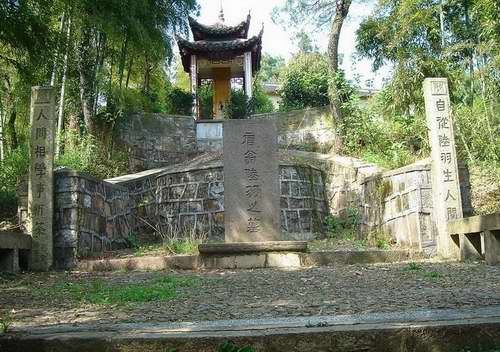
On the twenty-first day of the tenth month in the eighth year of the Dali era of the Tang Dynasty (773), Yan Zhenqing built the “Sangui Pavilion” for Lu Yu. The pavilion was named “Sangui” because it was constructed on a day with the cyclical characters gui (癸) for the year (year of Gui Chou), the month (month of Gui Mao), and the day (day of Gui Hai).
In the seventh year of the Dali era of the Tang Dynasty (772), the famous calligrapher Yan Zhenqing served as the Prefect of Huzhou. He held Lu Yu in high esteem, invited him and many other literati to gather on Zhushan Mountain, and asked him to participate in the compilation of the Yunhai Jingyuan.
Lu Yu lived in Huzhou for over thirty years, making it his second hometown. During this time, he traveled to eastern Zhejiang, southern Jiangsu, and northeastern Jiangxi to engage in tea-related activities, but he primarily conducted tea research and wrote The Classic of Tea in Huzhou.
During his thirty years in Huzhou, Lu Yu devoted his life to writing the world’s first monograph on tea research—The Classic of Tea. The book provides a comprehensive discussion on the characteristics, uses, grades, origins, water quality, harvesting, processing, and brewing methods of tea.
The entire book consists of three volumes and ten chapters, spanning just over seven thousand words. Despite undergoing three major revisions, it was finally completed as this timeless masterpiece. Lu Yu’s contributions to tea studies gained worldwide recognition, and he is revered by later generations as the “Tea Sage.”
Lu Yu passed away in Huzhou in the twentieth year of the Zhenyuan era of Emperor Dezong of the Tang Dynasty (804) at the age of seventy-one and was buried on Zhushan Mountain. His tomb remains there to this day.
Lu Yu (733~894) Lu Yu (733–804) was a native of Jingling in Fuzhou (present-day Tianmen City, Hubei Province) during the Tang Dynasty. His courtesy name was Hongjian, and he was also known as Ji or Qici, with the pseudonyms Jinglingzi, Sangzhuweng, and Donggangzi. He was a lifelong tea enthusiast, an expert in the art of tea, skilled in poetry and calligraphy, and became world-renowned for authoring the world’s first monograph on tea—The Classic of Tea, leaving a lasting legacy. Lu Yu’s life was filled with hardship and legend. According to the Tianmen County Annals, Shangrao County Annals, and Lu Yu’s autobiography, he was born around the twenty-first year of the Kaiyuan era during the reign of Emperor Xuanzong of the Tang Dynasty (733). As a child, he was abandoned under a small stone bridge in Jingling, Tianmen. At the time, the abbot of Longgai Temple in Jingling, Zhi... More+
Zhu Zhu reigned for 17 years. Zhu, the son of Shaokang. He participated in the war led by his father to restore the Xia Dynasty and achieved many military accomplishments. He invented armor and spears and launched extensive campaigns against the Dongyi tribes, achieving victory. Zhu, also known as Jizhu, was a ruler of the Xia Dynasty. His birth and death dates are unknown. He was the son of Shaokang and ascended the throne after Shaokang’s death from illness. He reigned for 17 years, died of illness, and was buried near Anyi. Zhu was shrewd and capable, having assisted his father Shaokang in defeating the power of the Han clan and reviving the Xia Dynasty. During his reign, he invented armor made from animal hides, which shielded soldiers from enemy stone blades and arrows, significantly enhancing combat effectiveness. He continued to fight with various Dongyi tribes, advancing all the way to... More+
Share
This article is published by HowToTrip. Sharing and reposting are welcome — please credit the source.
Article URL: https://www.howtotrip.net/travel-8312
Related Articles
- Shaoxing's "Grandpa Gourd" hangs the gourds back up: "If there are too many people, we'll interact less — just take a quick look from afar"
- Chinese authorities announce "reciprocal adjustment" to Japan visa fees — single-entry visa jumps from 2,250 to 16,750 yen!
- The "health stones" carried by a traveler were found to have radiation levels exceeding safety limits by a thousand times, potentially endangering fellow passengers on the same flight. Customs issues warning!
- Shenzhen Airport Issues Late-Night Notice: Unidentified Aerial Object Detected, Causing Widespread Flight Delays!
- “They only said it cost money after I opened the box and washed it!” 200g of grapes sold for 60 yuan on a high-speed train—12306 responds!
- Can't buy an airline ticket? Denied exit? Blocked from boarding? A large number of Chinese tourists have mysteriously become "discredited individuals"
- Adverse weather and economic fluctuations impact Colombia's coffee market
- Beach bathing area responds to 2 yuan/30 seconds fee for freshwater foot rinsing: Clearly priced!
- Taking off with an improperly closed cabin door? Wing malfunction? Multiple flights made emergency returns mid-journey!
- Experience the gifts of nature! A countdown of the world’s ten most stunning coastlines