Hakka Earthen Buildings in Hekeng
Hakka Earthen Buildings in Hekeng

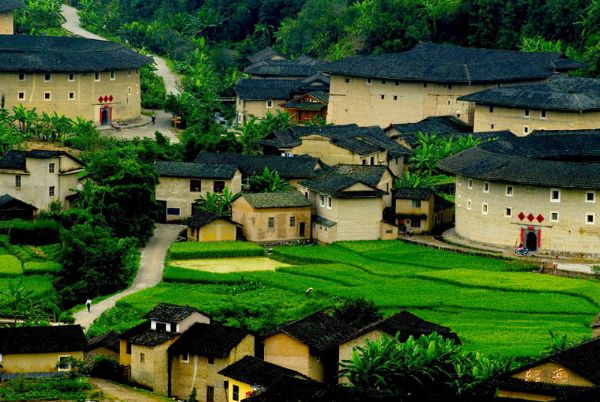
Standing atop Shizhidi Dong Mountain, you can view three clusters of differently shaped earthen buildings totaling 27 from three directions. To the right front, where an open area meets the hillside, there are seven earthen buildings: Dongsheng Building, Xiaochun Building, Yongqing Building, Chun Gui Building, Shengqing Building,
Nandong Building, and Yongrong Building — known as the "Big Dipper."
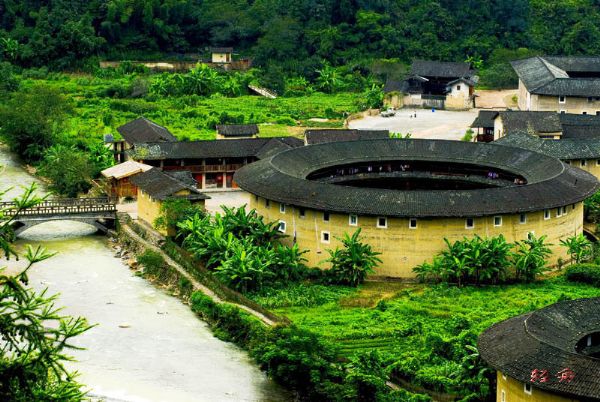
Looking to the left front, two small rivers converge at the foot of the mountain, forming the village’s feng shui symbol, the “T-shaped water.” Along both banks of this T-shaped stream are six square earthen buildings and three round ones.
Further to the left rear, in Qujiang Natural Village, there are 11 earthen buildings including Qingnan Building and Qingyu Building.
Walking through the tall, earthy, and distinctly lived-in Hakka earthen buildings of Hekeng Village brings a sense of tranquil seclusion. Each building is constructed with a cobblestone foundation and thick rammed-earth walls, standing three or four stories high with sheer, knife-edge walls.
These buildings are enclosed, with only one main gate on the ground floor. The gate towers feature semicircular stone arches, and the door bolts — all made of sturdy hardwood measuring about six inches square and over three meters long — are driven straight into the walls. They require two people to open or close. The second and third floors have evenly spaced windows along the outer walls, arranged in a well-balanced layout.
In the center of each earthen building is a courtyard, surrounded by uniformly divided sections, each about four meters wide and over three meters deep — these are the living quarters. Larger buildings such as Dongsheng Building, Chun Gui Building, and Yuchang Building have 36 rooms per floor, accommodating over 100 people. The rooms in the circular buildings are axe-shaped; when viewed from the courtyard, they resemble a giant wooden barrel, giving one the sensation of looking up from the bottom of a well.


Share
This article is published by HowToTrip. Sharing and reposting are welcome — please credit the source.
Article URL: https://www.howtotrip.net/travel-8259
Related Articles
- Shaoxing's "Grandpa Gourd" hangs the gourds back up: "If there are too many people, we'll interact less — just take a quick look from afar"
- Chinese authorities announce "reciprocal adjustment" to Japan visa fees — single-entry visa jumps from 2,250 to 16,750 yen!
- The "health stones" carried by a traveler were found to have radiation levels exceeding safety limits by a thousand times, potentially endangering fellow passengers on the same flight. Customs issues warning!
- Shenzhen Airport Issues Late-Night Notice: Unidentified Aerial Object Detected, Causing Widespread Flight Delays!
- “They only said it cost money after I opened the box and washed it!” 200g of grapes sold for 60 yuan on a high-speed train—12306 responds!
- Can't buy an airline ticket? Denied exit? Blocked from boarding? A large number of Chinese tourists have mysteriously become "discredited individuals"
- Adverse weather and economic fluctuations impact Colombia's coffee market
- Beach bathing area responds to 2 yuan/30 seconds fee for freshwater foot rinsing: Clearly priced!
- Taking off with an improperly closed cabin door? Wing malfunction? Multiple flights made emergency returns mid-journey!
- Experience the gifts of nature! A countdown of the world’s ten most stunning coastlines