Tulou Cluster of Tianluokeng
Tulou Cluster of Tianluokeng

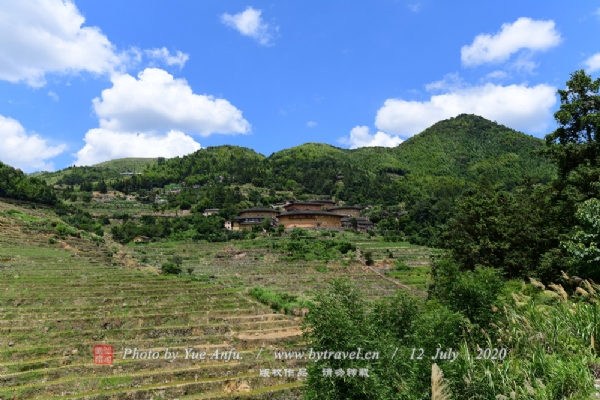
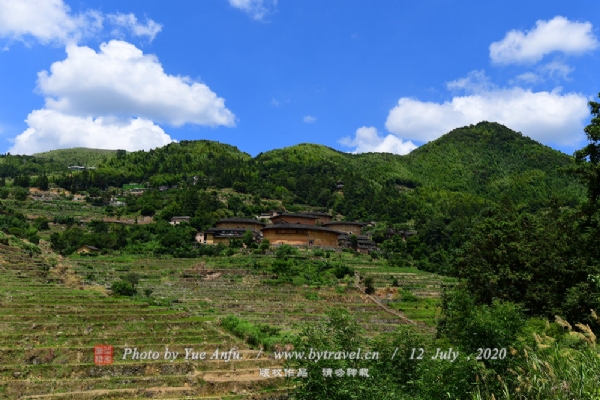
The Tulou Cluster of Tianluokeng is staggered along the mountain terrain, built on a mountainside and surrounded by green terraced fields. Viewed from high above, it looks like a blooming plum blossom dotting the earth. In May 2001, it was listed as a National Key Cultural Relics Protection Unit.
The earliest tulou in the cluster, Buyun Lou (the square tulou), was built during the Jiaqing era of the Qing Dynasty (1796), about 200 years ago. The latest, Wenchang Lou, was built in 1966. This tulou cluster gradually formed over a long period. The Jiaqing era marked the beginning and peak of tulou construction in this area, with three tulou built during that stage, after which no such large-scale construction took place again.
The Huang family genealogy of Tianluokeng confirms that Huang Baisanlang moved here from Yongding during the Jiaqing era of the Qing Dynasty and began his legendary life here. At the center of the ancestral hall in the tulou cluster is the spirit tablet of the ancestors, with Huang Baisanlang listed first. His tomb is located two kilometers away from Tianluokeng at "Wugengliao," where he is honored by the people of Tianluokeng every Qingming Festival.
This young duck farmer made full use of the abundance of snails in the muddy mountain streams and the advantages of the secluded, densely forested area to expand production and earn his first pot of gold. The first structure Huang Baisanlang built was the square tulou, also known as "that bowl of soup," with the elegant name "Buyun Lou." He built the central hall along the undulating terrain into a stepped shape, allowing visitors to experience the joy of "advancing step by step" upon entering the gate.
After the completion of "Buyun Lou," the descendants of Huang Baisanlang subsequently built four circular tulou — "Hechang," "Zhenchang," "Ruichang," and "Ruiyun" — around it. Modern architectural experts who visited and studied the site were all impressed by the ancient builders' wisdom. The builders of these four circular tulou successfully achieved a level second floor by adjusting the height of the columns according to the terrain, greatly facilitating daily living.



Share
This article is published by HowToTrip. Sharing and reposting are welcome — please credit the source.
Article URL: https://www.howtotrip.net/travel-8251
Related Articles
- Shaoxing's "Grandpa Gourd" hangs the gourds back up: "If there are too many people, we'll interact less — just take a quick look from afar"
- Chinese authorities announce "reciprocal adjustment" to Japan visa fees — single-entry visa jumps from 2,250 to 16,750 yen!
- The "health stones" carried by a traveler were found to have radiation levels exceeding safety limits by a thousand times, potentially endangering fellow passengers on the same flight. Customs issues warning!
- Shenzhen Airport Issues Late-Night Notice: Unidentified Aerial Object Detected, Causing Widespread Flight Delays!
- “They only said it cost money after I opened the box and washed it!” 200g of grapes sold for 60 yuan on a high-speed train—12306 responds!
- Can't buy an airline ticket? Denied exit? Blocked from boarding? A large number of Chinese tourists have mysteriously become "discredited individuals"
- Adverse weather and economic fluctuations impact Colombia's coffee market
- Beach bathing area responds to 2 yuan/30 seconds fee for freshwater foot rinsing: Clearly priced!
- Taking off with an improperly closed cabin door? Wing malfunction? Multiple flights made emergency returns mid-journey!
- Experience the gifts of nature! A countdown of the world’s ten most stunning coastlines