Huzhou Ancient Plum Blossom Taoist Temple
Huzhou Ancient Plum Blossom Taoist Temple
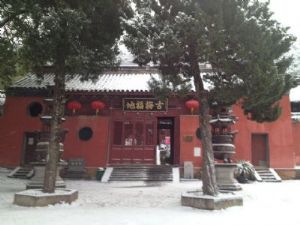
In the first year of the Jiaqing era (1796), the Taoist priest Min Shao Fu came to Jingga Mountain and built Chunyang Palace, naming it the “Ancient Plum Blossom Taoist Temple.” He honored Lu Xiujing as the founding patriarch. The resident Taoist priests at the temple have come from five different Taoist sects over time: Zhengyi, Lingbao, Quanzhen (i.e., the descendant Longmen sect), Shangqing, and Qingwei. Due to their small and irregular presence, the lineages of Zhengyi, Lingbao, Shangqing, and Qingwei are difficult to trace. Therefore, the current continuous lineage belongs to the orthodox Longmen sect of Quanzhen Taoism.
In the eleventh year of the Xianfeng era (1861), the Ancient Plum Blossom Temple was destroyed during wartime, leaving only the Chongde Hall intact. Reconstruction began in the ninth year of the Tongzhi era (1870) and was completed in the thirteenth year of the same era. The renowned educator Yu Yue wrote the “Record of the Reconstruction of Chunyang Palace on Jingga Mountain,” in which he praised the rapid completion of the project, stating, “The grand halls, cave gates, deep chambers, and vast rooms were all completed in sequence — how swift it was!” In the sixteenth year of the Guangxu era (1890), Shen Bingcheng and others built the “Great Compassion Pavilion,” “Jade Emperor Pavilion,” “Doumu Pavilion,” and “Buddha Hall.” In the twenty-ninth year of the Guangxu era, Yu Shide, a wealthy merchant from Huzhou, constructed the “Yiyun Courtyard” southwest of the Tiangjiang Hall. In the twelfth year of the Republic of China (1923), Zheng He from Shanghai built the “Jingchen Cottage” behind the Great Compassion Pavilion. The Ancient Plum Blossom Temple has a total of 137 structures, making it one of the largest Taoist temples in Zhejiang.
The Ancient Plum Blossom Temple remains hidden and unassuming from afar, almost invisible up close, but once you enter Tongfeng Valley, it suddenly opens up before you like a paradise on earth. The towering pavilions and flying corridors resemble celestial patterns, inspiring reverence among worshippers. Beside the temple lies Zilong Pool, in front is Bailong Pool, and behind stands the White Crane Pavilion. A couplet written by Wu Changshuo reads: “Clouds part at the valley gate where immortals dwell; nests hide among the pines where phoenixes roost.” This perfectly captures the essence of the Ancient Plum Blossom Temple.
In the fifteenth year of the Shunzhi era of the Qing dynasty (1658 AD), Tao Jing’an and Huang Jue received their precepts from Wang Changyue at Beijing’s Baiyun Temple. They were given sacred texts and sent back to Jingga Mountain to establish the Longmen Yunchao branch of the Quanzhen sect. Qing dynasty’s Min Yide wrote in “The Golden Lamp of Jingga Mountain”: “In the past, those who lived in the mountains — Tian Han and Chong Fa revered the Dharma, Qu Qu revered the Mysteries, Lu was erudite and grounded, Gong’s path was lofty and supreme, Mei’s work was near yet boundless, while Wei and He were committed to upholding principles and were wise. All were capable of nurturing heaven and earth and pioneering new paths. The Longmen sect delves into life and destiny, eschewing the supernatural — it is Taoist yet Confucian, a blend of Confucianism and Taoism. The founding patriarch of the sect was Qiu Chuji, also known as Changchun Zi, whose courtesy name was Chujiz. He was revered by Genghis Khan, who called him the ‘Confucian Immortal’ and posthumously honored his five generations, ultimately helping to unify the empire and famously ending the killing with a single word. Lü Dongbin was later granted an imperial title, and Emperor Wuzong of the Yuan dynasty bestowed praise upon him. Qiu was a disciple of Wang Chongyang, also known as Chongyang Zi. From then on, the disciples of Lü were invigorated by Qiu, and the sect flourished. This is why Tao and Huang adhered to the precepts.”
The eleventh-generation Longmen Taoist, Min Yide (also known as Lan Yun), advocated the idea that immortals and loyal, filial individuals are one and the same, and that becoming a monk or staying secular, serving in office or retreating to the mountains, should all be based on convenience. This made the Longmen sect more worldly. “Postscript to the Record of the Jueyun Lineage and Taoist Succession” states: “Since Patriarch Min advocated the ‘Convenient Dharma Sect,’ most followers have been laypeople with noble aspirations. As a result, there are increasingly more Confucians who follow Taoism, and the reach of the teachings continues to expand. Today, Taoist altars are spread all over Jiangsu and Zhejiang.” Min Yide initiated the “Convenient Dharma Gate” of Longmen — the descendant Longmen sect — with the principle of the unity of the Three Teachings and natural practice as its core. Whether living at home or in a temple, all engage in Taoist cultivation; fulfilling loyalty, filial piety, chastity, and brotherly duty is being immortal. This was unprecedented in the development history of the Longmen sect. This is also the reason I compiled this lineage record. Tracing back its roots, the descendant Longmen sect of the Ancient Plum Blossom Temple’s Longmen lineage is indeed a continuation of the Longmen Taoist tradition.
Share
This article is published by HowToTrip. Sharing and reposting are welcome — please credit the source.
Article URL: https://www.howtotrip.net/travel-8232
Related Articles
- Shaoxing's "Grandpa Gourd" hangs the gourds back up: "If there are too many people, we'll interact less — just take a quick look from afar"
- Chinese authorities announce "reciprocal adjustment" to Japan visa fees — single-entry visa jumps from 2,250 to 16,750 yen!
- The "health stones" carried by a traveler were found to have radiation levels exceeding safety limits by a thousand times, potentially endangering fellow passengers on the same flight. Customs issues warning!
- Shenzhen Airport Issues Late-Night Notice: Unidentified Aerial Object Detected, Causing Widespread Flight Delays!
- “They only said it cost money after I opened the box and washed it!” 200g of grapes sold for 60 yuan on a high-speed train—12306 responds!
- Can't buy an airline ticket? Denied exit? Blocked from boarding? A large number of Chinese tourists have mysteriously become "discredited individuals"
- Adverse weather and economic fluctuations impact Colombia's coffee market
- Beach bathing area responds to 2 yuan/30 seconds fee for freshwater foot rinsing: Clearly priced!
- Taking off with an improperly closed cabin door? Wing malfunction? Multiple flights made emergency returns mid-journey!
- Experience the gifts of nature! A countdown of the world’s ten most stunning coastlines