Anji Bamboo Expo Park
Anji Bamboo Expo Park

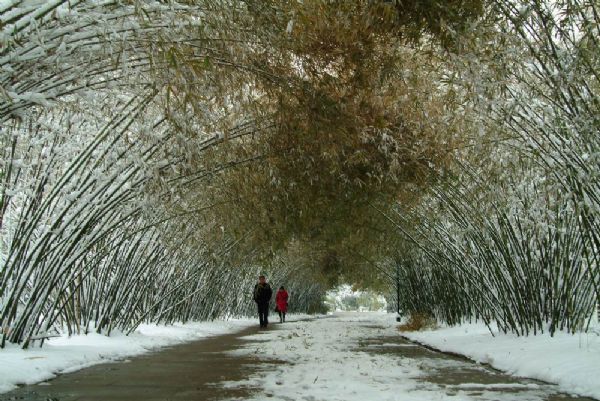
Anji is China’s No.1 bamboo hometown, and Anji Bamboo Expo Park is a national “AAAA”-rated scenic spot and a classic, must-visit destination. A visit to the park allows you to see a wide array of exotic bamboos from around the world and learn about the millennia-long history of bamboo processing and utilization. With gentle breezes swaying the bamboo and shadows dancing in the light, the 1,200-acre park is home to more than 389 species of bamboo. Strolling through the park feels like entering an ocean of bamboo — some towering and upright, others low and creeping; some as fine as knitting needles, others with leaves as broad as fabric; some vibrantly colored, others oddly twisted.
In autumn and winter, you can admire the forms, culm colors, shapes, and leaf shapes of the bamboos. In spring and summer, observing bamboo shoots is even more fascinating. Not to mention the dark green-husked Black Sprout Bamboo, the purple-red Golden Bamboo, the green Four-Season Bamboo, or the variegated Horned Bamboo. Nor to forget the spear-like Spear Bamboo or the sweet Sweet Bamboo and bitter Bitter Bamboo. Just the nurturing Nurse Bamboo and Yellow Sweet Bamboo alone are worth spending hours admiring.
Amidst the emerald bamboo groves, exquisitely designed landscapes tell age-old legends and stories of bamboo. Thatched cottages built with mud walls vividly recount the story of Meng Zong weeping by the bamboo; uniquely shaped bamboo huts bring to life the legend of the spotted bamboo; the “Ink Bamboo Courtyard” exudes the fragrance of calligraphy and painting; while the “Bamboo Peak Plank Walk” offers a real taste of the flying-through-bamboo-forest atmosphere from the movie “Crouching Tiger, Hidden Dragon.”
The China Bamboo Museum is a concentrated showcase of 6,000 years of bamboo culture and is a top-tier, world-leading specialized bamboo museum. Covering an area of 12,000 square meters, the museum is divided into eight exhibition halls: History Hall, Resources and Cultivation Hall, Literature and Art Hall, Craft Collection Hall, and International Exhibition Hall, among others. Here you can find bamboo-woven versions of the “Along the River During the Qingming Festival” and “Orchid Pavilion Preface,” the world’s thickest and largest Giant Dragon Bamboo, and the solid Gu Li Bamboo. With its rich exhibits and detailed historical materials, visitors can gain insight into China’s abundant bamboo resources, long-standing bamboo history, and splendid bamboo culture.
The Bamboo Expo Park also offers a variety of activities and performances. These include bird shows, horse riding, car racing, camping, barbecuing, fishing, navigating through bamboo mazes, solving plum blossom eight-diagram puzzles, listening to bamboo music, watching bamboo dance performances, boating on the lake, or sipping tea in the woods... Endless charm awaits.

Share
This article is published by HowToTrip. Sharing and reposting are welcome — please credit the source.
Article URL: https://www.howtotrip.net/travel-7953
Related Articles
- Shaoxing's "Grandpa Gourd" hangs the gourds back up: "If there are too many people, we'll interact less — just take a quick look from afar"
- Chinese authorities announce "reciprocal adjustment" to Japan visa fees — single-entry visa jumps from 2,250 to 16,750 yen!
- The "health stones" carried by a traveler were found to have radiation levels exceeding safety limits by a thousand times, potentially endangering fellow passengers on the same flight. Customs issues warning!
- Shenzhen Airport Issues Late-Night Notice: Unidentified Aerial Object Detected, Causing Widespread Flight Delays!
- “They only said it cost money after I opened the box and washed it!” 200g of grapes sold for 60 yuan on a high-speed train—12306 responds!
- Can't buy an airline ticket? Denied exit? Blocked from boarding? A large number of Chinese tourists have mysteriously become "discredited individuals"
- Adverse weather and economic fluctuations impact Colombia's coffee market
- Beach bathing area responds to 2 yuan/30 seconds fee for freshwater foot rinsing: Clearly priced!
- Taking off with an improperly closed cabin door? Wing malfunction? Multiple flights made emergency returns mid-journey!
- Experience the gifts of nature! A countdown of the world’s ten most stunning coastlines