Guizhou Colorful Wonderland Tourism City
Guizhou Colorful Wonderland Tourism City
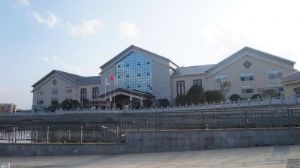
Reception Center
The design of the tourism city’s reception center mainly features a steel structure. It covers an area of 6 square kilometers with a built-up area of 18,000 square meters. The first floor mainly consists of an exhibition center and an eco-restaurant, while the second and third floors are primarily office areas. The design concept is inspired by the mountains of Guizhou, reflecting the province’s picturesque, quaint, and elegant characteristics. (Guizhou's terrain is part of the plateau and mountainous region in southwestern China. The climate in Guizhou is humid, characterized by a subtropical humid monsoon climate with small temperature variations, warm winters, and cool summers. Guizhou is known for its beautiful, quaint scenery, picturesque landscapes, pleasant climate, and abundant resources. Hence, mountains are also one of Guizhou’s major scenic features.)
Wind and Rain Corridor Bridge
The Wind and Rain Corridor Bridge, designed in the style of ethnic architecture, is one of the “Three Treasures” of Dong architecture. (The Wind and Rain Corridor Bridge, also known as the Flower Bridge or Fortune Bridge, is one of the architectural features the Dong people take pride in. The bridge is composed of massive stone piers, a wooden structure for the bridge body, a long corridor, and pavilions. Multiple tower-like pavilions rise from the top of the long corridor, their upturned eaves overlapping—some have three levels, others as many as five. The bridge body stands solemn and majestic, like a giant dragon lying across the river, awe-inspiring and spectacular. The design concept draws from the arch form of the Wind and Rain Bridge, incorporating this element into the Colorful Wonderland Tourism City. It reflects the architectural wisdom of the Dong people and provides visitors with shelter from wind and rain, as well as a place for sightseeing and rest.) Spanning two mountains, the bridge is 277 meters long, 12 meters wide, and 33 meters high. The first floor mainly serves as entrances for military, civilian, and commercial use, while the second floor is an ethnic culture corridor showcasing local Guizhou ethnic costumes, batik, silver ornaments, Miao embroidery, and more.
Colorful Joy Avenue
As the longitudinal main road of the entire park, “Colorful Joy Avenue” is 240 meters long and 50 meters wide. Along both sides of the avenue are four pairs of cultural totem poles rich in Guizhou’s ethnic cultural significance. From front to back, they are: the bronze drum of the Buyi ethnic group (the bronze drum, serving both musical and sacred functions, gradually became a symbol of importance. “The most important affairs of the state are rituals and warfare.” Those presiding over sacrificial ceremonies and commanding troops were tribal or clan leaders. Thus, the bronze drum became a symbol of status, power, and wealth.), the buffalo horn cup of the Miao ethnic group (Miao people in Guizhou carve intricate patterns on curved water buffalo horns, sometimes lacquering or inlaying them to create buffalo horn wine cups. These naturally and artfully combined cups hold a unique and special status in Miao drinking customs, thus treasured by people. Ancient buffalo horn cups have been passed down through generations, becoming precious ethnic artifacts.), the lusheng of the Dong ethnic group (a symbol of Dong culture, the Miao lusheng integrates lyrics, melodies, and dance during performances, preserving the primitiveness and simplicity of Miao historical culture and art. Lusheng-making skills have traditionally been passed down orally from master to apprentice, with no written records, and the craft is meticulous and difficult to inherit.), and the Tunbao face masks (Tunbao opera, named for being performed in open fields without a stage, can be seen in rural Anshun, often self-written and passed down through generations. People perform Tunbao opera mainly to drive away evil and pray for disaster relief, as well as for entertainment. Many grotesque characters are added to enhance the atmosphere of exorcism. Audiences also enjoy appreciating the opera masks.)
Terraced Field Water Screen Movie
The “Terraced Field Water Screen Movie” draws its design inspiration from the terraced fields of rural Guizhou and the world-famous Huangguoshu Waterfall. (Terraced fields are among the most beautiful curves in Guizhou, a perfect blend of human transformation and nature. They carry not only human production and life but also a piece of earthly paradise. Huangguoshu Waterfall, located in Zhenning Buyi and Miao Autonomous County, Anshun, Guizhou, is known as a “marvelous spectacle under heaven.” It is the largest of the nine-tiered waterfalls on the Baishui River, the largest waterfall in China, and the largest in Asia. Terraced fields and Huangguoshu Waterfall are symbols of Guizhou’s natural environment and tourist attractions. Therefore, the unique forms of Guizhou’s terraced fields are combined with the majestic flow of Huangguoshu Waterfall to highlight the cascading pool plaza at the entrance of Colorful Wonderland Tourism City, giving it vibrant life and distinctive ethnic and regional characteristics.) At night, the water screen movie, created using the latest international multimedia technologies such as fountains, music, fireworks, water screens, and lasers, delivers a stunning visual impact to tourists and local residents.
As a key commercial development section in the first phase of Colorful Wonderland Tourism City, Huangguoshu Outlets covers an area of approximately 50,000 m². It consists of the Outlets Boutique Street, Outlets Sky Street, Outlets Gold Street, Food City, and the Wind and Rain Corridor Bridge, with a total built-up area of about 100,000 m². It is located within the first-phase area of Colorful Wonderland Tourism City on Xihang Avenue, Anshun Economic and Technological Development Zone. It is 6 km from Huangguoshu Airport, 1.5 km from Huangguoshu Station on the Shanghai-Kunming High-Speed Railway, 1.9 km from the Anshun West Exit of the Shanghai-Kunming Expressway, and 4.5 km from the city center. The location provides transportation access to the central Guizhou region and extends to major southwestern cities such as Chongqing and Kunming.
The commercial scope of the Outlets includes international and domestic premium fashion and department stores, economy hotels, dining, supermarkets, luxury car showrooms, leisure, and entertainment. To date, it has successfully signed contracts and entered renovation phases with internationally renowned brands such as ARMANI, GUCCI, SALVATORE FERRAGAMO, POLO RALPH LAUREN, PAUL&SHARK, MONTBLANC, and COACH. Additionally, over 100 brands have been signed with both domestic and international well-known cosmetics, men’s and women’s apparel, outdoor sports, children’s wear and amusement, local specialty dining, import supermarkets, and luxury car showroom brands.
Share
This article is published by HowToTrip. Sharing and reposting are welcome — please credit the source.
Article URL: https://www.howtotrip.net/travel-21021
Related Articles
- Shaoxing's "Grandpa Gourd" hangs the gourds back up: "If there are too many people, we'll interact less — just take a quick look from afar"
- Chinese authorities announce "reciprocal adjustment" to Japan visa fees — single-entry visa jumps from 2,250 to 16,750 yen!
- The "health stones" carried by a traveler were found to have radiation levels exceeding safety limits by a thousand times, potentially endangering fellow passengers on the same flight. Customs issues warning!
- Shenzhen Airport Issues Late-Night Notice: Unidentified Aerial Object Detected, Causing Widespread Flight Delays!
- “They only said it cost money after I opened the box and washed it!” 200g of grapes sold for 60 yuan on a high-speed train—12306 responds!
- Can't buy an airline ticket? Denied exit? Blocked from boarding? A large number of Chinese tourists have mysteriously become "discredited individuals"
- Adverse weather and economic fluctuations impact Colombia's coffee market
- Beach bathing area responds to 2 yuan/30 seconds fee for freshwater foot rinsing: Clearly priced!
- Taking off with an improperly closed cabin door? Wing malfunction? Multiple flights made emergency returns mid-journey!
- Experience the gifts of nature! A countdown of the world’s ten most stunning coastlines