Jinman Village
Jinman Village
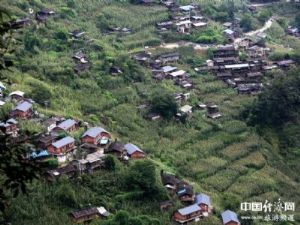
Jinman Village is situated on the mountainside of the Gaoligong Mountains west of Luobenzhuo Bai Ethnic Township in Nujiang Prefecture. Due to its high-altitude, rugged terrain, and isolated transportation and communication, villagers' lives were once greatly affected.
According to Luo Jianguo, Deputy Director of the Nujiang Prefecture Party Committee Office and the First Secretary stationed in Jinman Village, the per capita land here is less than 0.5 mu, with an annual yield of no more than 300 kilograms. Agricultural production and staple food rely solely on corn cultivation, resulting in a single and meager source of livelihood. As a result, it is also one of the deeply impoverished areas in Nujiang Prefecture. Moreover, as Jinman Village is located in a geologically active disaster-prone zone, most of its residents are from the Lemu subgroup of the Bai ethnic group, who live scattered in “Thousand-Leg Houses” — structures supported by wooden poles, fenced with bamboo, and roofed with wooden planks. This has posed serious threats to both personal and housing safety. To thoroughly resolve the housing and living conditions of the villagers, Nujiang Prefecture has been implementing relocation and centralized resettlement programs for residents in accordance with the national targeted poverty alleviation policies. As a result, the remaining ethnic-style clustered “Thousand-Leg Houses” and the ancient and unique “communal house” customs have become rare spectacles. The village has been recognized by Yunnan Province as a “Yunnan Historic and Cultural Village” and one of the “Top 30 Most Charming Villages in Yunnan,” and was included in the “National 20 Tourism Poverty Alleviation Demonstration Villages” in 2015, as well as listed as a “Nujiang Prefecture Tourism Characteristic Village” in 2016.
Share
This article is published by HowToTrip. Sharing and reposting are welcome — please credit the source.
Article URL: https://www.howtotrip.net/travel-20672
Related Articles
- Shaoxing's "Grandpa Gourd" hangs the gourds back up: "If there are too many people, we'll interact less — just take a quick look from afar"
- Chinese authorities announce "reciprocal adjustment" to Japan visa fees — single-entry visa jumps from 2,250 to 16,750 yen!
- The "health stones" carried by a traveler were found to have radiation levels exceeding safety limits by a thousand times, potentially endangering fellow passengers on the same flight. Customs issues warning!
- Shenzhen Airport Issues Late-Night Notice: Unidentified Aerial Object Detected, Causing Widespread Flight Delays!
- “They only said it cost money after I opened the box and washed it!” 200g of grapes sold for 60 yuan on a high-speed train—12306 responds!
- Can't buy an airline ticket? Denied exit? Blocked from boarding? A large number of Chinese tourists have mysteriously become "discredited individuals"
- Adverse weather and economic fluctuations impact Colombia's coffee market
- Beach bathing area responds to 2 yuan/30 seconds fee for freshwater foot rinsing: Clearly priced!
- Taking off with an improperly closed cabin door? Wing malfunction? Multiple flights made emergency returns mid-journey!
- Experience the gifts of nature! A countdown of the world’s ten most stunning coastlines