Tangya Temple Village
Tangya Temple Village
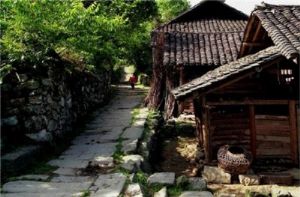
The Tangya River, which originates from Maoba Township in Lichuan City, winds through Xianfeng County, cutting through caves and passing gorges as it flows westward, eventually joining the Wu River at Gongtan Ancient Town in Chongqing. Because the river flows from east to west, there is a saying: “The river turns at Fuling, flowing backward for 3,800 li.”
Tangya Temple Village straddles the Tangya River. The once-flourishing Tangya Tusi King’s City is situated on the Xuanwu Mountain by the riverside.
The founding ancestor of the Tangya Tusi clan, the Qins, was named Qǐchùsòng. The *Qin Family Genealogy of Tangya* records: “In the 6th year of the Zhi Zheng era of the Yuan Dynasty (1346 AD), the first ancestor Qin Qichusong, for his meritorious service in suppressing night raids, was granted approval and appointed to the position of Tusi of Tangya, bestowed with the title of Xuanwei Si.” From then on, the Qin family became one of the 18 most renowned Tusi clans in western Hubei.
In ancient times, Tusi officials had both rank and level, with Xuanwei being the highest, followed by Xuanfu, and then the lower-ranking Zhixian. Regardless of rank, those who received imperial recognition became the “local kings,” and the Tusi cities were commonly referred to by the people as “Tusi Imperial Cities.”
Yang Xiaoming, a cultural relics expert from Xianfeng County, said that the most remarkable period of the Qin family’s 400-year hereditary rule over the Tangya Tusi Kingdom was during the era of Qin Ding: he was thrice ordered by the imperial court to quell rebellions, demonstrating great military might. Emperor Xizong of the Ming Dynasty, Zhu Youjiao, issued an imperial decree to construct the Pingxi General’s Command Palace, erect a Merit Archway, and bestow the inscription “Heroic Stronghold of Southern Jing, Shield of Chu and Shu” in eight large characters as an honor. Leveraging this prestige, the Qin family undertook large-scale construction—building palaces, temples, fortifications, and armories. The splendor of the Tangya Tusi Imperial City became closely associated with the name of Qin Ding.
Ascending the stone steps from the Tangya River wharf, the “Heroic Stronghold of Southern Jing” stone memorial archway stands majestically. Centered around it, the Imperial City is laid out with Upper, Middle, and Lower streets. Each street is seven chi wide and extends over a thousand meters, all paved with blue flagstones; there are six lanes that connect the four streets and eight alleys along the terrain. Structures such as the Command Palace, Official Hall, Academy, Treasury, Left and Right Barracks, Horse Racing Ground, Garden, and Beast Garden are all intact. Nearby, major temples like the Grand Temple Hall, Huanhou Temple, and Xuanwu Temple stand in their respective locations.
Historical records indicate that the Tangya Tusi City covered an area of over 100 hectares, even larger than Beijing’s Forbidden City. Zhang Zhongpei, former director of the Palace Museum and then-chairman of the Chinese Archaeological Society, remarked after inspecting the Tangya Tusi City ruins: “Beijing has a grand Forbidden City, and Xianfeng has a little Forbidden City.”
The stone memorial archway standing at the center of the Tangya Tusi City is quite majestic and grand. Entirely built of stone in imitation of wooden structures, it features a pavilion-style bracket design. The front is inscribed with “Heroic Stronghold of Southern Jing,” while the back reads “Shield of Chu and Shu.” Both sides also feature relief carvings depicting scenes such as “The Tusi King’s Procession,” “Fishermen and Woodcutters Farming and Reading,” “Clouds Swallowing Mist,” “Nezha Stirring Up the Sea,” and “Pagoda Tree Shade Delivering a Child.” The “Nezha Stirring Up the Sea” carving on the archway is particularly rare: Nezha holds the Hun Tian Ling (a magical red sash), with his right foot stepping on a carp that is just leaping out of the water. Yang Xiaoming noted that in ancient times, the dragon symbolized the emperor, and the archway ingeniously replaced the dragon with a fish to avoid disrespecting the emperor—this symbolic representation is unique among known architectural motifs in China.
Famous architecture and tourism expert Zhang Lianggao said that within Hubei Province, apart from the “Zhishì Xuanye” (Governing the World with Mysterious Mountain) archway on Mount Wudang, no other archway surpasses Tangya’s “Heroic Stronghold of Southern Jing, Shield of Chu and Shu.” The Tusi Tombs may even be unique in all of China.
Walking along the sandy stone paths in the mountains, the bluestone slabs of the “Three Streets” remain largely intact, and the “Eighteen Lanes” can still be clearly counted. Although the sites of the “Thirty-Six Courtyards” are hard to trace, the feng shui layout, central axis, and scenic vistas still stir the imagination.
Share
This article is published by HowToTrip. Sharing and reposting are welcome — please credit the source.
Article URL: https://www.howtotrip.net/travel-19387
Related Articles
- Shaoxing's "Grandpa Gourd" hangs the gourds back up: "If there are too many people, we'll interact less — just take a quick look from afar"
- Chinese authorities announce "reciprocal adjustment" to Japan visa fees — single-entry visa jumps from 2,250 to 16,750 yen!
- The "health stones" carried by a traveler were found to have radiation levels exceeding safety limits by a thousand times, potentially endangering fellow passengers on the same flight. Customs issues warning!
- Shenzhen Airport Issues Late-Night Notice: Unidentified Aerial Object Detected, Causing Widespread Flight Delays!
- “They only said it cost money after I opened the box and washed it!” 200g of grapes sold for 60 yuan on a high-speed train—12306 responds!
- Can't buy an airline ticket? Denied exit? Blocked from boarding? A large number of Chinese tourists have mysteriously become "discredited individuals"
- Adverse weather and economic fluctuations impact Colombia's coffee market
- Beach bathing area responds to 2 yuan/30 seconds fee for freshwater foot rinsing: Clearly priced!
- Taking off with an improperly closed cabin door? Wing malfunction? Multiple flights made emergency returns mid-journey!
- Experience the gifts of nature! A countdown of the world’s ten most stunning coastlines