Yvnü Village
Yvnü Village
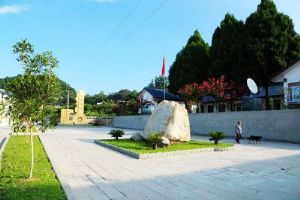
The legend of Yvnü Village in Lingjiang Town is tied to a beautiful woman. It is said that Emperor Gaozong of Tang, Li Zhi, and Empress Wu Zetian returned to Lizhou to visit family. Princess Ding’an, young and radiant as a flower, was captivated by the meandering natural scenery along the Jialing River. While traveling to a place called Hongwei, she caught a cold. The imperial physician who accompanied the royal entourage treated her with all his skill, but she did not recover. Emperor Li Zhi and Empress Wu were deeply worried. At this moment, Li Chunfeng, an official skilled in astronomy and the metaphysics of yin and yang, “revealed heavenly secrets” to the emperor: Princess Ding’an was destined to perish, and only by staying in this place to cultivate herself in tranquility could she prolong her life. Overcome with grief, Emperor Li Zhi and Empress Wu ordered the construction of the “Yvnü Temple.” From then on, Princess Ding’an began a long journey of spiritual practice, and her grace and beauty gradually seeped into the landscape.
Years later, local people renamed “Hongwei” to “Yvnü” in memory of the beautiful princess.
Today, strolling through the new Yvnü Village, you will surely visit the village’s Ecological Courtyard Economy Exhibition Hall. Every detail of the changing times, the laughter of visitors from near and far, and the many moments when the “Yvnü Spirit” has been shared beyond the village are all preserved here. In every household, in front of and behind the houses, the mountain village thrives with industry. Early-ripening pears and kiwifruit have become the “money trees” that bring prosperity to the villagers, with newly planted areas expanding by over a hundred acres each year.
The spring scenery of Yvnü Village makes you pause and look back again and again. Perhaps what you can’t bear to leave behind is the pure simplicity as fresh as a maiden’s, and the unadorned beauty that extends far beyond...
Source: Government Information Center
Share
This article is published by HowToTrip. Sharing and reposting are welcome — please credit the source.
Article URL: https://www.howtotrip.net/travel-19078
Related Articles
- Shaoxing's "Grandpa Gourd" hangs the gourds back up: "If there are too many people, we'll interact less — just take a quick look from afar"
- Chinese authorities announce "reciprocal adjustment" to Japan visa fees — single-entry visa jumps from 2,250 to 16,750 yen!
- The "health stones" carried by a traveler were found to have radiation levels exceeding safety limits by a thousand times, potentially endangering fellow passengers on the same flight. Customs issues warning!
- Shenzhen Airport Issues Late-Night Notice: Unidentified Aerial Object Detected, Causing Widespread Flight Delays!
- “They only said it cost money after I opened the box and washed it!” 200g of grapes sold for 60 yuan on a high-speed train—12306 responds!
- Can't buy an airline ticket? Denied exit? Blocked from boarding? A large number of Chinese tourists have mysteriously become "discredited individuals"
- Adverse weather and economic fluctuations impact Colombia's coffee market
- Beach bathing area responds to 2 yuan/30 seconds fee for freshwater foot rinsing: Clearly priced!
- Taking off with an improperly closed cabin door? Wing malfunction? Multiple flights made emergency returns mid-journey!
- Experience the gifts of nature! A countdown of the world’s ten most stunning coastlines