Hidden Screen Peak
Hidden Screen Peak
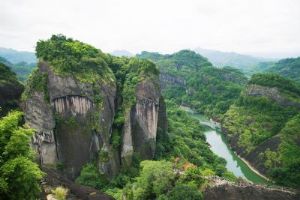
On the southern side of the peak, by the Pinglin Ferry, there are remnants of the "Wuyi Retreat" built by Zhu Xi. Heading eastward around the peak and then north leads to Tianyou Peak, while descending southeast brings you to the base of the Immortal Fishing Platform.
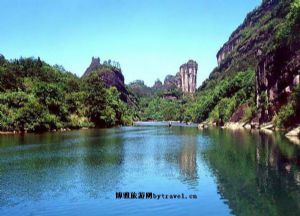
Hidden Screen Peak is located in the middle section of the Nine Bend Stream in Wuyi Mountain, hidden deep within the Wulin Ravine. Shrouded in mist, it rises straight up and down, sheer and towering, flat like a screen—hence its name. When viewed from a raft, only half of the peak, jutting from the treetops, can be seen. Only by climbing up to the Evening-Facing Peak on the south bank of the stream can one view the peak in its entirety.
Hidden Screen Peak can be ascended from the southern cliff via Tea Cave. To the west of the peak stands an oddly-shaped rock that points sharply upward with three horizontal fissures halfway up—it is called Bamboo Shoot Peak. The climbing path up Hidden Screen Peak is extremely steep and treacherous, nicknamed "Chicken Breast" and "Dragon’s Ridge," and was originally carved out by the Ming Dynasty Taoist priests Wang Sanbao and Liu Duanyang.
At the summit, there are ruins of the Xuan Yuan Taoist Temple and the Qing Wei Taoist Temple, as well as scenic spots such as the Boundary Between Mortals and Immortals, the Immortal Chess Pavilion, and the Southern Abyss Shrine, collectively known in ancient times as the "True Realm of Hidden Screen." On the southern side of the peak, by the Pinglin Ferry, there are remnants of the "Wuyi Retreat" built by Zhu Xi. Heading eastward around the peak and then north leads to Tianyou Peak, while descending southeast brings you to the base of the Immortal Fishing Platform.
Midway up Hidden Screen Peak, there is a spacious cave several zhang in size, called the "Xiantian Cave," also known as the "Fuxi Cave." Below the peak lies a rock with a bald top and rounded shoulders, standing upright like a statue of the Maitreya placed inside a niche—this is the Arhat Rock. Beneath the rock is a cave known as the Arhat Cave. Nearby is another cave, twisting and deep, so dark upon entering that it takes a moment before the colors of the stones become visible—hence it is named the "Black Cave."
At the cave entrance, two tall rocks rise up, with a long horizontal rock stretched across them, called the Cloud Bridge. Beside the bridge stands a lone rock that covers the path above, known as the "Cloud Path Stone." At the peak’s summit once stood the Qing Zhen Taoist Temple, built in the fifth year of the Wanli reign of the Ming Dynasty (1577 AD), but now in ruins. Descending from the peak’s south side, halfway down the cliff face is a cave called the Southern Abyss Shrine. The Ming Dynasty Taoist Liu Duanyang was buried here, and his stone tomb and spirit altar still remain. Below the peak is the Liu Yun Study House, where Dong Tiangong, compiler of the Wuyi Mountain Annals, once studied—now collapsed. At the base of the peak is a large stone inscription from the Ming Dynasty Wanli era by Xiong Mingyu, Minister of Justice, titled "Record of a Journey to Wuyi Mountain."
The summit of Hidden Screen Peak once housed the Qing Zhen Taoist Temple, also called the Qing Wei True Hall, built in 1577 (fifth year of the Wanli reign), but soon collapsed. In the fifteenth year of the Shunzhi reign of the Qing Dynasty (1658), the Taoist priest Jin Xiang rebuilt it and inscribed the plaque "Hermitage of Hidden Screen," which has also long been destroyed. The peak now retains a patch of primeval evergreen broadleaf forest, a typical vegetation type of the central subtropical zone, with a canopy density of 0.7. There are over 130 species of woody plants here, mainly including species such as Cyclobalanopsis glauca, Castanopsis eyrei, Engelhardtia roxburghiana, Pasania hancei, and Lithocarpus glaber, along with precious species like the yew, magnolia officinalis, and Quercus phillyraeoides. The forest is home to over 40 species of birds, including those from the Passeriformes and Falconiformes orders, as well as animals such as goats, muntjacs, and pangolins.
The most Taoist-inspired feature is the two characters “Bu Xu” (Step into Emptiness), engraved at the entrance of the stairway leading up Hidden Screen Peak. Meaning "to dance lightly through the void" or "the sacred steps of the spirit realm," it refers to the music and chants used by Taoists to imitate the sounds of celestial dances performed by immortals, and is also part of Taoist ritual music.






Share
This article is published by HowToTrip. Sharing and reposting are welcome — please credit the source.
Article URL: https://www.howtotrip.net/travel-19070
Related Articles
- Shaoxing's "Grandpa Gourd" hangs the gourds back up: "If there are too many people, we'll interact less — just take a quick look from afar"
- Chinese authorities announce "reciprocal adjustment" to Japan visa fees — single-entry visa jumps from 2,250 to 16,750 yen!
- The "health stones" carried by a traveler were found to have radiation levels exceeding safety limits by a thousand times, potentially endangering fellow passengers on the same flight. Customs issues warning!
- Shenzhen Airport Issues Late-Night Notice: Unidentified Aerial Object Detected, Causing Widespread Flight Delays!
- “They only said it cost money after I opened the box and washed it!” 200g of grapes sold for 60 yuan on a high-speed train—12306 responds!
- Can't buy an airline ticket? Denied exit? Blocked from boarding? A large number of Chinese tourists have mysteriously become "discredited individuals"
- Adverse weather and economic fluctuations impact Colombia's coffee market
- Beach bathing area responds to 2 yuan/30 seconds fee for freshwater foot rinsing: Clearly priced!
- Taking off with an improperly closed cabin door? Wing malfunction? Multiple flights made emergency returns mid-journey!
- Experience the gifts of nature! A countdown of the world’s ten most stunning coastlines