Zhu Xi Memorial Hall
Zhu Xi Memorial Hall

The Zhu Xi Memorial Hall is situated at the northern end of the Ancient Wuyi Palace Street in northern Fujian. It stands on the original site of Chongyou Temple, one of the six major temples of the Song Dynasty. Chongyou Temple was first constructed in the seventh year of the Tang Tianbao era (748 AD) and was historically known as a grand structure on a famous mountain. For over 1,200 years, it has survived wars, fires, and numerous restorations and reconstructions. In the late 1980s, relevant departments invested millions to rebuild the palace hall on the Dharma Hall site of Chongyou Temple, establishing it as the Zhu Xi Memorial Hall. It is the largest memorial building dedicated to the renowned Neo-Confucian scholar Zhu Xi in China;
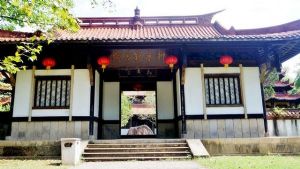
The Zhu Xi Memorial Hall is located on the Ancient Wuyi Palace Street in northern Wuyishan, Fujian Province. It is a Song-style imitation palace building, facing south with a rectangular layout, approximately 35 meters long from north to south and 25 meters wide from east to west, covering an area of about 875 square meters. It consists of a front hall, two corridors, a courtyard, and exhibition rooms.
The memorial hall prominently displays a horizontal plaque inscribed with the words “Zhu Xi Memorial Hall,” with the five bold and powerful characters exuding dignity. On both sides of the main gate, there are three couplets hanging from the pillars. One was composed and written by Zhao Puchu: “For millennia, diligent in pursuit, elucidating human nature and Heaven’s principles through the teachings of the Two Chengs; the three characters ‘Do Not Depart and Return’ speak of cultivating the heart’s virtues along the Nine Bend Stream.” Another is an imperial calligraphy piece from Emperor Kangxi of the Qing Dynasty: “Synthesizing the great traditions to continue learning lost for centuries; enlightening the ignorant to establish eternal principles for all generations.” The third was composed and written by Zhang Dainian, a famous Chinese historian and professor at Peking University: “Encompassing the vast and reaching the minute, encompassing the teachings of all dynasties; respecting virtue and pursuing knowledge, integrating theory and application.” On the surrounding walls on both sides of the gate are ten stone tablets each, inscribed with Zhu Xi’s handwritten poems from his “Twenty Scenic Spots South of Tanzhou City,” which he wrote during his visit to Zhang... in the southern outskirts of Tanzhou. Inside the hall, the walls are adorned with modern... scholars' inscriptions, such as “Three generations of sages, Neo-Confucianism in the Song Dynasty. Chinese culture’s roots intertwined with Zhu Xi’s.”
The western corridor of the memorial hall displays the life of Zhu Xi, divided into eight sections: Zhu Xi’s ancestors, his diligent childhood studies, settling in Wufu, philosophizing in the southeast, his ups and downs in officialdom, his soul returning to Tangshi, posthumous titles and honors, etc. Through a wealth of photos and abundant cultural relics, it vividly reflects Zhu Xi’s arduous yet great life. In the pavilion of the western corridor stands the Spirit Way Stele composed and written by Zhu Xi for Liu Gong, which has been listed as a provincial-level cultural relic protection unit and is the treasure of the hall. On both sides of the stele are Zhu Xi’s calligraphic inscriptions of the characters “Integrity” and “Rectitude,” while another plaque inscribed with “Sage of Both Ancient and Modern Times” is also in Zhu Xi’s handwriting.
The eastern corridor showcases the passing on of the torch, Zhu Xi’s prolific writings, his followers, international influence, domestic impact, four international academic conferences on Zhu Xi studies, cultural relics of Zhu Xi studies in northern Fujian, and descendants of Zhu Xi, among others. The exhibits are rich and diverse, vividly demonstrating how Zhu Xi’s philosophy spans ancient and modern times, spreading far and wide overseas.
The main hall features a double-eaved roof, with the upper plaque inscribed “Learning Reaches Human Nature and Heaven,” and the lower plaque inscribed “Tranquil Atmosphere,” both written by Emperor Kangxi of the Qing Dynasty. Stepping into the hall, the centerpiece is a seated bronze statue of Zhu Xi, with his right hand resting on his knee and left hand holding a book, appearing serene and exquisitely crafted. Above the statue hangs a horizontal plaque inscribed “Orthodox of Neo-Confucianism,” written by the renowned calligrapher Shen Jingshou. In front of the statue are four standing bronze statues of Zhu Xi’s disciples: Cai Yuanding and Chen Chun on the left, Huang Gan and You Zuo on the right, each displaying distinct character and scholarly demeanor.
The exhibition cabinets and display cases in the main hall and the two corridors house the voluminous and various editions of Zhu Xi’s Neo-Confucian writings, spanning from the Song Dynasty to the present day. Among the precious items are Zhu Xi’s calligraphy works, his chronology, his self-portrait, and imperial inscriptions bestowed by Emperor Kangxi of the Qing Dynasty upon Zhu Xi’s mentors Yang Shi and Li Dong, who were revered sages before him.
The memorial hall introduces Zhu Xi’s life through texts, photos, and artifacts, highlighting his extraordinary journey—from childhood education in Wuyi Mountain to writing in middle age and founding schools in old age until becoming a great Confucian master. It also outlines, through images and texts, how his teachings have transcended time and spread globally. For example, the Toegye School in Korea has now become an international academic institution for Zhu Xi studies. Exhibits include a portrait of its founder Yi Hwang (also known as Toegye), his literary works in Classical Chinese, and an overview of the 17 years from 1983 to 2000 during which six international conferences on Zhu Xi studies were held (two of which took place in Wuyi Mountain), as well as the diverse editions of Zhu Xi’s Neo-Confucian writings. Also notably rare is a Japanese Kanbun edition of the “Collected Commentaries on the Analects” from the Edo period.
Modern Neo-Confucian scholarly works—including those from the United States, Japan, Korea, Europe, and Australia—showcase the essence of domestic and international publications. Additionally, several special sections provide a broad overview of Zhu Xi’s descendants active both at home and abroad. Over its 12 years of existence, the Zhu Xi Memorial Hall has garnered significant attention from the global academic community. It has hosted scholars who attended international Zhu Xi conferences, received over 500 pieces of calligraphy and couplets, and welcomed foreign leaders enthusiastic about Sinology, such as the Queen of the Netherlands. Central government leaders in charge of national culture and education visited twice. ... and Deng Pufang, after seeing it, spoke highly of it.
Address: Ancient Wuyi Palace Street, Wuyishan City, Nanping, Fujian (near Dawang Peak).
Type: Memorial Hall
Recommended Visit Duration: 1 hour
Phone: 0599-5131890
Official Website: http://www.whwy.org/
Opening Hours:
7:30–17:30
Ticket Information:
No separate admission fee. Included in the Wuyi Mountain ticket.
Zhu Xi (1130~1200) Zhu Xi, courtesy name Yuanhui (later changed to Zhonghui), literary name Huian, also known as Ziyang, was from Wuyuan, Jiangxi, but born in Youxi, Fujian. His father, Zhu Song, served as the magistrate of Youxi County during the fifth year of the Song Xuanhe era (1123 AD). After completing his term, he stayed at the residence of Zheng Andao in Shuinan, the county. On September 15 of the fourth year of the Jianyan era (1130 AD), Zhu Xi was born. From an early age, Zhu Xi was intelligent and studious. At the age of seven, he moved with his parents to Jianzhou (present-day Jian’ou, Fujian). At 14, following his father’s dying wish, he went to study under his friends Hu Xian and Liu Mianzhi in Chong’an County. Hu and Liu treated Zhu Xi like a nephew, arranging his life and teaching him earnestly. Liu Mianzhi even married his daughter to Zhu Xi. More+







Share
This article is published by HowToTrip. Sharing and reposting are welcome — please credit the source.
Article URL: https://www.howtotrip.net/travel-19049
Related Articles
- Shaoxing's "Grandpa Gourd" hangs the gourds back up: "If there are too many people, we'll interact less — just take a quick look from afar"
- Chinese authorities announce "reciprocal adjustment" to Japan visa fees — single-entry visa jumps from 2,250 to 16,750 yen!
- The "health stones" carried by a traveler were found to have radiation levels exceeding safety limits by a thousand times, potentially endangering fellow passengers on the same flight. Customs issues warning!
- Shenzhen Airport Issues Late-Night Notice: Unidentified Aerial Object Detected, Causing Widespread Flight Delays!
- “They only said it cost money after I opened the box and washed it!” 200g of grapes sold for 60 yuan on a high-speed train—12306 responds!
- Can't buy an airline ticket? Denied exit? Blocked from boarding? A large number of Chinese tourists have mysteriously become "discredited individuals"
- Adverse weather and economic fluctuations impact Colombia's coffee market
- Beach bathing area responds to 2 yuan/30 seconds fee for freshwater foot rinsing: Clearly priced!
- Taking off with an improperly closed cabin door? Wing malfunction? Multiple flights made emergency returns mid-journey!
- Experience the gifts of nature! A countdown of the world’s ten most stunning coastlines