Former Residence at Daying
Former Residence at Daying

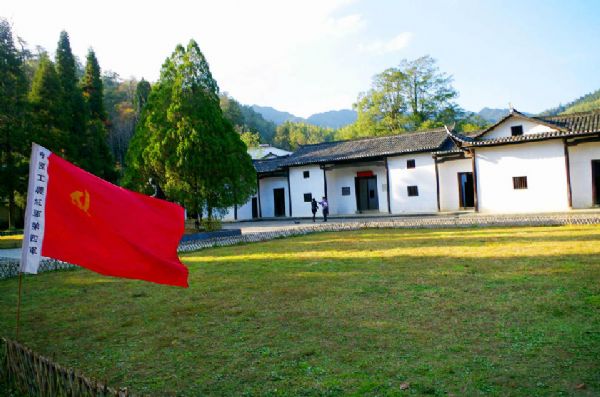
--Although this is a reconstructed version of the original site, it still carries deep cultural significance, with yellow and white houses complementing each other beautifully.
--Besides the cultural attractions, you’ll also find rare highland pastoral scenery that’s uncommon even in China’s famous mountains and rivers. The rolling hills present ever-changing views from different angles, with pine-covered peaks and bamboo groves blending into lush forests of ancient trees.
--The local residential architecture has a rustic charm that blends harmoniously with the surroundings. The rice paddies around the village resemble celestial stairways ascending into the misty depths.
--Visitors can escape the hustle and bustle of big cities here and enjoy the tranquility of nature.
Daying in Jinggangshan is situated seven kilometers northwest of Ciping. Revolutionary historical sites here include Mao Zedong’s Former Residence and the former site of the Red Army medical clinic. In late October 1927, Mao Zedong led the Chinese Workers’ and Peasants’ Revolutionary Army to Jinggangshan, arriving here first. He led the Red Army in connecting with the masses, spreading revolutionary ideals, organizing and arming the people, helping them with production, and addressing their practical difficulties. A Red Army medical clinic was also established here, providing free treatment to local residents. Additionally, efforts began here to educate and reform the local militia forces under Wang Zuo. In February 1928, Wang Zuo led his forces to join the Workers’ and Peasants’ Revolutionary Army, which were reorganized into the Second Battalion of the Second Regiment, thereby strengthening the revolutionary ranks. The revolutionary sites at Daying have been designated as key cultural relics protection units in China and are open to the public.
Beyond its revolutionary history, Daying also boasts rare highland pastoral scenery among China’s great mountains and rivers. The surrounding peaks present varied profiles when viewed from different angles, with pine-covered summits and bamboo thickets, ancient trees forming dense forests, and clear mountain streams teeming with fish. Delicious stone chickens and the rare and protected Chinese giant salamander also inhabit the area. Local homes are set in serene surroundings with rustic architecture that complements the landscape. The rice paddies around the village look like celestial stairways reaching into the clouds. Travelers arriving here from noisy cities are greeted by a highland pastoral painting and the poetry of nature, refreshing their senses and melting away all worries.
The former residences of great revolutionaries such as Mao Zedong, Peng Dehuai, Zhu De, and Chen Yi in Daying were burned down by enemy forces that invaded Jinggangshan after the failure of anti-encirclement campaigns and the main force of the Fourth Red Army’s advance to southern Jiangxi, including all houses in Daying Village. Mao Zedong’s residence, known as the “White House,” was left with only one surviving wall. It wasn’t until 1960, after the liberation of China, that the Jiangxi Provincial Government restored the “White House” to its original appearance, embedding the remaining wall into the new structure as a memorial. Inside Mao Zedong’s former residence, some of his personal belongings from that time are displayed, such as a washbasin, towels, and an oil lamp.
In front of Mao Zedong’s former residence lies a dark, smooth stone known as the “Reading Stone,” where he was said to have read. The “White House” is built in the style of a Hakka residence, but it’s unique because it consists of a row of interconnected courtyards. The central hall is flanked by two courtyards on either side, each containing two rows of four rooms and a separate gate. Each courtyard has a path leading to the central hall. Mao Zedong’s bedroom was in the second courtyard, where the lighting was dim even during the day. Fond of reading and studying, Mao would often sit on this large stone in front of his room to read newspapers, review documents, and study, leading to the stone being called the "Reading Stone."
Behind Mao Zedong’s former residence stand two magical trees—a yew and a photinia serratifolia—referred to as the “Evergreen Trees.” These remarkable trees also come with a legendary tale.
Legend says the two trees grew from the graves of two sworn sisters (named Yixiang and Zhixiu). The trees are believed to be spiritually attuned. During the Jinggangshan struggle, while Mao lived in the “White House,” he often read, rested, spoke to the masses about revolution, and trained soldiers under these trees. Over time, the trees grew fond of Mao—during scorching summers, they provided ample shade to keep him cool. In February 1929, when Mao led the Fourth Red Army to southern Jiangxi and enemies ransacked Daying Village, burning the “White House” to the ground, the trees were also scorched. Yet their spirit endured. In 1949, when Mao led the nation to victory, the trees miraculously came back to life, flourishing with lush foliage. In May 1965, when Mao revisited Jinggangshan, the trees bloomed for the first time with snow-white flowers as if welcoming him. On September 9, 1976, when Mao passed away, the trees seemed grief-stricken, shedding all their leaves and withering. But in 1978, with the winds of reform sweeping the nation, the trees miraculously revived, thriving once again. These extraordinary trees, regarded as sacred by locals, inspire awe in all who see them. Like Mao and the founding of the republic, they share a remarkable and mystical journey…
Though ravaged by war, the two miraculous “Evergreen Trees” and the shiny black “Reading Stone” Mao once sat upon faithfully record the history of the revolutionary struggle at Jinggangshan and Mao’s arduous journey leading the Workers’ and Peasants’ Red Army. Visiting these historic relics today and reflecting on Mao’s great contributions to establishing New China serves as the best commemoration of the 120th anniversary of his birth.
The spark lit by Mao Zedong and other revolutionary pioneers in Jinggangshan eventually became a raging wildfire. From this cradle of revolution emerged a people’s republic that stands tall among the nations of the world. Remember those who dug the well when you drink the water, and never forget: without the Communist Party, there would be no New China.
Suggested Duration
2 hours
Transportation
Located within the Huangyangjie Scenic Area, accessible on foot
Admission
Included in the Jinggangshan Scenic Area ticket
Opening Hours
8:00–17:00
Location
Huangyangjie Scenic Area, Jinggangshan
Share
This article is published by HowToTrip. Sharing and reposting are welcome — please credit the source.
Article URL: https://www.howtotrip.net/travel-19041
Related Articles
- Shaoxing's "Grandpa Gourd" hangs the gourds back up: "If there are too many people, we'll interact less — just take a quick look from afar"
- Chinese authorities announce "reciprocal adjustment" to Japan visa fees — single-entry visa jumps from 2,250 to 16,750 yen!
- The "health stones" carried by a traveler were found to have radiation levels exceeding safety limits by a thousand times, potentially endangering fellow passengers on the same flight. Customs issues warning!
- Shenzhen Airport Issues Late-Night Notice: Unidentified Aerial Object Detected, Causing Widespread Flight Delays!
- “They only said it cost money after I opened the box and washed it!” 200g of grapes sold for 60 yuan on a high-speed train—12306 responds!
- Can't buy an airline ticket? Denied exit? Blocked from boarding? A large number of Chinese tourists have mysteriously become "discredited individuals"
- Adverse weather and economic fluctuations impact Colombia's coffee market
- Beach bathing area responds to 2 yuan/30 seconds fee for freshwater foot rinsing: Clearly priced!
- Taking off with an improperly closed cabin door? Wing malfunction? Multiple flights made emergency returns mid-journey!
- Experience the gifts of nature! A countdown of the world’s ten most stunning coastlines