Tianjiaba
Tianjiaba
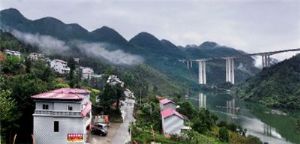
In 2013, it was included in the list of China's Traditional Villages.
Tianjiaba is not a particularly remote small village. The encroachment of modern civilization is gradually eroding the remnants of agrarian culture. The few remaining ancient buildings are modestly interspersed among newly built villas, and the contrast between collapsed old houses and rising new buildings makes it hard to associate the place with a traditional village. Only the surviving lacquer paintings on the firewalls of the old houses and the weathered walls whisper of the long-gone past.
Tianjiaba borders Badong and connects to Enshi. It was once a marketplace for the surrounding ten or so miles, historically referred to as a “street.” According to Tian Dachong, the former village Party branch secretary, during the late Qing Dynasty, the Tian family crossed the Qingjiang River from Badong and settled along the salt route. They set up stalls to sell medicinal herbs, raw lacquer, and bamboo products, gradually prospering. Subsequently, eight wealthy Tian families built houses and constructed buildings here, forming a market that stretched over a mile. On market days, the area would be bustling with people, gathering merchants and people from all walks of life. Thus, Tianjiaba became well-known across Badong, Jianshi, and the Sichuan-Hunan-Hubei salt route.
Tian Jianlong (1890–1933) is a source of pride and local lore in Tianjiaba. After graduating from Yichang Provincial No. 6 High School, Tian Jianlong returned to Tianjiaba, where he farmed with his family and traded in local specialties. He got to know Tang Shengzhi from Hunan and worked with him on railway projects. Within a few years, Tian Jianlong became wealthy and returned to Tianjiaba to start a company, which thrived, making his name widely known. At the time, warlords were fighting, and banditry was rampant. To protect his business, Tian Jianlong armed himself, recruited men, and established the Tianjiaba Autonomous Bureau. In 1923, he became the captain of the Jianshi County Militia. In 1926, when the Communist Nie Weizhen was ordered to return to his hometown to mobilize the masses in support of the Northern Expedition, Tian Jianlong, who was already in control of armed forces, joined the effort. Following instructions from the Temporary Special Committee of the Chinese Communist Party in Shihe (Hubei), he formed a joint defense regiment for Enshi, Jianshi, and Badong, serving as its commander. When his former friend Tang Shengzhi—by then the head of the Kuomintang’s Military Advisory Bureau and commander of the Fifth Route Army—heard of this, he sent a special envoy to secretly meet with Tian Jianlong and appointed him as the commander of the Ninth Division of the “Anti-Rebel National Salvation Army.” By then already a member of the Chinese Communist Party, Tian Jianlong used this opportunity to build up his forces. Together with Nie Weizhen, the secretary of the Jianshi County Communist Party Committee, he planned to develop a peasant militia, launch the Jianshi Uprising, and establish a Soviet regime. In the spring of 1931, the Jianshi Uprising failed. Tian Jianlong, who was being hunted by the authorities, went into hiding under the alias “Gong Kuantou,” teaching school in Changyang while secretly training cadres. He regrouped his former troops, incorporated local militias from Badong’s Dazhiping and Nan Tan areas, established the Nan Tan Soviet Government, reorganized the militia and local forces into the “Independent 1st Division of the Workers’ and Peasants’ Revolutionary Army of the Hunan-Hubei Border Region,” and served as its commander. In May 1933, he led his troops through Guandiankou to join He Long, eventually merging into the Third Red Army of the Chinese Workers’ and Peasants’.
Jianshi County is a mountainous agricultural region. The harsh living environment and the people’s desire to change their circumstances have given rise to many unique customs. The people of Tianjiaba are hospitable and always find a reason to invite you to share a drink: hosting a rice-transplanting wine feast in spring and eating “transplanting rice dumplings”; organizing grass-weeding wine feasts in summer with drum music to boost morale; and holding ceremonies to worship Lu Ban when starting house construction or receiving “water-blocking” guests after erecting the house frame.
The people of Tianjiaba commemorate their deceased loved ones in a special way. When an elder passes away, they express their grief through unique forms such as funeral drum performances, leaf-singing (Ye’erhe), spirit songs, sorrowful dances, and night vigil festivities. These are accompanied by drums, gongs, horse gongs, and cymbals, with dancers either performing on high stilts (standing) or low stilts (crouching), in groups of two or three. Their “Spirit Song” performances even gained fame—In 1957, they were invited to perform at the Second National Folk Music and Dance Performance in Beijing and have since participated multiple times in amateur art shows in Hubei Province and the Enshi Tujia and Miao Autonomous Prefecture.
Share
This article is published by HowToTrip. Sharing and reposting are welcome — please credit the source.
Article URL: https://www.howtotrip.net/travel-18982
Related Articles
- Shaoxing's "Grandpa Gourd" hangs the gourds back up: "If there are too many people, we'll interact less — just take a quick look from afar"
- Chinese authorities announce "reciprocal adjustment" to Japan visa fees — single-entry visa jumps from 2,250 to 16,750 yen!
- The "health stones" carried by a traveler were found to have radiation levels exceeding safety limits by a thousand times, potentially endangering fellow passengers on the same flight. Customs issues warning!
- Shenzhen Airport Issues Late-Night Notice: Unidentified Aerial Object Detected, Causing Widespread Flight Delays!
- “They only said it cost money after I opened the box and washed it!” 200g of grapes sold for 60 yuan on a high-speed train—12306 responds!
- Can't buy an airline ticket? Denied exit? Blocked from boarding? A large number of Chinese tourists have mysteriously become "discredited individuals"
- Adverse weather and economic fluctuations impact Colombia's coffee market
- Beach bathing area responds to 2 yuan/30 seconds fee for freshwater foot rinsing: Clearly priced!
- Taking off with an improperly closed cabin door? Wing malfunction? Multiple flights made emergency returns mid-journey!
- Experience the gifts of nature! A countdown of the world’s ten most stunning coastlines