The Revolutionary History Memorial Museum of the Xifeng Concentration Camp
Revolutionary History Memorial Museum of the Xifeng Concentration Camp
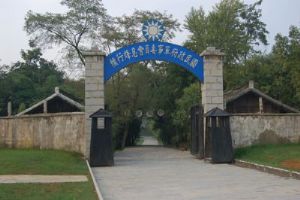
The Xifeng Concentration Camp consists of two parts: the main camp located in Yanglangba District and the Xuantian Cave, where General Yang Hucheng was imprisoned, 14 kilometers away. The main camp is situated in Maodong Village, Yanglangba, six kilometers south of Xifeng County, also known as the Maodong Concentration Camp. Covering an area of 57,124.4 square meters, before 1938 it was the estate of a landlord surnamed Liu. After the Military Statistics Bureau (Juntong) arrived in 1938, the landlord was driven out, and more than ten buildings were constructed to form the concentration camp. From its establishment in 1938 to its closure in 1946, over 1,200 communists, patriotic generals, and democratic figures—including Yang Hucheng, Ma Yinchu, Huang Xiansheng, Luo Shiwen, Che Yaoxian, Zhang Luping, and Xu Xiaoxuan—were imprisoned here. Over 600 were secretly killed or tortured to death, more than 400 went missing, and fewer than 100 survived. This killing den was publicly known as the “Xifeng Field Headquarters of the Military Committee of the Nationalist Government,” and internally called the “New Prison.”
Xuantian Cave is a naturally formed ancient cave in the Nanwang Mountain range of Xifeng, dating back hundreds of millions of years. It is eight kilometers from the county seat. In the late Ming Dynasty, a Sichuan Taoist priest named Ban Yue traveled here, built a Taoist temple inside the cave, and enshrined the Xuanwu deity, hence the name Xuantian Cave. By the Qing Dynasty’s Qianlong era, it had become a popular pilgrimage site bustling with worshippers and tourists. In 1938, Juntong seized the site and used it to imprison General Yang Hucheng’s family for eight years. Since then, the cave’s spiritual significance vanished, tourists stopped coming, and the once-thriving sacred site turned into a living hell.
The first phase of restoration was completed and opened to the public in May 1997, attracting nearly 6 million domestic and international visitors. Party and state leaders including Xi, Li Peng, Jiang Zemin, Zhu Rongji, Hu Jintao, Xi Jinping, and others have visited the site. In April 2003, Comrade Hu Jintao inspected the Xifeng Concentration Camp Memorial Museum and instructed that efforts be made to “build and manage the Xifeng Concentration Camp Memorial Museum well, so it can fully perform its functions and role.” To implement these directives, the Publicity Department of the CPC Central Committee, the Guizhou Provincial Committee of the CPC, the provincial government, the Guiyang Municipal Committee of the CPC, and the municipal government all placed great importance on the project, investing nearly 20 million yuan in the construction of the second phase. The new museum building, with a total floor area of 3,800 square meters, was completed and opened on August 19, 2005. The “Unquenched Flames” exhibition features numerous moving figures and events, using precious cultural relics, texts, images, charts, photographs, as well as sound, light, electricity, and scene simulations to comprehensively introduce the historical evolution of the Xifeng Concentration Camp and the activities of revolutionary martyrs in prison. It highlights a chapter of struggle and victory in China’s revolutionary history.
To enrich the exhibition content, over 60 cultural relics have been collected through years of research and visits.
The Revolutionary History Memorial Museum of the Xifeng Concentration Camp is open daily from 8:30 AM to 5:30 PM, year-round without closure.
There are two transportation options: one is the group tour route. Travelers leave downtown Guiyang via the Lanzhou–Haikou Expressway (Guiyang–Zunyi section), drive 60 kilometers to the Xifeng exit, then travel six kilometers through downtown Xifeng to reach the museum. The other is the self-drive route. Drivers leave downtown Guiyang, take the Lanzhou–Haikou Expressway (Guiyang–Zunyi section) for 30 kilometers to the Jiuchang exit, then follow National Highway 210 toward Zunyi for 25 kilometers to arrive at the Revolutionary History Memorial Museum of the Xifeng Concentration Camp.
Share
This article is published by HowToTrip. Sharing and reposting are welcome — please credit the source.
Article URL: https://www.howtotrip.net/travel-18206
Related Articles
- Shaoxing's "Grandpa Gourd" hangs the gourds back up: "If there are too many people, we'll interact less — just take a quick look from afar"
- Chinese authorities announce "reciprocal adjustment" to Japan visa fees — single-entry visa jumps from 2,250 to 16,750 yen!
- The "health stones" carried by a traveler were found to have radiation levels exceeding safety limits by a thousand times, potentially endangering fellow passengers on the same flight. Customs issues warning!
- Shenzhen Airport Issues Late-Night Notice: Unidentified Aerial Object Detected, Causing Widespread Flight Delays!
- “They only said it cost money after I opened the box and washed it!” 200g of grapes sold for 60 yuan on a high-speed train—12306 responds!
- Can't buy an airline ticket? Denied exit? Blocked from boarding? A large number of Chinese tourists have mysteriously become "discredited individuals"
- Adverse weather and economic fluctuations impact Colombia's coffee market
- Beach bathing area responds to 2 yuan/30 seconds fee for freshwater foot rinsing: Clearly priced!
- Taking off with an improperly closed cabin door? Wing malfunction? Multiple flights made emergency returns mid-journey!
- Experience the gifts of nature! A countdown of the world’s ten most stunning coastlines