Xinhui Chakeng Village
Xinhui Chakeng Village
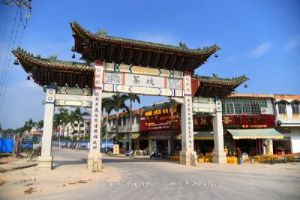
Hometown of Liang Qichao and the land of dried tangerine peel — Xinhui Chakeng Village
Chakeng Village is located by Yinzhou Lake at the Yazhou Waterway, one of the eight estuaries of the Pearl River. Backed by Fengshan Mountain and surrounded by fields and fishponds, it features orderly arrangements of large banyan trees, stone-paved lanes, and blue-brick houses. Truly nestled against mountains and water, it is a place of outstanding natural beauty. This is the birthplace of Liang Qichao, a renowned Chinese revolutionary, thinker, politician, educator, and writer of modern times. Born and raised here, Liang Qichao possessed a strong sense of patriotism and an unwavering pursuit of truth. He left behind a splendid cultural legacy for Chakeng Village, where human culture and natural scenery blend to make this Lingnan village even more beautiful.
To trace the history of Chakeng Village, one must mention the Lingyun Pagoda standing atop Fengshan Mountain. Commonly known as Xiong (Note: should be 0, ni sound, second tone)zi Pagoda among locals, historical records and scholarly research indicate that Lingyun Pagoda was built in the 37th year of the Wanli reign during the Ming Dynasty (1609), making it over 400 years old. It is a key cultural relic protection unit in Xinhui and is just two kilometers away from Liang Qichao’s former residence. The pagoda is designed in the style of a writing brush, taking an octagonal prism shape and standing seven stories tall, approximately 46 meters high. Because its doorways at each level face different directions, looking through the doors from one level to another offers constantly changing views, much like peering into a kaleidoscope, showcasing the panoramic scenery surrounding the pagoda.
Chakeng Village has a long history and has produced many talented individuals. The fame of Liang Qichao’s hometown has grown especially prominent because of the presence of such a historic figure. In his youth, Liang Qichao lived in Chakeng Village, where his brilliance began to show. The former residence of this notable figure has become a sentimental site for people to remember the great man, as well as a learning base for understanding the spirit of Liang Qichao.
Liang Qichao’s Former Residence was built during the Guangxu reign of the Qing Dynasty. Nestled among farmhouses, it is an old-fashioned yet elegant building made of blue bricks and earthen tiles, consisting of a main hall, a side hall, a dining room, and two wing rooms, covering an area of 155 square meters. The residence has been carefully preserved over the years. In the past 20 years, governments at various levels have allocated special funds multiple times for restoration work carried out by cultural relics authorities, adhering to the principle of “no alteration of the original state” to restore it to its former appearance. In 1996, the State Council designated Liang Qichao’s Former Residence as part of the fourth group of Major Historical and Cultural Sites Protected at the National Level.
Liang Qichao Memorial Hall
In 2001, the Liang Qichao Memorial Hall was completed. Its architectural style blends Chinese and Western elements, and the overall layout reflects classical traditional principles along with the use of modern techniques. It carries the charm of late Qing dynasty Lingnan overseas Chinese architecture while subtly echoing the style of Tianjin’s Yinbing Study. Here, you can learn about the life of Mr. Liang Qichao and understand the essence of the Liang Qichao spirit through images, paintings, and text.
Chakeng Village is actually not very large and is perfect for strolling. As you walk through the village, you’ll find a mix of old and new houses, giving a feeling of traveling through time. There are two archways: one is the newer one near the road on the outer edge, and the other is an older archway hidden among the village houses. Passing through the old archway, you’ll find yourself in a completely different world — with stone-paved lanes and blue-brick houses, everything feels even more quaint.
Not far away, you’ll find a rather distinctive building — the Old Township Government Office of Chakeng. A local “legend” has it that this old government office was designed by Liang Sicheng, the eldest son of Liang Qichao and a famous architect. Although this claim remains to be verified, it doesn’t stop people from admiring this unique structure. This place once served as the center of Chakeng Village and has witnessed the passage of time.
The Old Township Government Office of Chakeng is simple yet exquisite. It is a garden-style building that combines architectural features of both northern and southern China with Western styles. The front section features a traditional Chinese-style archway, while the rear section incorporates design elements reminiscent of Soviet-era architecture, showcasing its distinctive design.
It is said that the Old Township Government Office of Chakeng was originally a Temple of the Northern Emperor and an ancestral hall. After its construction, its purpose changed multiple times. It was once used as an elementary school before being converted back into the office of the village committee. By 2012, the village committee had moved out. Currently, the rear section of the building, after renovation, serves as housing for five local low-income households.
Strolling through Chakeng Village, you might inadvertently come across traces of history and feel a strong sense of historical atmosphere. Chakeng Village is an ancient settlement that seems to have been favored by history. Having endured a century of ups and downs, it may bear some marks of vicissitude, but more importantly, it has refined a serene and composed character that allows one to calm down, reflect on history, the present, and life, quietly listening to the grand epic of this small village.
When it comes to experiencing the historical beauty of Chakeng Village, one must mention the scattered buildings throughout the village. Every brick and tile, even every inch of land, bears witness to the village’s past and present. Generations of villagers have lived, worked, and studied here. Despite the changes of history, this village has been preserved and continues to quietly guard its spot, showcasing its unique historical beauty to the world.
Chakeng Village is the hometown of Liang Qichao and also the land of dried tangerine peel. Local legend says that the founding history of Chakeng Village is the history of growing Xinhui oranges. It is said that the best area for cultivating Xinhui oranges is defined by whether you can see Lingyun Pagoda with the naked eye. And Lingyun Pagoda, located on Fengshan Mountain, is right where Chakeng Village nestles against the mountain — making it the most suitable place for growing Xinhui oranges.
Xinhui Dried Tangerine Peel Village
The people of Chakeng have been growing Xinhui oranges and producing Xinhui dried tangerine peel for generations, boasting a long history and fine tradition in their production and sale. It could be said that Xinhui oranges are nature’s gift to Chakeng. The dried tangerine peel industry has enabled the village to develop and its people to live peaceful and prosperous lives. The simple folk customs of Chakeng Village and the industrious and kind-hearted nature of its people have been passed down from generation to generation through their labor.
Share
This article is published by HowToTrip. Sharing and reposting are welcome — please credit the source.
Article URL: https://www.howtotrip.net/travel-17446
Related Articles
- Shaoxing's "Grandpa Gourd" hangs the gourds back up: "If there are too many people, we'll interact less — just take a quick look from afar"
- Chinese authorities announce "reciprocal adjustment" to Japan visa fees — single-entry visa jumps from 2,250 to 16,750 yen!
- The "health stones" carried by a traveler were found to have radiation levels exceeding safety limits by a thousand times, potentially endangering fellow passengers on the same flight. Customs issues warning!
- Shenzhen Airport Issues Late-Night Notice: Unidentified Aerial Object Detected, Causing Widespread Flight Delays!
- “They only said it cost money after I opened the box and washed it!” 200g of grapes sold for 60 yuan on a high-speed train—12306 responds!
- Can't buy an airline ticket? Denied exit? Blocked from boarding? A large number of Chinese tourists have mysteriously become "discredited individuals"
- Adverse weather and economic fluctuations impact Colombia's coffee market
- Beach bathing area responds to 2 yuan/30 seconds fee for freshwater foot rinsing: Clearly priced!
- Taking off with an improperly closed cabin door? Wing malfunction? Multiple flights made emergency returns mid-journey!
- Experience the gifts of nature! A countdown of the world’s ten most stunning coastlines