Lao Wuji Old Street
Lao Wuji Old Street
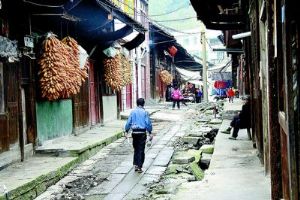
In the past, the local terrain was summarized as: two rivers, three forks, four saddles, and eighteen valleys, surrounded by mountains. There are five large mountains nearby, known as the “Five Dragons Holding the Sacred.” Lion Fort stands behind Lao Wuji Old Street, resembling a lion perched majestically. Qinglong Mouth winds down from Qixing Rock until it reaches Lao Wuji Old Street, where it ends, its head held high, encircling the area alongside Lion Fort. To the west of the old street are Zhaigong and Zhaimu — one mountain with relatively sharp stones is called Zhaigong (male fortress), and another with more square-shaped stones is called Zhaimu (female fortress). Legend says they are the incarnations of young men and women who pursued eternal love.
Lao Wuji began to form as a street neighborhood during the Qing Dynasty’s Qianlong era. That year, a great fire reduced the upper street to ashes, but people still preferred to do business here, so they rebuilt their houses. Later, those houses were burned down again, and the owners rebuilt them. Repeatedly burned and rebuilt, the place eventually became known as Lao Wuji (Old House Foundation). A couplet related to this story goes: “Lao Wuji, house foundation old, foundation old but the house isn’t old,” and to this day, no fitting second line has been found.
During the Guangxu era, local villagers paved the fish-back-shaped street surface with hemp stones. The wide slabs were carefully carved into slopes, making the middle of the street higher than the sides — an effective design for drainage. After years of foot traffic, the stone slabs have become very smooth.
The old street has been included in the third batch of China’s National Traditional Villages Protection Program; in 2014, it served as the main filming location for the movie “Love in the 1980s.”
The old street is about 200 meters long and 3 meters wide, running from north to south. The traditional village is situated on both sides of the old street, consisting of all-wooden structures, most of which were built in the late Qing Dynasty and early Republican period. There are currently 66 surviving wooden buildings, covering an area of over 3,800 square meters, with a total floor space of 8,140 square meters. The houses are typical traditional wooden stilted buildings and courtyard homes, with deep eaves, so that standing on the street you can only see a slice of the sky. The old street is distinctly separated from the new street. Compared to the new street, the old one sits slightly lower, and its graceful skyline is formed by the varying slopes and undulations of the rooftops. Most of the buildings along the sides are one or two stories, many of which are dilapidated, with wooden lattice windows and doorframes of different sizes and styles leaning or fallen, while only the blue tiles on the roofs remain intact. “In the past, the Tusi chieftains only allowed local commoners to use fir bark or thatch for roofing, saying, ‘You may buy horses, but you are not allowed to tile your roofs.’ It wasn’t until the ‘Abolition of Native Chieftainships and Establishment of Prefectures and Counties’ in the 13th year of Emperor Yongzheng’s reign (1735) that tiling became common. The old houses still inhabited today had their roof tiles renovated uniformly just a few years ago.”
The main local surnames include Zhang, Wang, Huang, Tan, Xie, Li, Jiang, Yi, Shan, and Ma. The population is predominantly ethnic minorities, mainly Tujia, with some Miao and Han people also living here. During the Qing Dynasty’s Qianlong era, the native families of Ma, Huang, and Qin established the street neighborhood.
Share
This article is published by HowToTrip. Sharing and reposting are welcome — please credit the source.
Article URL: https://www.howtotrip.net/travel-16150
Related Articles
- Shaoxing's "Grandpa Gourd" hangs the gourds back up: "If there are too many people, we'll interact less — just take a quick look from afar"
- Chinese authorities announce "reciprocal adjustment" to Japan visa fees — single-entry visa jumps from 2,250 to 16,750 yen!
- The "health stones" carried by a traveler were found to have radiation levels exceeding safety limits by a thousand times, potentially endangering fellow passengers on the same flight. Customs issues warning!
- Shenzhen Airport Issues Late-Night Notice: Unidentified Aerial Object Detected, Causing Widespread Flight Delays!
- “They only said it cost money after I opened the box and washed it!” 200g of grapes sold for 60 yuan on a high-speed train—12306 responds!
- Can't buy an airline ticket? Denied exit? Blocked from boarding? A large number of Chinese tourists have mysteriously become "discredited individuals"
- Adverse weather and economic fluctuations impact Colombia's coffee market
- Beach bathing area responds to 2 yuan/30 seconds fee for freshwater foot rinsing: Clearly priced!
- Taking off with an improperly closed cabin door? Wing malfunction? Multiple flights made emergency returns mid-journey!
- Experience the gifts of nature! A countdown of the world’s ten most stunning coastlines