Zhanggao Village
Zhanggao Village
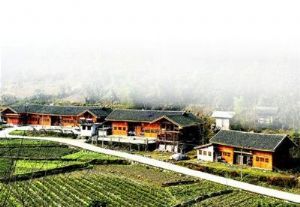
Shaxi Township, where Zhanggao Village is located, was historically part of the ancient Ba State and is one of the most remote townships in Lichuan City.
Legend has it that Zhang Gao was the first person to settle here. Known for his kindness and compassion, he often helped his neighbors and became renowned as a good-hearted man in the area. At the time, the place had no name, so “Zhang Gao” became a local landmark, and people began calling it “Zhanggao Village.”
Surrounded by mountains, Zhanggao Village is especially known for Mount Leiyin. There were no roads on the mountain, but over the centuries, travelers trod out a rugged path in front of the village. This path was once an ancient salt trade route stretching from eastern Sichuan (now eastern Chongqing) to Hubei, Chongqing, Hunan, and Guizhou—historically referred to as the “Ba Salt Ancient Road.” Initially, a few passersby would stop at the village, which had no nearby towns, just to ask for a drink of water or a place to stay. Over time, salt merchants, mountain goods traders, cloth dealers, and opium traders traveling from the north and south would spend the night here when it was too late or unsafe to continue their journeys. In response, the villagers expanded their side rooms and modified kitchens, lighting tree-root fires, warming up corn liquor, and cooking potato rice to soothe the tiredness of travelers. Their warm hospitality naturally attracted more guests, leading to the establishment of more than ten small inns in the village, such as Mao Dianzi, Heng Dianzi, Chuanxin Dian, and Bayan Dian. A few enterprising households even built a market about 100 meters long on a stone platform. Trade in salt, mountain produce, grain, cloth, and gypsum flourished, turning the village into a bustling hub along the ancient road. The Tujia, Miao, Han, and Dong peoples all lived and thrived here, raising families for generations.
Today, Zhanggao Village is made up of over 70 households living in 45 traditional houses, forming three relatively concentrated courtyards, which make up three villager groups.
The village houses are mostly designed in a straight line (“一” shape) with a single row of main rooms, a “T” shape with one wing room attached, or a “工” shape with two wing rooms on either side. Built along the terrain and slopes, many are “horse-turning tower buildings” with upturned eaves and corners.
Hu Xiaoli, an engineer from the Lichuan City Housing and Urban-Rural Development Bureau, said that Zhanggao Village, built along the ancient salt route by the stream, represents a survival choice of settling in a strategically chosen location. The features of the traditional houses—“stilted buildings, upturned eaves, lattice windows, and vermilion doors”—showcase the fusion of architectural styles of the Tujia, Miao, Dong, and Han peoples.
Share
This article is published by HowToTrip. Sharing and reposting are welcome — please credit the source.
Article URL: https://www.howtotrip.net/travel-16147
Related Articles
- Shaoxing's "Grandpa Gourd" hangs the gourds back up: "If there are too many people, we'll interact less — just take a quick look from afar"
- Chinese authorities announce "reciprocal adjustment" to Japan visa fees — single-entry visa jumps from 2,250 to 16,750 yen!
- The "health stones" carried by a traveler were found to have radiation levels exceeding safety limits by a thousand times, potentially endangering fellow passengers on the same flight. Customs issues warning!
- Shenzhen Airport Issues Late-Night Notice: Unidentified Aerial Object Detected, Causing Widespread Flight Delays!
- “They only said it cost money after I opened the box and washed it!” 200g of grapes sold for 60 yuan on a high-speed train—12306 responds!
- Can't buy an airline ticket? Denied exit? Blocked from boarding? A large number of Chinese tourists have mysteriously become "discredited individuals"
- Adverse weather and economic fluctuations impact Colombia's coffee market
- Beach bathing area responds to 2 yuan/30 seconds fee for freshwater foot rinsing: Clearly priced!
- Taking off with an improperly closed cabin door? Wing malfunction? Multiple flights made emergency returns mid-journey!
- Experience the gifts of nature! A countdown of the world’s ten most stunning coastlines