Monument to Martyr Qu Qiubai
Monument to Martyr Qu Qiubai
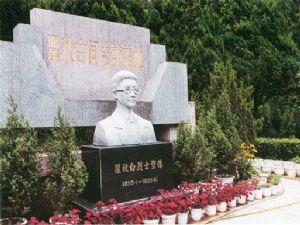
The Monument to Martyr Qu Qiubai was built in 1952 but was damaged during the Cultural Revolution. On June 18, 1985, to commemorate the 50th anniversary of Qu Qiubai’s martyrdom, a ceremony was held to unveil the newly built monument. The monument stands 30.59 meters tall, with a brick-concrete structure. The gilded inscription of the monument’s name was penned by Lu Dingyi, Vice Chairman of the National Committee of the Chinese People's Political Consultative Conference, while the marble inscription was written by the Fujian Provincial Committee and Government of the Communist Party of China. In 1985, it was designated as a provincial-level cultural relics protection unit, in 1986 as a national key martyrs' memorial building protection unit, in 2001 as a national patriotic education demonstration base by the Publicity Department of the CPC Central Committee, and in 2010 as a field teaching site for the China Executive Leadership Academy Jinggangshan. The memorial park also houses the Qu Qiubai Memorial Hall and the site where Qu Qiubai was executed.
Qu Qiubai (1899~1935) Qu Qiubai (1899–1935) was a male of Han ethnicity from Changzhou, Jiangsu Province, and a member of the Communist Party of China. He participated in and led the student movement in Beijing during the May Fourth Movement of 1919. In early 1920, he joined the Marxist Theory Research Association. Later, he went to Soviet Russia as a journalist. He joined the Communist Party of China in 1922. After the failure of the Great Revolution, he presided over the August 7th Meeting, which established the Party’s general policy of land revolution and armed resistance against the reactionary rule of the Kuomintang. After the meeting, he served as Chairman of the Provisional Politburo of the Central Committee and led the central work. In June 1928, he attended the Sixth National Congress of the Party, then participated in the Sixth Congress of the Communist International, and later served as... Details+
Share
This article is published by HowToTrip. Sharing and reposting are welcome — please credit the source.
Article URL: https://www.howtotrip.net/travel-16137
Related Articles
- Shaoxing's "Grandpa Gourd" hangs the gourds back up: "If there are too many people, we'll interact less — just take a quick look from afar"
- Chinese authorities announce "reciprocal adjustment" to Japan visa fees — single-entry visa jumps from 2,250 to 16,750 yen!
- The "health stones" carried by a traveler were found to have radiation levels exceeding safety limits by a thousand times, potentially endangering fellow passengers on the same flight. Customs issues warning!
- Shenzhen Airport Issues Late-Night Notice: Unidentified Aerial Object Detected, Causing Widespread Flight Delays!
- “They only said it cost money after I opened the box and washed it!” 200g of grapes sold for 60 yuan on a high-speed train—12306 responds!
- Can't buy an airline ticket? Denied exit? Blocked from boarding? A large number of Chinese tourists have mysteriously become "discredited individuals"
- Adverse weather and economic fluctuations impact Colombia's coffee market
- Beach bathing area responds to 2 yuan/30 seconds fee for freshwater foot rinsing: Clearly priced!
- Taking off with an improperly closed cabin door? Wing malfunction? Multiple flights made emergency returns mid-journey!
- Experience the gifts of nature! A countdown of the world’s ten most stunning coastlines