Bashan Red Army Park
Bashan Red Army Park
Contact Number: 0818-5231183
Brief Overview: Standing in Bashan Red Army Park and looking out from the heights, you’ll be greeted by lush greenery, blooming flowers, and crisscrossing stone steps — a truly refreshing sight. Gazing down at the panoramic view, you’ll see the convergence of the Qianhe, Zhonghe, and Houhe rivers, flowing like a jade ribbon. Bashan Red Army Park is not only a great place to relax and unwind, but also a living book filled with revolutionary stories.
Park Introduction:
Bashan Red Army Park, originally named Xiangshan Park, covers an area of 300 acres. Surrounded by water on three sides, it resembles a peninsula. The park is built along the contours of the mountain, featuring planted flowers, trees, pavilions, and towers, all set within a serene and shaded environment.
A Revolutionary Memorial Museum
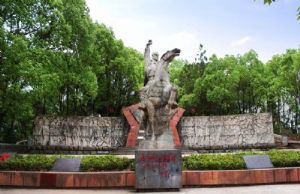
Bashan Red Army Park is formed by two winding mountain ridges that meet. Ascending along the easternmost ridge, the first thing you see is a marble statue of General Wang Weizhou on horseback, brandishing his weapon across the battlefield, set against a backdrop of group sculptures depicting the brave people of Xuanhan joining the army, supporting the Red Army, and fighting heroically. The main figure and background blend seamlessly, complementing each other and presenting a vivid picture of a turbulent history. Standing and looking up, against the blue sky and white clouds, one can almost envision the heroic figures of the people of Xuanhan over 70 years ago, courageously rising up in armed resistance against the reactionary Kuomintang, and faintly hear the roars of “Overthrow the landlords, distribute the land!” echoing along the Zhou River...
Bashan Red Army Park, themed around revolutionary education and Red Army culture, features not only the Wang Weizhou Memorial Hall but also attractions such as a bas-relief of the heroic “Bashan Scholar” Yuan Tingjiao, a relief wall depicting the White Lotus Rebellion, an exhibition room for cultural relics unearthed from Ba people sites, and a dinosaur exhibition room.
A Monument Forged in Blood and Flesh
Within the park stands a 13-meter-high monument, topped with a vivid sculpture of a red army battle flag. On the front of the monument are 16 gleaming characters personally inscribed by Marshal Xu Xiangqian: “Monument Commemorating the Founding of the 33rd Army of the Chinese Workers’ and Peasants’ Red Army.” Veteran Red Army soldiers who once fought in Xuanhan, such as Xu Shiyou, Zhang Aiping, and Wang Bo, have also inscribed words of commemoration on the monument. Towering into the sky and surrounded by pine and cypress trees and floral arrangements, the monument exudes solemnity and reverence. This monument, forged by the blood and sacrifice of tens of thousands of soldiers, will forever inspire the people of Xuanhan to unite and strive toward a happier tomorrow.
A Park That Combines Commemoration with Leisure
The park is shaded by trees, with over 270 acres covered mainly by camphor trees, along with ornamental species such as tower pines, cycads, and yellowhorn trees, as well as botanical gardens of various sizes including the Crape Myrtle Garden, Hibiscus Garden, Peach Garden, Plum Garden, and Osmanthus Garden. Winding paths lead to secluded spots, with pavilions tucked among the greenery, including the Refreshing Pavilion, Four-Corner Pavilion, Six-Corner Pavilion, Red Heart Pavilion, and the Horticultural Pavilion. The park holds tomb-sweeping activities every Qingming Festival and large-scale commemorative events on Army Day.
Museums, monuments, and the vast green canopy of trees — these are the real sights we can see in Bashan Red Army Park. As for the revolutionary history we’ve never experienced and the revolutionary martyrs we’ve never met, we can only flip through the yellowed pages, gaze up at the monuments, and pause in contemplation...
Share
This article is published by HowToTrip. Sharing and reposting are welcome — please credit the source.
Article URL: https://www.howtotrip.net/travel-15354
Related Articles
- Shaoxing's "Grandpa Gourd" hangs the gourds back up: "If there are too many people, we'll interact less — just take a quick look from afar"
- Chinese authorities announce "reciprocal adjustment" to Japan visa fees — single-entry visa jumps from 2,250 to 16,750 yen!
- The "health stones" carried by a traveler were found to have radiation levels exceeding safety limits by a thousand times, potentially endangering fellow passengers on the same flight. Customs issues warning!
- Shenzhen Airport Issues Late-Night Notice: Unidentified Aerial Object Detected, Causing Widespread Flight Delays!
- “They only said it cost money after I opened the box and washed it!” 200g of grapes sold for 60 yuan on a high-speed train—12306 responds!
- Can't buy an airline ticket? Denied exit? Blocked from boarding? A large number of Chinese tourists have mysteriously become "discredited individuals"
- Adverse weather and economic fluctuations impact Colombia's coffee market
- Beach bathing area responds to 2 yuan/30 seconds fee for freshwater foot rinsing: Clearly priced!
- Taking off with an improperly closed cabin door? Wing malfunction? Multiple flights made emergency returns mid-journey!
- Experience the gifts of nature! A countdown of the world’s ten most stunning coastlines