Yuantian Village
Yuantian Village
Travel Highlights
1) A 700-year-old ancient village and a significant birthplace of the Hakka Li clan. The descendants of Liumude, the elder brother of Li Huode, namely the Sijiu Langong lineage, returned from Zhangping to Yuantian and became the representatives of the Mude lineage in Hakka regions, subsequently spreading to various parts of the world. After enduring 700 years of vicissitudes, Yuantian has become a crucial origin of the Hakka Li clan, holding a status as significant as that of Guantian, the site of the Li Clan Ancestral Hall. The village originally had a grand Li Clan Ancestral Hall, comparable in layout and even more exquisitely built than the one in Guantian, attracting descendants of Mude from across the country for ancestral worship every year. It gradually faded in prominence after being demolished in the 1980s for certain reasons. However, nothing can alter Yuantian’s rich 700-year history or the fact that it remains a vital cradle of the Hakka Li clan.
2) The second hometown of a renowned poet and one of the birthplaces of China’s misty poetry. Shu Ting, current chairperson of the Xiamen Federation of Literary and Art Circles, is not only an iconic figure in Xiamen but also a globally influential poet. In the early 1970s, she was sent to Yuantian for re-education through labor during the Cultural Revolution, spending an unforgettable period of her youth there. During her time in Yuantian, she immersed herself in reading and wrote a large body of poetry, including “To Hangcheng,” laying the foundation for her status as the “Queen” of the Misty Poetry movement. Yuantian thus rightly earns its place as one of the birthplaces of China’s misty poetry.
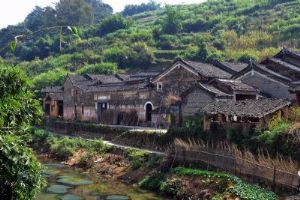
Yuantian Village preserves over 20 ancient dwellings, both large and small, among which 12 are particularly grand structures such as “Yingchuan Zhi,” “Dianyou Ju,” and “Langguan Di,” all dating back 200 to 300 years. The architecture primarily reflects traditional Qing Dynasty styles, featuring ancient buildings with layouts such as “nine halls and eighteen courtyards, with covered corridors running through,” as well as courtyard-style houses, square earthen towers, enclosed residences, and Huizhou-style architecture. Each building holds significant cultural and historical value.
Among the most representative residences in Yuantian Village are: “Dianyou Ju” (the ancient house of Gong Ling), “Shengqi PanYu” (the ancient house of Zhen Ling), the ancient house of Kailing, and “Simaji.” These structures were built between the Jiaqing and Daoguang eras of the Qing Dynasty, boasting nearly 200 years of history. They are among the longest-preserved traditional wooden structures in rural China. All four buildings were constructed by the 18th-generation ancestors of the Li clan (with Gongling, Zhenling, and Kailing likely being brothers or cousins). These traditional dwellings demonstrate that Yuantian Village experienced a period of prosperity in the early 19th century—a time when the area was relatively wealthy and produced many talented individuals.
The residences of Gongling, Zhenling, and Kailing each cover an area of over 4,000 square meters, while Simaji spans more than 1,000 square meters. These houses are large, enclosed courtyard-style buildings, combining architectural features reminiscent of the “nine halls and eighteen courtyards” layout seen in Peitian residences and the “Five Phoenix Tower” style common in Yongding. This distinctive style is locally referred to as: “nine halls and eighteen courtyards, with covered corridors running through.”
Yuantian Village has long been known for its gifted people and spiritual land. During the Ming Dynasty, it produced the anti-Wokou (Japanese pirate) hero Li Fuying, who repeatedly followed imperial orders to quell rebellions. He was appointed by the Ming Emperor to oversee both civil and military affairs outside the city as Dengshi Lang and inside as Commander before the Emperor’s carriage, and was later posthumously honored by Emperor Yongzheng of the Qing Dynasty as a Loyal and Heroic Martyr, with a temple dedicated to filial piety and loyalty established in his honor. The Qing Dynasty saw Li Yinghua, a second-rank Jinshi scholar and Chief of the Ministry of Punishments, who was bestowed the honorary title of Zhongxian Daifu.
The Hakka culture of Yuantian is deeply rooted and flourishing, represented notably by puppetry and lion dance. Historical records indicate that in the early years of liberation, Yuantian was home to the only puppet troupe in Taibai Township—Lao Guihua, led by Li Guanyin. Yuantian’s lion dance is also widely renowned, known for its vivid performances and particularly impressive martial arts displays that command great respect in the region.
Source: Fujian Provincial Tourism Development Commission
Share
This article is published by HowToTrip. Sharing and reposting are welcome — please credit the source.
Article URL: https://www.howtotrip.net/travel-14879
Related Articles
- Shaoxing's "Grandpa Gourd" hangs the gourds back up: "If there are too many people, we'll interact less — just take a quick look from afar"
- Chinese authorities announce "reciprocal adjustment" to Japan visa fees — single-entry visa jumps from 2,250 to 16,750 yen!
- The "health stones" carried by a traveler were found to have radiation levels exceeding safety limits by a thousand times, potentially endangering fellow passengers on the same flight. Customs issues warning!
- Shenzhen Airport Issues Late-Night Notice: Unidentified Aerial Object Detected, Causing Widespread Flight Delays!
- “They only said it cost money after I opened the box and washed it!” 200g of grapes sold for 60 yuan on a high-speed train—12306 responds!
- Can't buy an airline ticket? Denied exit? Blocked from boarding? A large number of Chinese tourists have mysteriously become "discredited individuals"
- Adverse weather and economic fluctuations impact Colombia's coffee market
- Beach bathing area responds to 2 yuan/30 seconds fee for freshwater foot rinsing: Clearly priced!
- Taking off with an improperly closed cabin door? Wing malfunction? Multiple flights made emergency returns mid-journey!
- Experience the gifts of nature! A countdown of the world’s ten most stunning coastlines