Nanjiang Village
Nanjiang Village
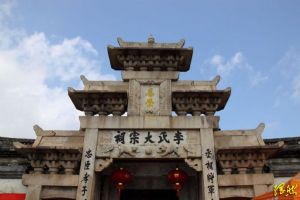
Spanning just 5.5 square kilometers, Nanjiang Village is home to over 30 well-preserved Ming and Qing dynasty buildings, including residences, ancestral halls, study rooms, and ancient wells. The village also features 23 tulou of diverse architectural styles and forms.
Many of the tulou in Nanjiang Village are named with the character "庆" (Qìng, meaning celebration), such as Xianqing Lou, Yuqing Lou, Huanqing Lou, Tianqing Lou, and Xingqing Lou. Other names, like Zhenyang Lou, Fuxing Lou, and Jingxun Lou, carry rich cultural meanings. Among them, the most distinctive are the "Tianyi Lou" and "Dongcheng Lou."
Originally called Yuanju Lou, Tianyi Lou was built in 1915, covering an area of 1,200 square meters with an oval shape. The building earned its name because it lies between two streams that converge and flow around it before merging into one. However, a devastating fire in 1929 caused extensive damage. Later, the 26th-generation ancestor of the Jiang family rebuilt it on the original site and renamed it "Tianyi Lou," meaning "Heaven Generates Water," hoping that water would suppress fire and bless the building.
Constructed in 1843, Dongcheng Lou sits at Qiaozitou in Nanjiang Village, facing west with an octagonal layout. This earthen structure covers about 2,400 square meters. It’s said that the name of the building was personally inscribed by Wu Yifu, a Qing Dynasty Hanlin academician. Initially planned as a square tulou, one corner of the structure pointed directly toward the tomb of Huang Popo, an elderly woman from the village. The tomb was designed in the shape of a descending tiger, and the corner of the building resembled an arrow aimed at the tiger’s head—sparking a dispute. While the builders wanted to proceed, the tomb’s descendants objected, leading to rising tensions. Eventually, a mediator suggested bringing in Hanlin academician Wu Yifu to help resolve the issue. After gathering input from both sides, he arranged a face-to-face discussion. The builders agreed to remove the corner pointing at the tomb, and for better aesthetic harmony, they removed three other corners, resulting in the only octagonal tulou in Yongding.
Nanjiang Village also offers a unique sight known as the "Daughter Forest." According to local accounts, over 400 years ago, village girls began planting a pine tree beside the mountain path on their wedding day, accompanied by siblings or parents. This act honored their parents’ hard work traveling the mountain roads to tend fields and served as a way to express gratitude and longing for their homeland.
Today, the 3.5-kilometer-long mountain path is covered in lush greenery, lined with over 3,000 pine and jujube trees. The oldest pine tree is more than 400 years old. Many tree canopies are adorned with bright red ribbons. Villagers say these ribbons symbolize memories and gratitude. Even during times when illegal logging was rampant, no one dared touch the "Daughter Forest."
During major traditional holidays each year, villagers who have moved away or their descendants return to walk along the mountain trails beneath the "Daughter Forest" and replace the red ribbons on the trees planted by their ancestors.
(Image source: Official website of the Longyan Yongding District Committee)
Share
This article is published by HowToTrip. Sharing and reposting are welcome — please credit the source.
Article URL: https://www.howtotrip.net/travel-14011
Related Articles
- Shaoxing's "Grandpa Gourd" hangs the gourds back up: "If there are too many people, we'll interact less — just take a quick look from afar"
- Chinese authorities announce "reciprocal adjustment" to Japan visa fees — single-entry visa jumps from 2,250 to 16,750 yen!
- The "health stones" carried by a traveler were found to have radiation levels exceeding safety limits by a thousand times, potentially endangering fellow passengers on the same flight. Customs issues warning!
- Shenzhen Airport Issues Late-Night Notice: Unidentified Aerial Object Detected, Causing Widespread Flight Delays!
- “They only said it cost money after I opened the box and washed it!” 200g of grapes sold for 60 yuan on a high-speed train—12306 responds!
- Can't buy an airline ticket? Denied exit? Blocked from boarding? A large number of Chinese tourists have mysteriously become "discredited individuals"
- Adverse weather and economic fluctuations impact Colombia's coffee market
- Beach bathing area responds to 2 yuan/30 seconds fee for freshwater foot rinsing: Clearly priced!
- Taking off with an improperly closed cabin door? Wing malfunction? Multiple flights made emergency returns mid-journey!
- Experience the gifts of nature! A countdown of the world’s ten most stunning coastlines