Longche Temple
Longche Temple

The temple is located at the convergence of the Huaying Mountain and Zhongliang Mountain ranges. With uniquely beautiful scenery and a spiritually auspicious atmosphere, it is said to have a dragon vein running through its hills and valleys, making it the ancestral vein of the Bayue sacred site. Legend has it that this is the dwelling place of a divine dragon, hence the peak is called “Longju Mountain” (Dragon Perched Mountain), and the temple takes its name from the mountain, known as “Longju Temple.” It was once one of the three major ancient temples in Beibei District (Jinyun Temple, Wenquan Temple, and Longche Temple). After the temple was built, Buddhist activities flourished, eminent monks emerged in great numbers, spiritual responses were strong, and prayers were answered. Devotees flocked to the mountain to pay homage, leading to a change from the character “踞” (perched) to “车” (progress), symbolizing “auspiciousness, success, and advancement.” This reflects the aspiration that, with the blessing of the Buddha’s power, the wishes of worshippers would come true, bringing them good fortune and wisdom.
The temple underwent three major renovations and expansions in the ninth year of the Kangxi reign (1617) during the Qing Dynasty, the first year of the Tongzhi reign (1861), and the seventh year of the Guangxu reign (1883). Gradually reaching the scale of a monastic complex, it housed a resident monastic community of over 300 monks. After the liberation, the temple gradually fell into disrepair. In 1997, Zhao Rongfa and Zhou Xiujuan, the chairman and his wife of Shanghai Puya Industrial Company and patrons of the temple, constructed a cemetery here and invested heavily in rebuilding the temple. After more than 500 years, Longche Temple regained its former monastic grandeur. The merit of the donors is beyond measure.
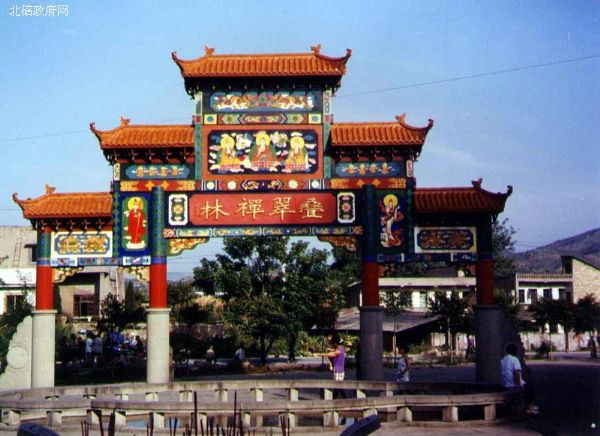
Longche Temple is a Chan (Zen) Buddhism site. The temple covers an area of over 11 acres, with a total construction area of 3,740 square meters. Its main structure follows a traditional central axis layout, including a memorial archway, the Heavenly King Hall, the Mahavira Hall, the Guanyin Hall, and the Medicine Buddha Hall. On both sides are side halls, the kitchen, the guest hall, the bell and drum towers, the lay practitioners' quarters, and the monks' quarters, among others. The temple is surrounded by lush trees, offering a serene and tranquil environment. The halls are majestic, the Buddha statues solemn, and the overall complex is magnificent. The surrounding corridors and pavilions feature intricately carved beams and painted rafters, flying eaves, and flowing colors, all showcasing exquisite craftsmanship and representing fine examples of ancient-style architectural art.
Share
This article is published by HowToTrip. Sharing and reposting are welcome — please credit the source.
Article URL: https://www.howtotrip.net/travel-10035
Related Articles
- Shaoxing's "Grandpa Gourd" hangs the gourds back up: "If there are too many people, we'll interact less — just take a quick look from afar"
- Chinese authorities announce "reciprocal adjustment" to Japan visa fees — single-entry visa jumps from 2,250 to 16,750 yen!
- The "health stones" carried by a traveler were found to have radiation levels exceeding safety limits by a thousand times, potentially endangering fellow passengers on the same flight. Customs issues warning!
- Shenzhen Airport Issues Late-Night Notice: Unidentified Aerial Object Detected, Causing Widespread Flight Delays!
- “They only said it cost money after I opened the box and washed it!” 200g of grapes sold for 60 yuan on a high-speed train—12306 responds!
- Can't buy an airline ticket? Denied exit? Blocked from boarding? A large number of Chinese tourists have mysteriously become "discredited individuals"
- Adverse weather and economic fluctuations impact Colombia's coffee market
- Beach bathing area responds to 2 yuan/30 seconds fee for freshwater foot rinsing: Clearly priced!
- Taking off with an improperly closed cabin door? Wing malfunction? Multiple flights made emergency returns mid-journey!
- Experience the gifts of nature! A countdown of the world’s ten most stunning coastlines