What’s the difference between PWN Golden Mandheling and Lintong Mandheling? What are the brewing methods for PWN Golden Mandheling?
Many netizens often don’t understand what exactly sets PWN Golden Mandheling apart from Lintong Mandheling, or how their flavors differ. Today, we’re going to explore just how different these two types of coffee are. First, let’s talk about flavor. Golden Mandheling offers a complex and layered flavor profile, with a clean and balanced initial taste and a long-lasting caramel-like sweetness in the aftertaste. In contrast, Lintong Mandheling features herbal, plant-like notes, dark chocolate, caramel, and a sweet finish.
As for the origin of the name “Mandheling,” the story is quite unique. There are two commonly told versions. The first goes like this: in the early days, PWN had a rubber plantation on the island of Sumatra that collected rubber sap for export to Japan. During World War II, when Japan colonized Indonesia, a Japanese officer reportedly tasted a very delicious coffee while stationed in the region. PWN had a rubber plantation in Sumatra that collected rubber sap for export to Japan, and later, when the Japanese officer needed coffee beans, he asked PWN to source the best beans from the production areas in Indonesia. The PWN manager visited various regions, collected premium coffee beans, and sent them to Japan for tasting. One particular coffee caught the attention of the Japanese, who were so impressed that they asked what kind of coffee it was. The PWN representative originally wanted to say that it came from near the Mandailing area in their rubber department’s production zone. However, not wanting to disclose the commercial source, he instead said “Mandheling.” From then on, PWN gradually entered the coffee bean market.

The second version says that the Japanese officer asked the shop owner what the coffee he was drinking was called, but the shop owner misunderstood and thought the officer was asking about his origin. The owner replied, “Mandailing.” Due to the officer’s mispronunciation, “Mandailing” became “Mandheling.” And so the name stuck. After returning to Japan, the officer couldn’t forget the Indonesian coffee and commissioned local traders to find green coffee beans.
PWN Golden Mandheling
The origins of PWN Golden Mandheling: PWN is actually an Indonesian company that specializes in purchasing high-quality green Mandheling coffee beans. Additionally, PWN registered the name “Golden Mandheling” as a trademark, hence the name PWN Golden Mandheling.

According to relevant sources: PAWANI (PWN) was established in 1958 in Medan, on the island of Sumatra, Indonesia. It is a long-established coffee bean exporter (not a Japanese company). Because it initially exported to Japan, where coffee is highly valued, all the beans were hand-picked and processed. PWN further refined the Mandheling beans through a strict process involving three rounds of manual sorting and one mechanical selection. This results in uniformly sized and aesthetically pleasing Golden Mandheling beans that produce cleaner-tasting coffee when roasted.
Lintong Mandheling comes from altitudes between 1200 to 1500 meters and is one of the most famous coffees from the Lake Toba region in North Sumatra. Its beans are larger in size and have a harder texture..
Roasting analysis of Golden Mandheling and Lintong Mandheling
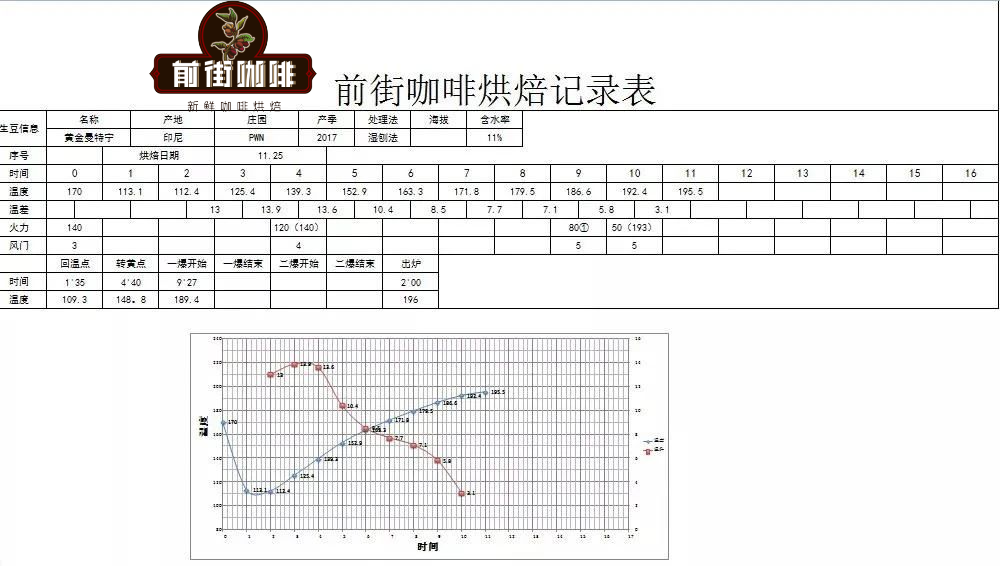
Front Street Coffee’s roasting curve for PWN Golden Mandheling
Front Street Coffee’s roasting curve for Lintong Mandheling
It can be seen that Golden Mandheling is a type of green bean with relatively high moisture content. There is a significant difference in moisture compared to sundried beans, so special care is required during the drying phase. For green beans with high moisture, you can try closing the air vent immediately after adding the beans, allowing a 30-second pre-bloom, then opening the air vent to level 3 until the bean color turns light green or white. Then open the air vent to level 4. After the first crack, open it to level 5 (maximum).
Front Street Coffee recommends keeping detailed records before roasting—data such as the coffee bean’s moisture content, density, origin, processing method, as well as the roasting environment temperature and humidity inside the roastery. Plan your roasting curve accordingly. During the roasting process, document the related chemical and physical changes. All of this will help you better understand the final roast outcome and refine your roasting curve.
Start with a roaster temperature of 200°C. Set the air vent to level 3. After 1 minute, adjust the heat to 160°C, keeping the air vent unchanged. Roast until 5’40”, when the temperature reaches 148°C. The bean surface turns yellow, and the grassy smell completely disappears, indicating the drying phase is complete. Adjust the heat to 140°C and the air vent to level 4. At the 9’40” mark, the bean surface shows rough wrinkles and dark spots, and the toast-like aroma clearly transitions to a coffee fragrance—this can be defined as the prelude to the first crack. At this point, listen carefully for the sound of the first crack. At 9’54”, the first crack begins. Reduce the heat to 60°C and fully open the air vent (be very careful not to reduce the heat to the point where no cracking sound is heard). Drop the beans at 204.5°C.
Golden Mandheling and Lintong Mandheling Cupping Report

Golden Mandheling tastes cleaner than Lintong Mandheling. The typical herbal, earthy, and woody notes of Mandheling are almost absent, but the caramel sweetness is more intense, and the fruit acidity is brighter and more elegant. Generally, Lintong Mandheling is best roasted to just after the second crack to effectively reduce off-flavors. Golden Mandheling, however, performs well whether dropped before or after the second crack, offering great clarity and sweetness with a broader range for roasting interpretation.
Front Street Coffee Brewing Analysis
Both of Front Street Coffee’s beans—Lintong Mandheling and Golden Mandheling—are medium-dark roasted. Medium-dark roasted beans usually have a higher dehydration rate, making them lighter in weight. During brewing, the grounds don’t fully settle at the bottom. As soon as water is poured, it’s quickly absorbed. With strong degassing, bubbles form around the grounds, creating channels. The fresher the beans, the longer these channels are maintained, causing the water level to drop quickly. I usually use a coarse water flow and circle slowly.
Front Street Coffee Brewing Recommendations
Filter: KONO
Coffee dose: 15 grams
Coffee-to-water ratio: 1:15
Water temperature: 86-88°C
Grind size: Medium-coarse (70% passing through a 20-mesh national standard sieve)
Front Street Coffee Brewing Technique
First pour: 30 grams of water for a 30-second bloom. Second pour: Slowly circle-pour with a small stream of water up to 125 grams for the first segment. When the water level drops close to exposing the coffee bed, proceed to the third pour and add water up to 225 grams, then stop pouring. Wait until the water level drops again close to exposing the coffee bed, then remove the filter (start timing from the bloom). Total brew time: 2’00”.
In summary, Golden Mandheling tastes cleaner than Lintong Mandheling. The typical herbal, earthy, and woody notes of Mandheling are almost absent, but the caramel sweetness is more intense, and the fruit acidity is brighter and more elegant.
Share
This article is published by HowToTrip. Sharing and reposting are welcome — please credit the source.
Article URL: https://www.howtotrip.net/techan42166
Related Articles
- Shaoxing's "Grandpa Gourd" hangs the gourds back up: "If there are too many people, we'll interact less — just take a quick look from afar"
- Chinese authorities announce "reciprocal adjustment" to Japan visa fees — single-entry visa jumps from 2,250 to 16,750 yen!
- The "health stones" carried by a traveler were found to have radiation levels exceeding safety limits by a thousand times, potentially endangering fellow passengers on the same flight. Customs issues warning!
- Shenzhen Airport Issues Late-Night Notice: Unidentified Aerial Object Detected, Causing Widespread Flight Delays!
- “They only said it cost money after I opened the box and washed it!” 200g of grapes sold for 60 yuan on a high-speed train—12306 responds!
- Can't buy an airline ticket? Denied exit? Blocked from boarding? A large number of Chinese tourists have mysteriously become "discredited individuals"
- Adverse weather and economic fluctuations impact Colombia's coffee market
- Beach bathing area responds to 2 yuan/30 seconds fee for freshwater foot rinsing: Clearly priced!
- Taking off with an improperly closed cabin door? Wing malfunction? Multiple flights made emergency returns mid-journey!
- Experience the gifts of nature! A countdown of the world’s ten most stunning coastlines