Namibia
A desert country in southwestern Africa, known for its red sand seas, Skeleton Coast, and wildlife in the Etosha salt pans, making it one of Africa’s safest destinations for self-drive road trips.
Namibia (Republic of Namibia)
| Capital | Windhoek |
|---|---|
| Continent | Africa |
| Languages | English |
| Currency | Namibian Dollar (NAD N$) |
| Time Zone | UTC+2 |
| Dialling Code | +264 |
| Area / Population | Approximately 824,300 square kilometers / Approximately 2.6 million |
| Visa | Most foreign visitors need to apply for a visa in advance to visit Namibia. Visas can be obtained through Namibian embassies or consulates in your own country, and visa on arrival is available during certain periods. Policies and fees are subject to change, so please check the latest official announcements. |
| Best Season | The best time to visit is during the dry season from May to October, when animals gather around water sources and roads are dry. The Sossusvlei sand dunes are accessible year-round, and the coastal areas remain cool year-round due to the Benguela Current. |
| Main Cities | Windhoek, Swakopmund, Walvis Bay, Lüderitz, Keetmanshoop, Otjiwarongo, Oshakati, Katima Mulilo |
Namibia in Detail
Namibia Overview
Namibia is located in the southwest of Africa, bordered by the Atlantic Ocean to the west, Angola and Zambia to the north, Botswana to the east, and South Africa to the south. Its southeastern corner extends into the Caprivi Strip, which lies between Zambia and Zimbabwe. With a land area of approximately 824,300 square kilometers, the country has a population of only about 2.6 million, resulting in a population density of less than four people per square kilometer, making it one of the most sparsely populated countries in the world. The capital, Windhoek, is situated on the central plateau at an altitude of about 1,700 meters. Its German-style architecture and tree-lined boulevards give it the feel of a Central European town.
Namibia is a multi-party presidential republic. English is the official language, while German, Afrikaans, Oshiwambo, and Damara/Nama are also widely spoken across the country, making it one of the most linguistically diverse nations in sub-Saharan Africa.
Geography and Climate
Namibia’s landscape is almost like a living textbook on deserts: the Namib Desert, which stretches along the Atlantic coast and runs the length of the country, is considered the oldest desert in the world, with a history of over 50 million years. The towering red sand dunes of the Sossusvlei area, some reaching 200 to 300 meters in height, are a photographer’s paradise. Dune 45 is a particularly iconic spot. In Dead Vlei, a white clay pan surrounded by rust-colored dunes, stand the skeletal remains of ancient trees that have been dead for nearly a thousand years, creating one of the world’s most famous photographic scenes. The cold Benguela Current along the Atlantic coast results in the foggy and arid Skeleton Coast, where shipwrecks are scattered across the misty shores. Inland, there is the Fish River Canyon, the second-largest canyon in Africa, the vast salt pans of the Etosha National Park, and the granite mountains of Damaraland and the isolated peaks of Spitzkoppe. Due to its proximity to the Tropic of Capricorn, the country mainly experiences arid and semi-arid climates, with significant temperature variations between day and night. The coastal areas are cool and foggy, while the inland regions are hot and dry.
Historical Background
Rock paintings in the Namib Desert and the Twyfelfontein rock engravings in Damaraland (inscribed as a UNESCO World Heritage Site in 2007) demonstrate that hunter-gatherer groups such as the San people have lived here for thousands of years. Nomadic tribes like the Himba (known as the Red People) still maintain their traditional way of life. In 1884, Germany designated the region as German South West Africa. From 1904 to 1908, German colonial forces carried out brutal suppression of the Herero and Nama peoples, resulting in the deaths of a large number of indigenous people. This dark chapter remains one of the most significant examples of colonial violence. In 1915, South Africa occupied the territory and subsequently administered it under a mandate, implementing a system of racial segregation. The independence struggle led by the South West Africa People’s Organization (SWAPO) lasted for decades, and Namibia finally gained independence on March 21, 1990, becoming one of the last African countries to decolonize. Since independence, the country has enjoyed political stability, a strong rule of law, and multiple peaceful transitions of power.
Economy and Currency
Namibia’s economy is driven primarily by mining, as it is a significant global producer of diamonds, uranium, and copper. The offshore diamond mines near Oranjemund are particularly well-known. Livestock farming (especially Karakul sheepskins and beef) and fishing (notably the Walvis Bay fishing grounds) are also important sectors, while tourism is the fastest-growing industry, with nearly half of the country’s land area dedicated to wildlife conservation. The official currency is the Namibian Dollar (NAD), issued by the Bank of Namibia. Since 1993, it has been pegged 1:1 to the South African Rand, which is also legal tender in Namibia.
Culture and Society
Namibian culture is a blend of indigenous traditions, German colonial heritage, and southern African customs. In the north, Himba women are known as the "Red People" for covering their bodies and hair with a mixture of ochre and animal fat. Herero women continue to wear Victorian-style dresses. The rock art of Damaraland and the German-style beer halls and cinnamon apple strudel of Swakopmund reflect other layers of the country’s history. The architecture, bakeries, and annual Octoberfest from the German colonial era have earned Namibia the nickname "Africa’s Germany in shadow."
Tourism Overview
Namibia is considered one of the safest self-drive destinations in Africa due to its low population density, political stability, and well-developed road and campsite systems. A classic route involves renting a 4x4 vehicle in Windhoek and following a southern loop that includes the Sossusvlei sand dunes, the coastal towns of Swakopmund and Sandwich Harbour, the Skeleton Coast, the rock art of Damaraland, and the wildlife of Etosha National Park, including lions, elephants, and rhinos, before ending at the Fish River Canyon viewpoint. A family-friendly highlight is taking a boat trip from Walvis Bay to see dolphins and the tens of thousands of seals at Cape Cross. Most roads are gravel, and gas stations can be 200–300 kilometers apart, but with proper planning, the journey is smooth and rewarding.
Local Currency: Namibian Dollar (NAD)
Currency Overview
The official currency of Namibia is the Namibian Dollar (currency code NAD, symbol N$), issued by the Bank of Namibia since 1993. The Namibian Dollar is pegged 1:1 to the South African Rand, which is also legal tender in Namibia, allowing visitors to use Rand directly for purchases. However, the reverse is not true—Namibian Dollars are not accepted in South Africa. Before leaving Namibia, exchange any remaining N$ back to Rand or US Dollars. One Namibian Dollar is divided into 100 cents, and its exchange rate is aligned with the South African Rand. The exchange rate against other currencies fluctuates according to real-time market rates.
Denominations
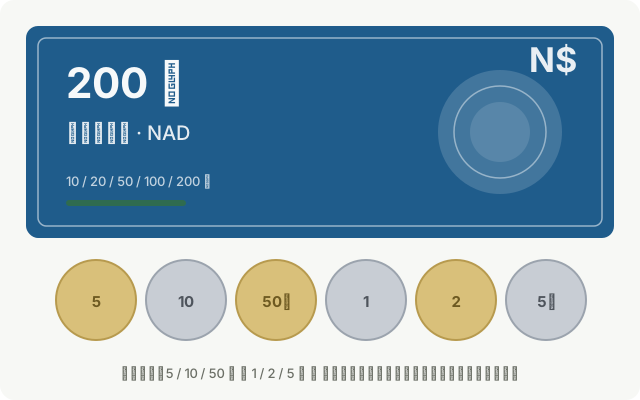
Banknotes come in denominations of 10, 20, 50, 100, and 200 Namibian Dollars. The current series features a portrait of Namibia’s founding president, Dr. Sam Nujoma, on the front, while the reverse sides depict various natural and cultural scenes, such as salt pan rhinos, waterfalls, and agricultural harvests. Some banknotes include tactile marks for the visually impaired. Coins are available in denominations of 5, 10, 50 cents, and 1, 5, and 10 Namibian Dollars. The 5 and 10 Namibian Dollar coins are commonly used in daily transactions and often feature the national bird, the African fish eagle, and elements of the national coat of arms.
Cash and Payment Habits
Namibia has one of the most developed card payment environments in Africa. Hotels, supermarkets (such as Checkers, Spar, and Pick n Pay), gas stations, and restaurants in Windhoek, Swakopmund, and Walvis Bay generally accept Visa and Mastercard. Many campsites and private game reserves also accept card payments, including some European debit cards. However, when driving through deserts or northern regions, you will need a significant amount of cash—remote gas stations, roadside stalls, craft markets, and some smaller campsites only accept cash, and credit cards may not be accepted for fuel deposits. ATMs are concentrated in urban centers, and machines from the four major banks (FNB, Standard Bank, Bank Windhoek, and Nedbank) all support international cards. When traveling on B- and C-grade gravel roads, it is common to go 200–300 kilometers without encountering a bank, so prepare accordingly by following the principle of “filling up at every stop and carrying 1,000–2,000 Namibian Dollars in reserve.”
Traveler Tips
- South African Rand and Namibian Dollar are interchangeable at par, but Namibian Dollars are not accepted in South Africa. Exchange any Namibian Dollars back to Rand before spending in South Africa.
- Fuel at remote locations is often dispensed manually and may not accept credit cards. Always carry 100–200 Namibian Dollars in cash for fuel and tips.
- There are no banks or ATMs on gravel roads. Make sure to withdraw enough cash before leaving Windhoek or coastal cities.
- For large purchases, use cards when possible to minimize the amount of cash you carry. Be aware that some merchants may charge a 3–5% card processing fee.
- A 10% tip is customary in restaurants. Tips for gas station attendants and campsite cleaners are usually given in cash.
Flag Meaning
Flag Design
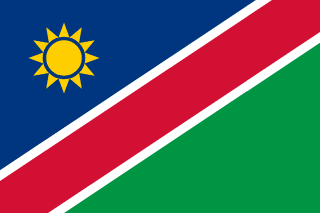
The Namibian flag has a 2:3 aspect ratio and features a diagonal red stripe as its central element. The upper left corner is a blue triangle, and the lower right corner is a green triangle, with a red diagonal band extending from the bottom left to the top right, bordered by white edges on both sides. A thin golden line separates the blue and green triangles at their meeting point near the flagpole. At the center of the blue triangle is a golden sun with twelve straight rays.
Meaning
Blue represents the clear skies and the Atlantic Ocean over Namibia, as well as rain, the most precious resource in this desert nation. Red symbolizes the Namibian people and their heroic struggle, honoring those who sacrificed their lives during the fight for independence. Green stands for vegetation and agriculture, reflecting the hope for renewal in the desert. The white borders signify peace and unity. The golden sun represents life and energy, with its twelve rays symbolizing the nurturing power of sunlight. The overall design reflects the country’s natural landscapes (sand seas, oceans, and grasslands) and the vision of national reconciliation.
History and Legal Status
The current flag was adopted on March 21, 1990, the day of Namibia’s independence. It was designed based on a national competition, with modifications made by a parliamentary committee. The design incorporates colors from the former flag of the South West Africa People’s Organization (SWAPO)—red, green, blue, and gold—and uses a diagonal layout to symbolize the unity of all ethnic groups across history. The use of the flag is regulated by the Namibian Constitution and related flag laws. On national holidays such as Independence Day (March 21) and Heroes’ Day, public buildings are required to fly the flag. Insulting the flag is a criminal offense.
Today, the blue-red-green flag with its golden sun and diagonal stripes is prominently displayed at government buildings, border posts, schools, and on the uniforms of national sports teams. Its unique diagonal design is also recognized internationally as a representative example of modern African flag design.
Namibia Travel Guide
All Guides »Namibia Pre-Trip Guide: Visa, 4WD Rental, Seasons, Budget & Etiquette
Pre-trip checklist for Africa’s safest self-drive destination: how to apply for ...
Classic 7-Day Namibia Self-Drive Loop: Sossusvlei – Swakopmund – Damaraland – Etosha 7 days
One loop combines red sand dunes, Deadvlei, the Skeleton Coast, prehistoric rock...
Namibia 4-Day Short Trip: Southern Classic Loop (Windhoek – Sossusvlei – Swakopmund) 4 days
A condensed alternative to the long northern route: see the red sand dunes, Dead...
Essential Attractions in Namibia: Red Sand Seas, Etosha Salt Pans, Ghost Towns, and Grand Canyons
A regional guide to Namibia’s 14 most worthwhile must-visit attractions: red san...
Namibia Food Guide: Safari Game Meat, German Sausages & Bread, and Coastal Oysters
German Bakeries Meet Braai BBQ: How to Order Oryx Steak, What Is Katutura Street...
Namibia Travel Guide: 4WD Self-Drive Rentals, Gravel Road Rules, and Inter-City Transport Options
Mastering the self-drive rules is half the battle: car rental checklist, fuel es...
Essential Namibia Travel Tips: Self-Driving Safety, Health, Cash, and Indigenous Etiquette
Top 10 Things to Know Before and During Your Trip: How to Drive on Gravel Roads,...