Must-visit spots to experience Japanese geisha culture: Kyoto’s famous six hanamachi (geisha districts)!
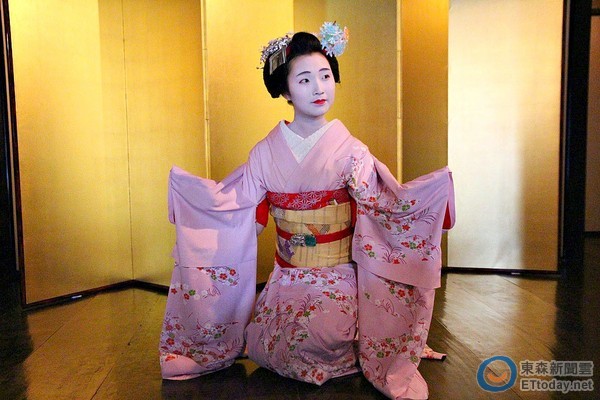
▲Illustration of a maiko in Kyoto, Japan. (Photo / by reporter Yu Tzu-ju)
Text by Erudite Persistence Club, excerpted from Kyoto: The Truth Behind the Tradition, published by Footprint Culture Press
Translator / Su Wen-shu
Hanamachi with maiko are not limited to Gion.
Among Kyoto’s several hanamachi, the most famous isGion. Travel guides often mention “Gion’s maiko,” and the annual “Miyako Odori” held every April always draws crowds of tourists.
So when people think of maiko, they usually associate them with Gion. However, apart from Gion, other parts of Kyoto also have geisha and maiko. Currently, Kyoto has six hanamachi.
Not to mention anything else, everyone always says Gion, Gion, but strictly speaking, Gion is actually divided into“Gion Kobu” and “Gion Higashi”. These two areas originally developed as the machiya (townspeople's district) west of Yasaka Shrine, and the “Miyako Odori” is held in Gion Kobu, where geisha and maiko learn the Inoue school of dance. As for the area formerly known as “Gion Otomiya” or Gion Higashi, it hosts the “Miyako Gion” event in autumn.
The boundary between Gion Kobu and Gion Higashi is located at the intersection of Shijo-Kawaramachi. The vast areas to the southeast, southwest, and northwest of the intersection belong to Gion Kobu, while the northeast section belongs to Gion Higashi.
Second only to Gion in fame isPontochō, pronounced “Bon-to-cho.” Along this narrow, two-meter-wide street, many tea houses stand in rows. This area was the first reclaimed land along the Kamo River during the Edo period, hence the name comes from the Portuguese words meaning “first” and “point”—“ponto”—and was rendered phonetically into the kanji“先斗” ※.
Kyoto’s oldest hanamachi is said to be“Kamishichiken”, located near Kitano Tenmangu Shrine. During the early Muromachi period, Kitano Tenmangu was destroyed by fire, and leftover wood from its reconstruction was used to build seven teahouses—hence the name “Shichiken” (seven shops). It is close to the birthplace of Nishijin textiles, and fabric merchants have frequented the area since ancient times.
South of Gion Kaburenjo Theatre liesMiyagawa-chō, a district famed for the “Miyako Odori” event. Since ancient times, Kyoto’s literati and artists were said to prefer this more secluded spot.
The sixth hanamachi isShimabara, once the only officially recognized pleasure quarter under the Tokugawa shogunate in Kyoto. In the past, only Yoshiwara in Edo and Shimabara in Kyoto had the highest-ranking courtesans, known as “tayū.” Today, Shimabara still features performances by tayū.
※Note:The correct Portuguese word is “ponta”; why the mispronunciation occurred remains a mystery.
Work and school are super boring—can’t wait to travel?
Download the “ETtoday News Cloud APP” and take a virtual trip with us →
iOS:https://goo.gl/rmIDdx
Android:https://goo.gl/XPe8Uj
Share
This article is published by HowToTrip. Sharing and reposting are welcome — please credit the source.
Article URL: https://www.howtotrip.net/views-9286
Related Articles
- Shaoxing's "Grandpa Gourd" hangs the gourds back up: "If there are too many people, we'll interact less — just take a quick look from afar"
- Chinese authorities announce "reciprocal adjustment" to Japan visa fees — single-entry visa jumps from 2,250 to 16,750 yen!
- The "health stones" carried by a traveler were found to have radiation levels exceeding safety limits by a thousand times, potentially endangering fellow passengers on the same flight. Customs issues warning!
- Shenzhen Airport Issues Late-Night Notice: Unidentified Aerial Object Detected, Causing Widespread Flight Delays!
- “They only said it cost money after I opened the box and washed it!” 200g of grapes sold for 60 yuan on a high-speed train—12306 responds!
- Can't buy an airline ticket? Denied exit? Blocked from boarding? A large number of Chinese tourists have mysteriously become "discredited individuals"
- Adverse weather and economic fluctuations impact Colombia's coffee market
- Beach bathing area responds to 2 yuan/30 seconds fee for freshwater foot rinsing: Clearly priced!
- Taking off with an improperly closed cabin door? Wing malfunction? Multiple flights made emergency returns mid-journey!
- Experience the gifts of nature! A countdown of the world’s ten most stunning coastlines