Taipei Main Station Celebrates Its 125th Anniversary — Zhang Zhesheng Recounts the Evolution of Three Generations of the Station
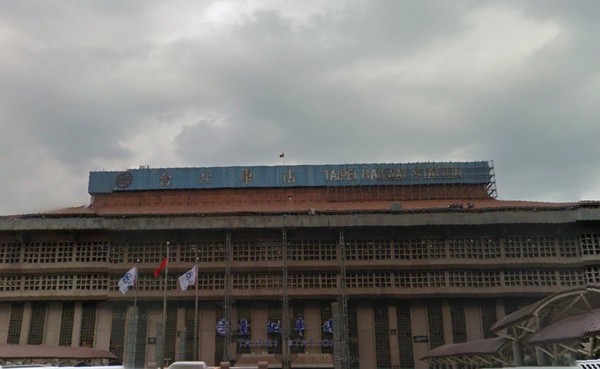
▲ Current Taipei Main Station. (Photo / Screenshot from Google Maps)
ReporterYan Xintong/ Reporting
Taipei Main Station held a celebration on the 23rd marking its 125th anniversary, and will turn 125 years old on January 25, 2016. But did you know that as a Taiwanese, there have actually been four generations of Taipei Main Station? Zhang Zhesheng, an internet personality known for photographing then-and-now scenes around Taiwan, revealed that Taipei Main Station has had four generations — setting aside the current fourth generation which was completed in 1989, he discussed the general history of the first three during the interview.(The following is an exclusive interview with Zhang Zhesheng, unauthorized reproduction is prohibited.)
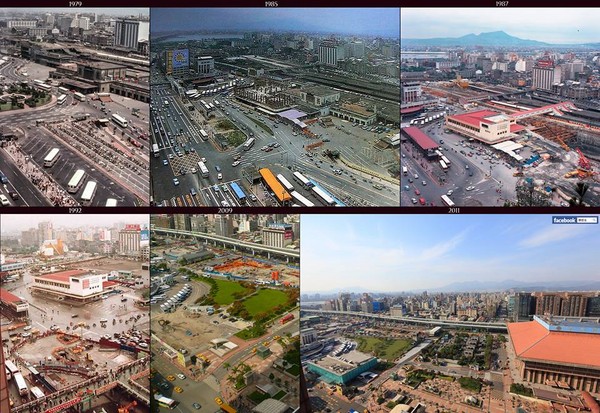
▲ Taipei Main Station 1979–2011 (Photo / Screenshot fromZhang ZheshengFan Page)
The First Generation Taipei Main Station — Established During the Guangxu Era of the Qing Dynasty
Taipei Main Station is an important urban hub. The first generation was actually located on the south side of Dadaocheng District, approximately where the current Beimen MRT Station is. It was built in 1891 (the 17th year of the Guangxu reign in the Qing Dynasty) and went into operation during the tenure of Liu Mingchuan, the Governor of Taiwan, along with the successive openings of railways to Hsinchu and Keelung. It was aEuropean-style shed station.
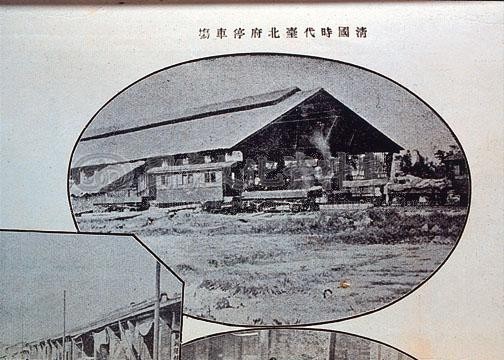
▲ First Generation Taipei Main Station (Photo / Screenshot from[Taipei Stories] About Taipei’s PastFan Page)
The Taiwan Railways Administration Secretariat stated that according to historical documents, Taipei Main Station was built in 1891, though the exact date is unknown. January 25, 2016, marks its 125th anniversary.
The Second Generation Taipei Main Station — Built by the Japanese, in Renaissance Style
After Japan’s colonization of Taiwan, the first generation station continued in use until August 25, 1901. A wooden station built by the Japanese in 1908 resembled a parking lot. The second generation station, however, commenced operations on August 25, 1901. In the same year, diagonally opposite the second generation station, the then-high-end Taipei Railway Hotel was constructed (destroyed in the U.S. air raids in 1945, now the site of the Shin Kong Mitsukoshi Building and the Daya Department Store area).
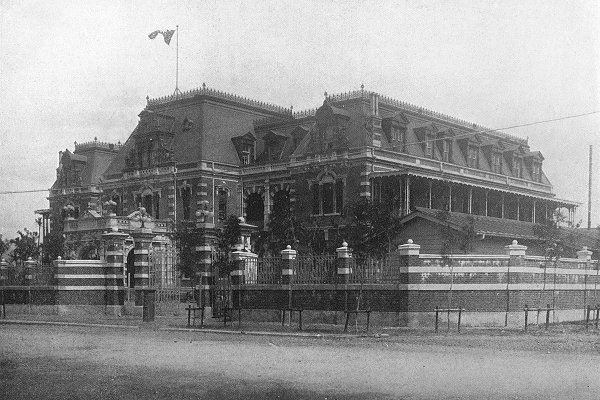
▲ Taiwan Railway Hotel (Photo / Screenshot from[Taipei Stories] About Taipei’s PastFan Page)
The second generation station featured a Renaissance architectural style. Zhang Zhesheng also mentioned that building aesthetics at the time were heavily influenced by Western styles, which were then integrated with local elements, resulting in some Greek palace-like features. It opened on August 25, 1901, with the inauguration of the Tamsui Line and the rerouting of the railway between Hsinchu and Keelung (then called “Taipei Depot”).
The reason the Japanese built the second generation Taipei Main Station was mainly to accommodate the railway rerouting, the urban redevelopment plan, and the needs of the Japanese population. The wooden station was moved eastward to near the northern wall of Taipei’s old city (which was later demolished and replaced by “Beisan Road,” today’s Zhongxiao West Road), with the main entrance facing “Hyōmachi-dōri” (now Guanqian Road), standing opposite the Museum of the Governor-General of Taiwan (today’s National Taiwan Museum).
After the first generation station was demolished in 1908, the Dadaocheng Depot was relocated here in the same year. This station was originally established on the southwest side of this location by the Tamsui River on February 1, 1902, dedicated to freight services; it began handling passenger transport on June 1 of the same year; and became the origin station of the Tamsui Line in 1903. In 1908, it moved to the site of the first generation station, where a new Japanese-style wooden station was built; on August 17, 1916, it was converted into a freight station, with passenger services taken over by the Beimen Station that opened on the same day; and after the completion of the Huashan Freight Depot on December 1, 1937, the Dadaocheng Depot was closed.
On March 6, 1923, the Japanese additionally built a smaller Taipei Back Station (then called “Uchi Taipei Station”) on the north side of the rail tracks within the station area, replacing the Beimen Station which ceased operations on the same day, becoming the new terminus of the Tamsui Line and facilitating access for the local Taiwanese (i.e., ethnic Chinese) residents of Dadaocheng. The Taipei Back Station was a small wooden structure.

▲ Second Generation Taipei Main Station — 1931, Taipei Station (Taipei Main Station) in front of Beisan Road (now Zhongxiao West Road). (Photo / Screenshot fromZhang ZheshengFan page)
In 1939, after the Taipei Workshop was relocated to Songshan, both the paint shop and the passenger car shop were converted into offices. After the war, the original paint shop was demolished in 1950, while the original passenger car shop was repurposed as the Taiwan Railways Administration auditorium (four sets of riveted steel beams were removed during the construction of Civic Boulevard). The remaining part of the auditorium has been designated as a historic site and is currently undergoing restoration.
The 3rd-generation Taipei Railway Station – A modernist-style square concrete building
Later, due to insufficient space at the original front station, it was rebuilt on the same site in 1939 into a square concrete building with a modernist style (the 3rd-generation station, completed in 1941, then renamed “Taipei Station”). This significantly increased the available interior space. In addition, buses that had been taken over from private operators by the municipal government in 1930 also used Taipei Railway Station as one of their main terminal stations.

▲ 3rd-generation Taipei Railway Station (Photo / Reproduced from[Taipei Stories] About Taipei’s PastFan page)

▲ Aerial view of Taipei Railway Station in 1985, looking northwest, with Zhongxiao West Road at the bottom right corner. (Photo / Reproduced from Zhang Zhesheng’s fan page)
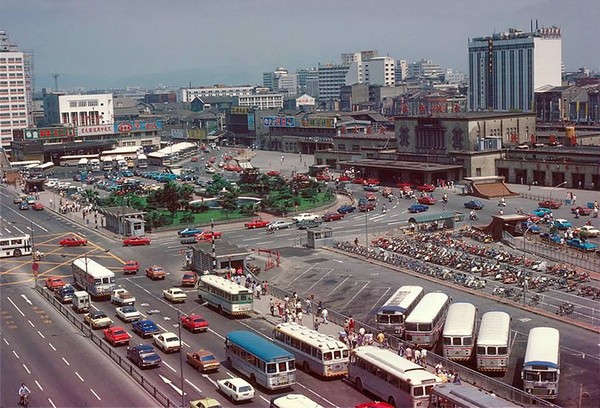
▲ The 3rd-generation Taipei Railway Station (1941–1986) in 1978. (Photo / Reproduced fromZhang ZheshengFan page)
Additionally, Zhang Zhesheng also mentioned: “What we see now is the 4th-generation station, completed in 1989, mainly rebuilt for the railway’s undergrounding project. The 2nd and 3rd generations were both built by the Japanese to expand capacity and enhance functionality. The Japanese had a 100-year plan to govern Taiwan and use it as a base for southward expansion, with transportation being the first priority in their infrastructure development.” The 3rd-generation station was the longest-used one, operating for about 48 years. Looking back at the historical charm of old Taipei, the four transformations of Taipei Railway Station can’t help but make one marvel at the powerful force of time.
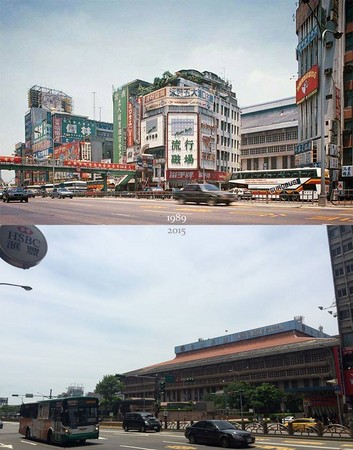
▲ Street view of the north side of Section 1, Zhongxiao West Road, Taipei City, 1989 vs 2015 (Photo / Reproduced from Zhang Zhesheng’s fan page)
Share
This article is published by HowToTrip. Sharing and reposting are welcome — please credit the source.
Article URL: https://www.howtotrip.net/views-9053
Related Articles
- Shaoxing's "Grandpa Gourd" hangs the gourds back up: "If there are too many people, we'll interact less — just take a quick look from afar"
- Chinese authorities announce "reciprocal adjustment" to Japan visa fees — single-entry visa jumps from 2,250 to 16,750 yen!
- The "health stones" carried by a traveler were found to have radiation levels exceeding safety limits by a thousand times, potentially endangering fellow passengers on the same flight. Customs issues warning!
- Shenzhen Airport Issues Late-Night Notice: Unidentified Aerial Object Detected, Causing Widespread Flight Delays!
- “They only said it cost money after I opened the box and washed it!” 200g of grapes sold for 60 yuan on a high-speed train—12306 responds!
- Can't buy an airline ticket? Denied exit? Blocked from boarding? A large number of Chinese tourists have mysteriously become "discredited individuals"
- Adverse weather and economic fluctuations impact Colombia's coffee market
- Beach bathing area responds to 2 yuan/30 seconds fee for freshwater foot rinsing: Clearly priced!
- Taking off with an improperly closed cabin door? Wing malfunction? Multiple flights made emergency returns mid-journey!
- Experience the gifts of nature! A countdown of the world’s ten most stunning coastlines