Everyone has their own “All-time favourite” movies. I believe that besides titles like 《Wanderlust》 and 《Into the Wild》, travelers must also include this one — 《The Secret Life of Walter Mitty》 (Taiwanese title: 《白日夢冒險王》). The story follows an ordinary “middle-aged nobody” who has spent most of his life stuck in an office, living safely but without any self-confidence. By chance, he steps out of his comfort zone, travels the world in search of a mysterious photographer, and along the way, discovers how vast the world truly is—and that he is not a failure after all. The hobbies that seemed useless actually become his strength in critical moments. I love the realistic ending of the movie: after traveling the world, he doesn’t become a superhero, nor does he dramatically achieve career success or defeat his arrogant new boss. Back to reality, he’s still unemployed and facing an uncertain future, but the spiritual gains he’s made mean he has no regrets about his life.
The main filming location of the movie is Iceland. Aside from seeing the Northern Lights, another goal of this trip was to visit the shooting locations of one of my “All-time favourite” films — a kind of pilgrimage. Whether in the film or in real life, it’s also a journey of “chasing dreams.”
As a restless traveler, I was deeply moved by the movie even after watching it several times—especially the scene where the protagonist takes his first step and boards a helicopter, accompanied by David Bowie’s song: “This is ground control to Major Tom…” It always moves me to the point of tears. Perhaps it’s an inherent trait in every traveler, a passion that those who only stick to conventional frameworks and never dare to try will never understand.
The movie features many memorable lines about travelers and life. One that stands out is when the protagonist Walter finally finds the photographer Sean, who has been waiting a long time for the perfect shot—but doesn’t press the shutter. Walter, puzzled, asks how long he’ll wait. Sean replies: “If I like a moment, for me, personally, I don’t like to have the distraction of the camera. I
just want to stay in it.” (If it’s a moment I love, I don’t want the distraction of the camera. I just want to be in it.)
This scene left a deep impression on me. Since digital cameras became popular, it seems everyone has adopted the “camera first” mentality. Whether it’s food or scenery, it’s all about “traveling with the camera,” not “traveling with the eyes.” Everyone is busy admiring the world through the tiny screen of the lens, but forgets that the whole vibrant world is right in front of them, with fresh and delicious food waiting to be savored. Truly experiencing the world with your senses is the real essence of travel—not the camera hanging around your neck.
Of course, I’m also a photography enthusiast and enjoy capturing beautiful scenery, but I’m not like some people who “take photos whether they should or not.” I understand that when you’ve traveled a long way to a place, you naturally want to take photos as memories. But I follow the principle of “one or two shots at most.” I’ll never understand why, during local tours, I often see people taking photos nonstop. For a 30-minute visit, they spend 25 minutes shooting and then get back on the bus. I went on about this because I truly understood this lesson while chasing the Northern Lights in Iceland.
Viewing the aurora in Iceland really depends on luck. I went for a week and barely saw any. A fellow traveler I met at the hostel, who had been there for over half a month, hadn’t seen any either. Every day we waited patiently, checked if the “aurora tour” could depart, and stared at the sky by the sea. Even on the South Coast, where the sky was so clear you could see the stars, we still didn’t see any auroras. We stayed up until the early hours for several nights in a row, exhausted and almost ready to give up.
The tour guide kept encouraging us not to give up, reminding us that when we do see the aurora, don’t just focus on taking photos—remember to look up at the sky: “Remember to use your eyes. I’m sure it will be one of the most memorable experiences of your life.”
Unfortunately, we still didn’t see anything. I had pretty much given up and was about to go back to the hotel lobby to “steal Wi-Fi” and surf the internet before going to bed. Suddenly, some Thai guests were excitedly talking to each other in Thai, their faces flushed with joy. They quickly ran back to their rooms and told me: “Some…some…something outside!” Without thinking, I knew what the “something” was and rushed back to my room to grab my camera and tripod. I ran into a Singaporean from our group and said: “Northern light outside!” Like we had a silent agreement, we shouted along the way back: “Wake up!Northern light!” Our kind effort didn’t attract much attention—only a few group members joined us outside.
Seeing the aurora requires not only patience but also using your camera to measure the light. After adjusting the shutter speed, the lens can capture some light that’s invisible to the naked eye. At that moment, we saw a faint “blue-green glow” in the viewfinder—that was the sign of the aurora. Over the past few days, even though we hadn’t seen anything, we had heard and read so much that we felt like seasoned pros. Fully mentally prepared, we waited in the wilderness. The lights flickered in strength, still invisible to the naked eye, but the camera told us: tonight, there was a chance.
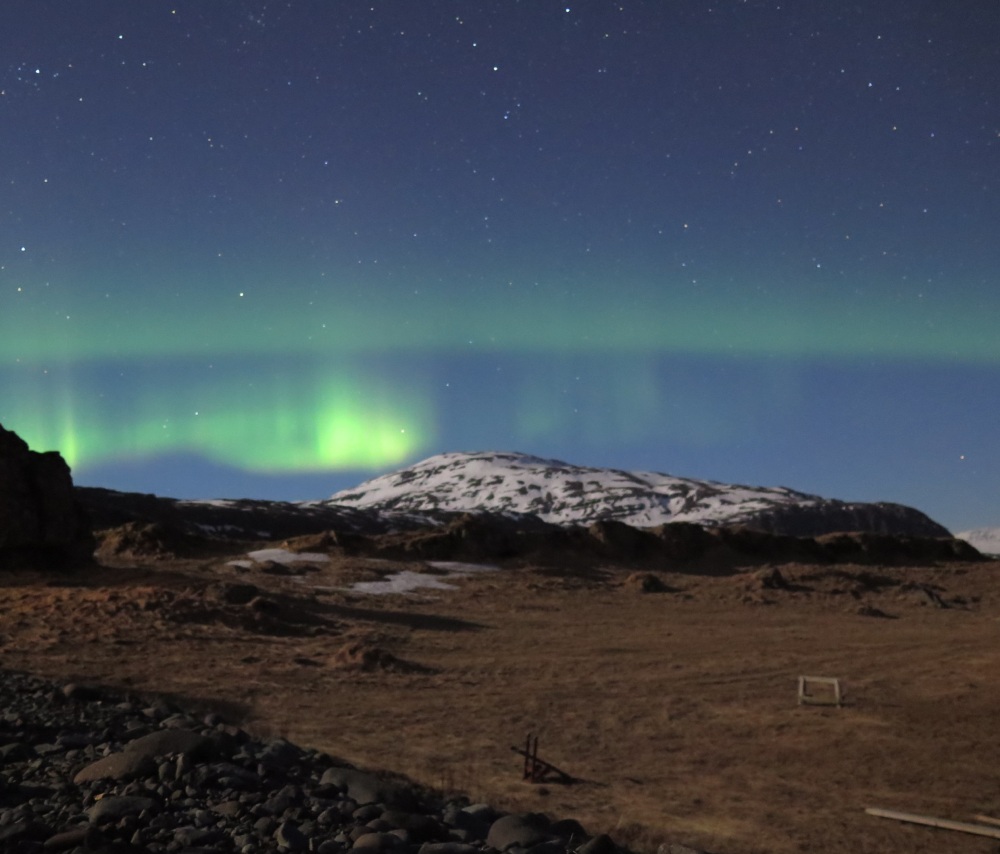
I had prepared everything in advance, adjusting my camera settings and positioning so I could press the shutter the moment the aurora appeared. Finally, the sky began to shimmer with thread-like lights. At first glance, it might seem a bit eerie, but then it grew brighter, swayed with the wind, and lit up the sky, rushing straight toward us. That moment made you feel like you were in another world—a scene you’d only see in a sci-fi movie. It was one of the most beautiful, magical, mysterious, wonderful, and breathtaking sights I’ve ever witnessed. Everyone gasped, and some even applauded. I took a few photos, snapped one with myself in it, then turned off the camera and quietly enjoyed this gift from nature.
The people around me were in a flurry, holding cameras but not knowing how to adjust them. They kept asking me how to set the aperture, shutter speed, and ISO. Everyone had a DSLR, yet no one knew how to adjust anything beyond “Auto.” Possessing the gear but not knowing how to use it—the most basic settings were beyond them. I briefly explained the theory, but how to operate the camera was ultimately up to them, and I didn’t have time to adjust everything for them. So, without tripods, without adjusting aperture or shutter speed, they just used “Auto” and tried to shoot by hand. Unsurprisingly, they didn’t get any good shots. More frustratingly, they said they had tried so hard, but couldn’t take photos and couldn’t even see the aurora.
Looking at them, I genuinely felt conflicted and sorry for them—unable to see or capture the moment. Though I think not being able to see it was the greater pity.
That night, in that small hotel, we helped each other because of this important moment. We didn’t know each other, and some of us talked through the night in the dark—we probably couldn’t even see each other’s faces—but that spirit of mutual aid was truly unforgettable. I’m also grateful to those Thai guests. As for those who slept too early and missed the aurora entirely, I couldn’t bring myself to tell them we had all seen it the night before.
In any case, this experience made me realize deeply that we shouldn’t always “travel with the camera.” Using your eyes to feel the moment is the most direct travel experience. Maybe at ordinary attractions, taking photos all day won’t matter, but the aurora is such a rare and hard-earned wonder. Why insist on viewing the world through a lens? What’s the meaning of capturing the most beautiful scenery if you didn’t see it with your own eyes? Once again, I do enjoy photography, but taking a few satisfying photos as memories is enough. Why stay somewhere longer just to take more photos? If you “eat with your camera first,” can you really taste the food? Does eating a completely melted ice cream taste better than savoring a whole scoop?
I find it most “astonishing” that whenever I go to museums, I see people constantly taking photos of exhibits and descriptions without really looking. Do you really go back and read all the stories of the exhibits afterward? In the past, I did this “on trips” to jot down information—it was a last resort—but I never understood why ordinary travel required such behavior.
My sincere advice to anyone planning to see the aurora, no matter where you go: set aside time to let your eyes enjoy this visual feast.
“f^。观影记事” Facebook Page:
www.facebook.com/jackyheimovie
Travel Page “有故事的旅人” Facebook Page:
www.facebook.com/360.days.in.australia