
The first member of the Luzhou Red Cross Mountain Rescue Team enters the cave.
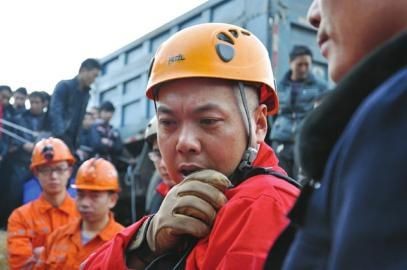
Xiao Bing communicates with the rescuers inside the cave via walkie-talkie.
Case
A similar rescue once descended into a 200-meter sinkhole
In February 2011, the Luzhou Red Cross Mountain Rescue Team also participated in a "sinkhole" search and rescue mission. The incident occurred in Houshan Town, Xuyong County, where a local villager fell off their motorcycle while driving and plunged into a nearby sinkhole as deep as 200 meters.
After receiving a distress call from the Xuyong County Public Security Bureau, the Luzhou Red Cross Mountain Rescue Team dispatched seven members to the scene for rescue. Due to the vast size of the sinkhole and the presence of three progressively descending platforms, each with a waterfall, rescuers could only use 100-meter lifelines to descend platform by platform. Eventually, upon reaching the lowest platform, they successfully located the victim and brought the body back to the surface.
Falling into a deep cave: Experts teach you how to self-rescue
The unfortunate death of Gan Fengmei after falling into a karst cave has left readers saddened. But how should one self-rescue if such an incident happens again?
Yesterday, Xiao Bing, leader of the Luzhou Red Cross Mountain Rescue Team, explained that the first step is to stay calm and carefully check for any injuries. If there is a fracture or bleeding, self-rescue measures should be taken immediately to prevent further harm. Then consider using a mobile phone or shouting for help.
It is also important not to casually use open flames, which could cause explosions of flammable gases accumulated in the cave. Additionally, one should try to find water and food sources in the cave to maintain strength. If conditions allow, it’s also advisable to get a general sense of the cave’s layout to assist rescuers in formulating the best rescue plan.
Nine rescue team members rented a vehicle overnight to reach the site, but on-site they had to rely on borrowing specialized equipment from other rescue units.
They do not charge for any rescue services, but funding has become the “bottleneck” hindering the team’s growth. Training costs are shared among members on an AA basis.
After being “missing” for about 46 hours, Gan Fengmei was finally brought back to the surface. Though she had already passed away, the daring cave descent by the Luzhou Red Cross Mountain Rescue Team (also known as the Luzhou Branch of the Sichuan Mountain Rescue Team) to attempt her rescue deeply moved her family.
As China’s first structured civilian rescue team, the Luzhou Red Cross Mountain Rescue Team was established in October 2004. It currently consists of 22 members, all volunteers from various professions. In recent years, they have been present at major domestic rescue sites. On December 5th, International Volunteers Day, the volunteers of the Luzhou Red Cross Mountain Rescue Team once again impressed with their skilled performance.
Yesterday afternoon, after successfully bringing Gan Fengmei back to the surface, the team rushed back to Luzhou as soon as possible, as they needed to return to their respective jobs promptly.
Overall smooth but encountered challenges during the rescue
Speaking about this rescue, Xiao Bing, leader of the Luzhou Red Cross Mountain Rescue Team, said, “Overall, it went relatively smoothly, but there were indeed some minor challenges.”
Xiao Bing said these challenges mainly came from the cave’s unique terrain and litter carelessly discarded by residents. The sinkhole is shaped like a pickled vegetable jar, preventing rescuers from descending straight down. They had to first walk down a slope before being slowly lowered by lifeline.
“Going down was okay, but coming up, rescuers could easily get stuck on ledges,” Xiao Bing explained. In addition, garbage and soil dumped into the cave by nearby residents posed significant risks. “The light inside the cave is very dim, and rescuers can easily step on loose soil or bump into cave walls.”
Xiao Bing added that this loose soil could easily collapse and fall onto rescuers. “The rescuers are hanging from lifelines, and even trying to dodge is very difficult.”
Insufficient equipment forces reliance on rented vehicles—awkward situation
On the afternoon of September 4, after contacting Xiao Bing, the rescue team immediately began organizing rescue equipment. However, due to their limited resources, many essential pieces of professional gear could not be gathered. Also, as the team did not have specialized vehicles, nine members rented a van and a private car to rush to the scene as quickly as possible.
“The conditions are a bit tough, but we were able to get to the scene quickly,” Xiao Bing said. Upon arriving at the karst cave, after careful inspection, they found that essential rescue equipment—including an air respirator and a toxic gas detector—was required. However, the Luzhou Red Cross Mountain Rescue Team lacked sufficient funds to purchase such gear, so they had to borrow it temporarily from other rescue units on-site.
After coordination by local government officials and reporters from Huaxi City Reader, the Gulin County Mine Rescue Team provided the equipment. “Operationally, there was no problem—we’ve borrowed similar gear for training before,” Xiao Bing said. Temporary equipment borrowing has often occurred in past rescues. “The rescue team’s funding is just too tight.”
Facing challenges: Lack of stable funding sources—current situation
Since its establishment in 2004, the Luzhou Red Cross Mountain Rescue Team has participated in numerous major domestic rescue operations. These include the “5·12” Wenchuan Earthquake, the “4·14” Yushu Earthquake, and the search for missing persons on Meili Snow Mountain in Yunnan.
As a civilian public welfare rescue organization, all rescue missions are carried out free of charge. But funding has become the “bottleneck” restricting the team’s continued growth. In November this year, the team’s search and rescue dog base faced closure due to financial difficulties. The news drew significant public attention.
Xiao Bing explained that the team’s funding comes from two sources. Operational expenses are covered by the Luzhou Municipal Red Cross Society. Meanwhile, the costs for daily training and equipment purchases rely solely on donations from private enterprises and individuals. “Training costs are shared among team members on an AA basis,” Xiao Bing said. Purchasing specialized equipment remains financially unattainable.
Taking this rescue operation as an example, Xiao Bing did the math for the reporter: excluding equipment wear and tear, they spent roughly over 1,000 yuan on transportation and accommodation. However, since reimbursement couldn’t be done in advance, they had to cover the costs out of their own pockets. “So we have to be very frugal and rush back to Luzhou immediately after the rescue to save on some accommodation expenses,” said Xiao Bing. The 450 meters of life-saving rope used up during the rescue had to be paid for by the team members themselves.