Good morning, young people who have to get up at five to start work.
By Li Anjun
Enter with caution. This roll of toilet paper is so high up that only someone with super long arms can reach it — very “inconvenient”! Please look at the picture below. It’s the accessible toilet on the second floor of Taipei Metro’s Wenhu Line Zoo Station. What’s the problem? You can spot it right away — the toilet paper is placed way too high. Uh-oh, what now? Pull, pull, pull, but you just can’t reach it.
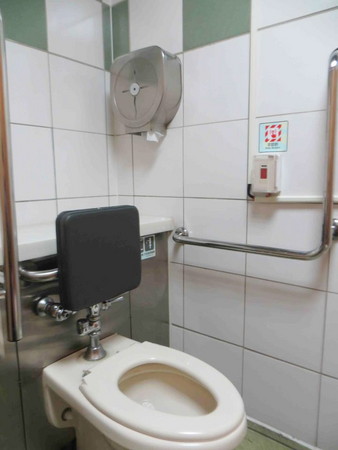
▲ Just look at this height — even an average person would struggle to grab the toilet paper, let alone someone with a disability. (Photo provided by Angel)
Angel was dumbfounded when she saw this roll of toilet paper. "Many accessible toilets use foot-pedal trash bins, but the thing is, our feet aren’t always usable, so we have to use our hands.That’s unhygienic." There are quite a few accessibility issues in Taiwan’s barrier-free spaces.
Let’s look at another real story.
There was a family — deep blue voters — who one day took their wheelchair-bound father on a five-day, four-night island-wide trip. They ate, drank, and had fun, and everywhere they went had accessible facilities. Their father, who usually felt cooped up at home, was genuinely happy. He laughed and said, "I really can’t stand Ma Ying-jeou, but he did get some things done. Taiwan’s barrier-free spaces are actually pretty great."

▲ This British grandmother is a huge fan of Show Lo and has visited Taiwan three years in a row. Thanks to Xu Zuofu for helping her meet her idol. (Photo provided by Show Lo’s fan club)
What’s going on here? Actually, this father’s son is very filial.He had arranged in advance for specialists to eliminate all inconveniences along the journey, selecting restaurants, homestays, amusement parks, and restrooms that are all accessible.Moreover, knowing his father had trouble chewing, he asked the restaurants in advance to prepare softer dishes and to chop up any long-shaped food into smaller pieces, making them easier for his father to eat.
Here’s another scenario.
Recently, a movie called *The Sessions* was released, tackling the serious topic of sexuality among people with disabilities. On that day, Fox Movie Studios specially opened up their screening room — normally reserved for media, directors, and critics — to invite five wheelchair users to watch the film. They were thrilled, finally realizing their dream of watching a movie in comfort.
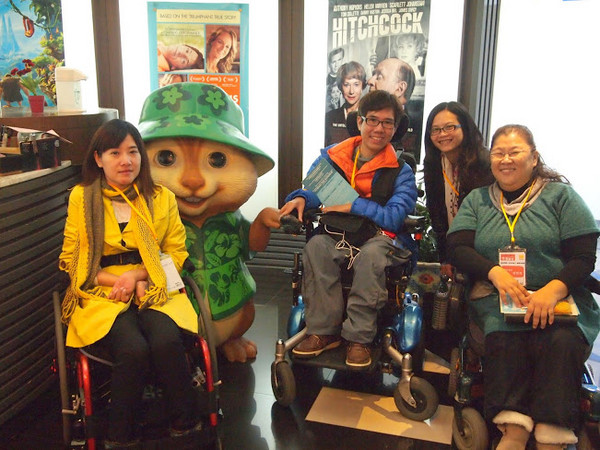
▲ The studio opened the screening room so they could finally enjoy a movie in peace. But when will movie theaters have good systems in place so they don’t have to “resort” to occupying aisles and disturbing other viewers? (Photo provided by Xu Zuofu)
*The Sessions* is based on the moving true story of Mark O’Brien, a journalist and poet from California. Mark contracted polio at age six and spent most of his life inside an iron lung. Yet, despite his disability, he thrived, attending UC Berkeley and becoming a journalist and poet. At age 38, he decided to lose his virginity and sought help from a sex surrogate named Cheryl. With Cheryl’s guidance, Mark finally achieved his “first time.” The whole process of making his sexual fantasy come true felt like a journey of self-discovery and confidence-building for him.
All these little details, big and small, were thanks to Xu Zuofu and his Dofu Transportation team, who communicated with relevant organizations in advance to sort out every aspect of the father’s trip. They also worked with the movie studio to ensure that wheelchair users could enjoy the film without worry. As for those “barrier spaces,” Xu Zuofu is often the first to step up, helping people with disabilities coordinate improvements with individuals or government departments. “Although there’s still a lot I can’t do anything about.”
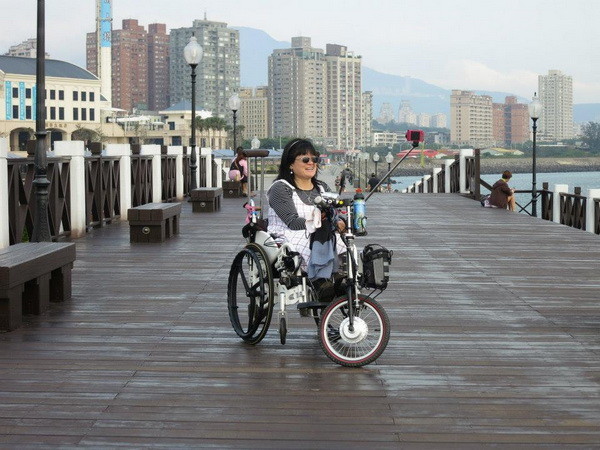
▲ Angel loves to travel. She even had electric wheels added to her manual wheelchair to make her “steps” faster. She says that, in truth, people with disabilities don’t like to trouble anyone. “Independence” is their greatest desire. (Photo provided by Angel)
The members of this team are young — from the boss and COO to the drivers — and they have to get up before 5 a.m. every day. They drive privately operated rehabilitation buses to take seniors or people with disabilities for a stroll in the park.These friends have limited mobility and live in old apartment buildings. Going up and down stairs is a daily struggle for them and their families. Xu Zuofu provides “stair climbers” and minibuses designed for wheelchair users, enabling many who have been stuck at home for years to finally go outside, enjoy the sun, feel the breeze, see the scenery, and chat with others.
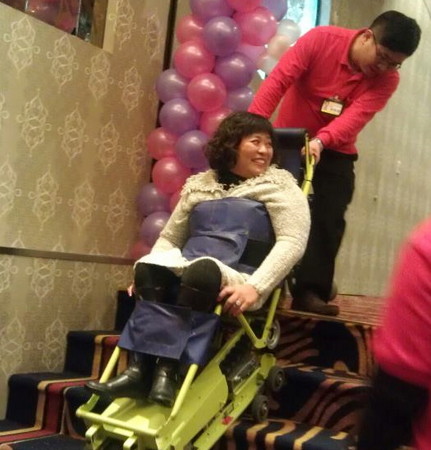
▲ “I really want to attend my sister’s wedding!” But the restaurant is on the second floor and there’s no elevator. What to do? The stair climber comes to the rescue, taking them up and down the stairs. That day, four wheelchair users attended the wedding banquet together and witnessed their friend’s happy moment — they were overjoyed.
Here’s another story.
There was a grandfather who was afraid of being a burden to his family. Because it was difficult for him to navigate the stairs in their apartment building, he stayed indoors for three years, not leaving the house once. He was always worried and upset, putting a lot of pressure on his family. His grandson felt especially uneasy. For three full years, under this tense atmosphere, the whole family treated each other “politely like ice,” afraid to accidentally bring up anything that might upset the grandfather. One day, they learned about a paid “stair climber” service, scheduled a time,and excitedly took the grandfather to Dajia Park for a walk. At that moment, the whole family hugged and cried. The grandfather was especially emotional, and his feelings took a long time to calm down. The warm sunlight shone on their faces as they smiled brightly. “It’s been three years. I’m so happy!”

▲ A former documentary director who cares deeply for vulnerable groups, Xu Zuofu crouches down to accompany wheelchair users and see the world from their perspective. (Photo provided byDofu Transportation, same below)
Then there’s the story of an elderly boss who suffered a stroke and uses a wheelchair. His home is a two-story house with an internal staircase. Out of filial piety, his son insisted on carrying him up and down the stairs, until he injured his back. He then switched to hiring a helper, who also ended up getting hurt accidentally. The boss got angry — but not because no one was carrying him. He was upset because he felt like a useless “burden.” In the past, he had been a powerful figure in the business world, giving orders and calling the shots. After his stroke, his outlook changed drastically, and he became critical of everyone. But once machines were available to help him go up and down the stairs and get out of the house, his temper improved, and the atmosphere at home completely changed.
When you're young, you don't understand why old people are often so happy — you might even think it's because their minds are deteriorating. But after hearing the true story that Zuo Fu told me,I realized it’s actually loneliness, and perhaps also a sense of being a burden.
Xu Zuo Fu doesn’t take part in government tender projects, which often involve the public sector and can be very troublesome. Instead, he chose to run a rehabilitation bus service on his own. Running this tough business requires passion, communication, coordination, getting up early, stamina, and most importantly, patience. Even an ordinary “stair-climbing machine” requires advance arrangements — “It has a certain size, so stairwells can’t be too narrow. Neighbors shouldn’t place umbrella racks or shoe cabinets nearby. Especially if the person has medical tubes attached, extra care is needed.”

▲A small bus is modified into a wheelchair-accessible rehabilitation bus, with each vehicle costing three million NT dollars — so expensive. But it enables many people to go out safely and with peace of mind, making it priceless in meaning.
Many times, customers say, “The stair-climbing machine is really a great thing.” Young staff members would correct them: “If there were barrier-free spaces, you wouldn’t need to use the stair-climbing machine!” Each trip costs five hundred NT dollars. Xu Zuo Fu says he’d rather not make that money and instead promote opportunities for people with disabilities to “go out.” So while making a profit, he also travels around advocating for better barrier-free infrastructure in Taiwan.
Xu Zuo Fu once worked as an assistant at director Chang Tso-chi’s studio and was also part of the crew for the film *The Best of Times*. Later, he turned to documentary filmmaking. He paid attention to children in remote areas and engaged with disadvantaged communities, developing greater empathy for these groups. Later, when an elderly family member fell and became mobility-impaired, “we were all busy running around for follow-up appointments and rehabilitation. Everyone was suffering,” Xu Zuo Fu said.People with bone injuries shouldn’t bend their limbs to ride in regular cars or taxis. “We sought help from the government’s rehabilitation bus service, only to find the regulations are strict: 1. You must have a disability certificate to ride. 2. You can’t cross between Taipei City and Taipei County.”

▲In many such situations, there’s always someone able-bodied who speaks up — and that person is Xu Zuo Fu.
Happy people who have seen and served those who are struggling will want to do more for them. Once you get involved, you can never leave — and that’s a good thing, a virtuous cycle, Xu Zuo Fu said. The company is full of young people,young folks who start working at five in the morning. Staff turnover is very low because everyone feels they’re doing something meaningful and valuable.
Zuo Fu told me that running a service business like this is incredibly tough, but moving moments keep happening. Seeing people with limited mobility finally able to go out, even traveling across the province happily and safely — no matter how busy he is, no matter how many communication challenges or bureaucratic hurdles he faces, he always keeps an upbeat smile. “There were times I cried alone in the office at night, licking my wounds. Then the next day, I’d greet the staff with a smile, telling everyone to cheer up. We’re doing good work, and we have to keep going.”
Share
This article is published by HowToTrip. Sharing and reposting are welcome — please credit the source.
Article URL: https://www.howtotrip.net/views-29255
Related Articles
- Shaoxing's "Grandpa Gourd" hangs the gourds back up: "If there are too many people, we'll interact less — just take a quick look from afar"
- Chinese authorities announce "reciprocal adjustment" to Japan visa fees — single-entry visa jumps from 2,250 to 16,750 yen!
- The "health stones" carried by a traveler were found to have radiation levels exceeding safety limits by a thousand times, potentially endangering fellow passengers on the same flight. Customs issues warning!
- Shenzhen Airport Issues Late-Night Notice: Unidentified Aerial Object Detected, Causing Widespread Flight Delays!
- “They only said it cost money after I opened the box and washed it!” 200g of grapes sold for 60 yuan on a high-speed train—12306 responds!
- Can't buy an airline ticket? Denied exit? Blocked from boarding? A large number of Chinese tourists have mysteriously become "discredited individuals"
- Adverse weather and economic fluctuations impact Colombia's coffee market
- Beach bathing area responds to 2 yuan/30 seconds fee for freshwater foot rinsing: Clearly priced!
- Taking off with an improperly closed cabin door? Wing malfunction? Multiple flights made emergency returns mid-journey!
- Experience the gifts of nature! A countdown of the world’s ten most stunning coastlines